
A scoreboard left unwatched during a match creates immediate confusion for players, spectators, and coaches—which is why knowing what each column and number represents is a practical necessity, not a casual nicety. Reading a tennis scoreboard correctly means understanding how four nested levels of scoring—points, games, sets, and matches—stack together to determine a winner. This tennis scoreboard explained guide gives you the concrete structure behind every number, so a quick glance at courtside tells you exactly where the match stands.
Tennis scoring and scoreboard reading explained
Tennis scoring operates as a hierarchy: individual points accumulate into games, games accumulate into sets, and sets determine the match outcome. A scoreboard displays all four levels simultaneously—the current game score, the games won in each set, and the number of completed sets. Without that nested structure, a single scoreboard number means nothing; with it, the entire match context is visible at once.
How the tennis scoring system works point by point
The smallest unit in the tennis scoring system is the point. A point is awarded when the opponent fails to return the ball in play, hits it out of bounds, or commits a service fault. Points use a unique terminology: love (zero), 15 (one point), 30 (two points), 40 (three points), and game (four or more points with a two-point margin).
- Love: Zero points in a game; the term derives from the French word for egg, “l’œuf,” because a zero resembles an egg shape.
- 15: One point earned; the server’s point score is announced first (e.g., “15-love” means the server has one point, the receiver has zero).
- 30: Two points earned in the current game; progression continues at 15, 30, 40 intervals regardless of who scores.
- 40: Three points earned; this is the final named level before either winning the game or entering deuce territory.
When both players reach three points each (40-40), the score is called deuce. From deuce, the next point is called advantage—”Ad-In” if the server wins it, “Ad-Out” if the receiver wins it. Winning the following point after advantage wins the game; losing it returns the score to deuce, and the cycle repeats until one player achieves a two-point margin.
How a game and set are decided in tennis
To win four points—progressing through love, 15, 30, 40, and then game—with a two-point margin wins a single game. The tennis scoring rules require this two-point cushion to prevent erratic outcomes when one player holds only a slim lead. Once a player wins a game, their game total increases by one on the scoreboard, and a new game begins at love-love.
A set is the next structural level: the first player to win six games with at least a two-game margin wins the set. Valid set scores include 6-0, 6-1, 6-3, 6-4, and 7-5. When a set reaches 6-6, a tie-break game is played rather than continuing indefinitely—the winner of the tie-break wins the set 7-6. The tie-break uses a different points system: players score 1, 2, 3, and so on up to 7, and must win by a two-point margin. On the scoreboard, tie-break scores appear in brackets after the set score (e.g., 7-6 (7-4) means the set was decided by a tie-break won 7-4).
| Score Notation | Games Won | Points Margin | Set Winner |
| 6-0 | 6 games | 6-game margin | Player A wins decisively |
| 6-4 | 6 games | 2-game margin | Player A wins convincingly |
| 7-5 | 7 games | 2-game margin | Player A wins in extended set |
| 7-6 (7-4) | 7 games | Won via tie-break | Player A wins set through tie-break |
The tennis scoring rules enforce the same two-point margin at every level: point level (deuce and advantage), game level within a set, and set level within a match. This consistent structure ensures competitive balance across all three tiers of scoring.
What every column on a tennis scoreboard means
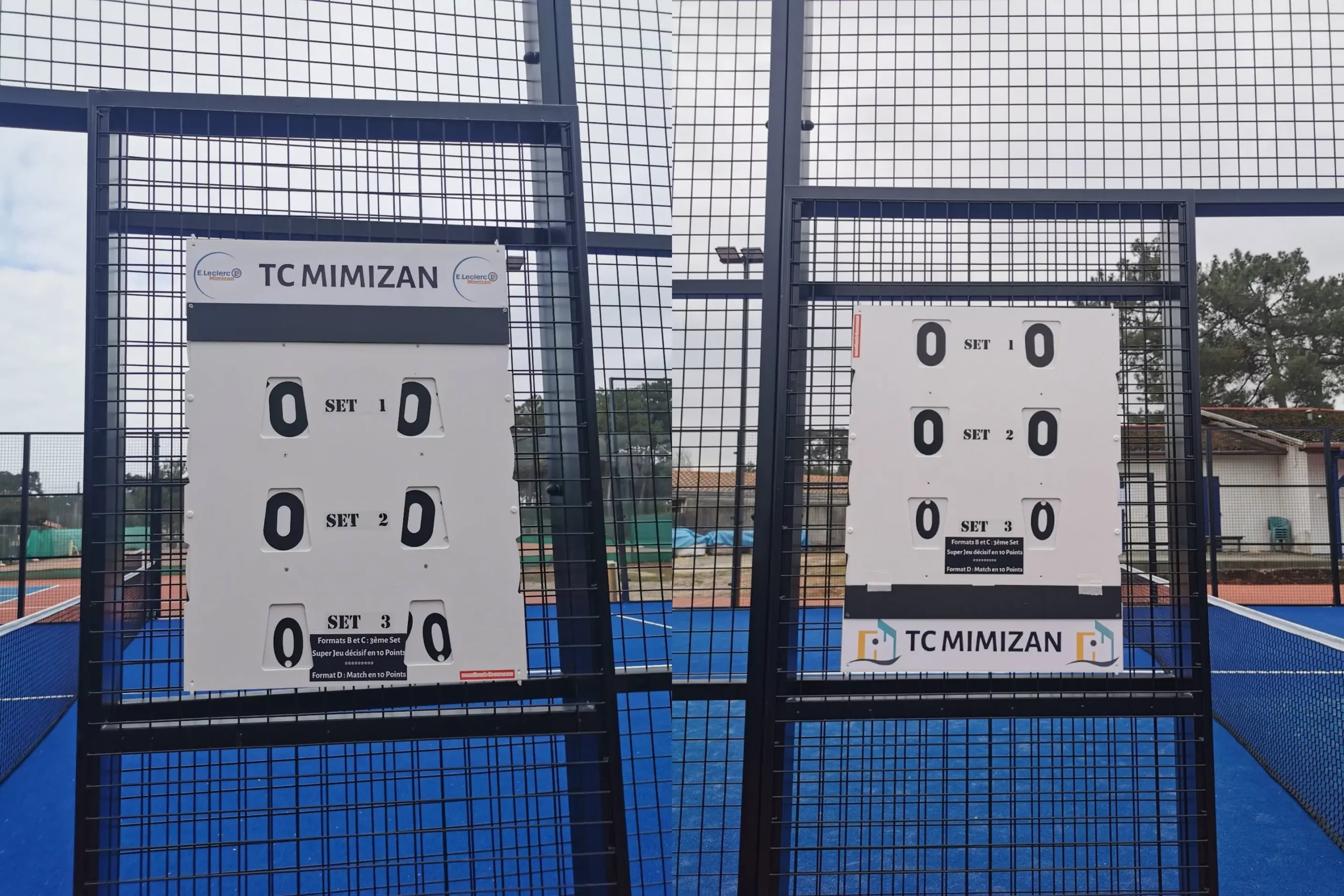
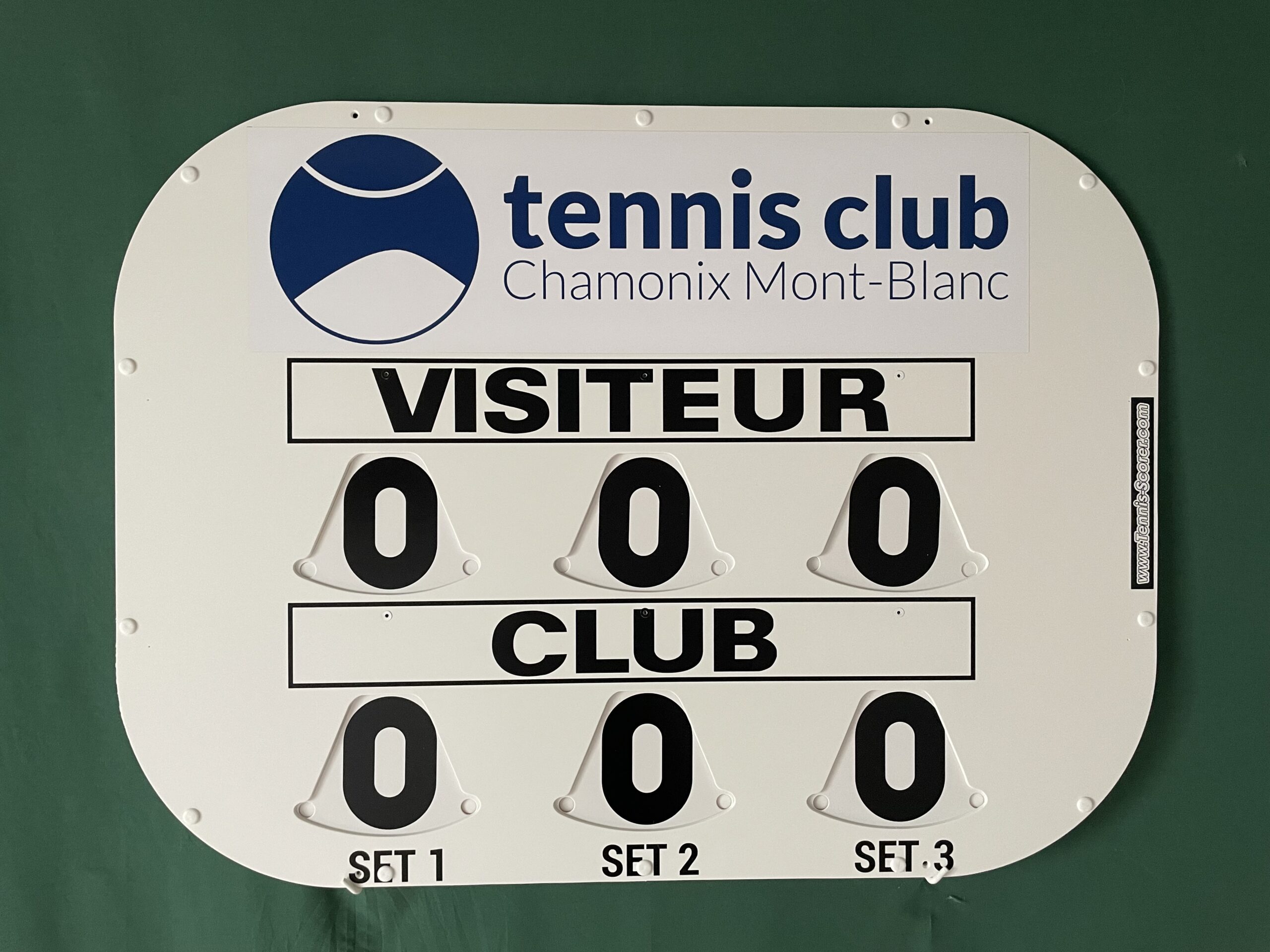
A standard tennis scoreboard displays columns for each player’s name, the current point score in the game being played, and one column per set in the match. The game score column shows the point progression—love, 15, 30, 40, deuce, advantage—for the game currently in progress. To the right, columns labeled “Set 1,” “Set 2,” and “Set 3” show how many games each player has won in each set. A manual tennis scoreboard uses rotating discs that turn to display the correct number (0 through 7 for games within a set), and a serving indicator—often a dot or triangle—marks which player is currently serving. The large tennis scoreboard model displays 12 cm digits readable from over 50 metres, making the game score and set score legible even from the back of the stadium.
When reading a scoreboard mid-match, focus first on the current game score, then check the set columns to place that game in context. If you see “6-4, 3-2” displayed, it means: Player A won Set 1 by 6 games to 4, and in the current Set 2, Player A leads 3-2 in games—with the game in progress showing its own point score separately. The manual tennis scoreboard design keeps numbers large and high-contrast against white PVC, ensuring visibility in sunlight, shadows, and all weather conditions.
Match format and tiebreak rules on the scoreboard
A match consists of either best-of-three sets—standard for most professional tournaments and club matches—or best-of-five sets, used in men’s singles at Grand Slams and some championship events. Best-of-three means the first player to win two sets wins the match; best-of-five means the first player to win three sets wins. This format determines how many set columns appear on the scoreboard: three columns for best-of-three, five for best-of-five. Unused columns remain blank or show zero when a match concludes early.
A tie-break game occurs only when a set reaches 6-6 in games. Unlike regular scoring, the tie-break uses straight numerical scoring starting from 0—the first player to reach seven points with a two-point margin wins the tie-break and the set 7-6. Some tournaments, particularly the final set at Grand Slams such as the Australian Open and Roland-Garros, replace the full third set with a 10-point super tie-break—also called a Championship tie-break or match tie-break—where the first player to reach 10 points with a two-point margin wins the match immediately. The decisive game scoreboard handles tie-break scoring with numerical discs covering a 0–7 or 0–10 range, separate from regular game scoring, making it visually clear when a tie-break is in progress. The tennis scoring system maintains the two-point margin principle at every level—from a single point at deuce to a deciding set—to preserve competitive integrity throughout the match.
Frequently Asked Questions
How do you read the scoreboard in tennis?
Tennis scoring reads left to right: start with the player names, then check the game score in the middle section— love, 15, 30, 40, deuce, or advantage—then scan the set columns to see how many games each player has won per set. The serving indicator, a dot or symbol next to a name, confirms whose service turn it is.
All three elements together give you the complete match situation: the current game score, the set score, and which player is serving. Read them in that order and tennis scoring becomes straightforward, not abstract.
What does a score like 6-4, 2-3 mean on a tennis scoreboard?
The set score 6-4 means the first player won six games in that set, their opponent won four—first set closed. The second figure, 2-3, is the live game score in the current set: the second player leads 3-2, because each number belongs to the player in the corresponding column.
Once you identify which column belongs to which player, the set score reads immediately. Tennis scoring requires a player to reach the game totals needed for a set or match win, so every number on the scoreboard reflects a precise, earned point tally—not an approximation.
Why does the scoreboard sometimes show a number in brackets after a set score like 7-6 (7-4)?
The bracketed number is the tie-break score. When a set reaches 6-6 in games, a tie-break is played—scored numerically 0, 1, 2, 3 rather than love, 15, 30, 40—and the first player to reach seven points with a two-point margin wins that set at 7-6.
The notation 7-6 (7-4) means the set winner clinched 7-6 overall, winning the tie-break 7-4. That bracket instantly signals the set was decided by a tie-break, not by a standard sequence like 6-4 or 7-5—which prevents misreading close set outcomes on the scoreboard during a match.