
Table of Contents
Marking out a tennis court accurately rests on a few fixed rules: every line has a set position, width and measuring edge under the 2026 ITF Rules of Tennis. The sections below cover the regulation layout, the tape-and-peg setting-out, the tolerances to check before anything becomes permanent, and the right line material for each surface.
What are the regulation tennis court lines and dimensions?
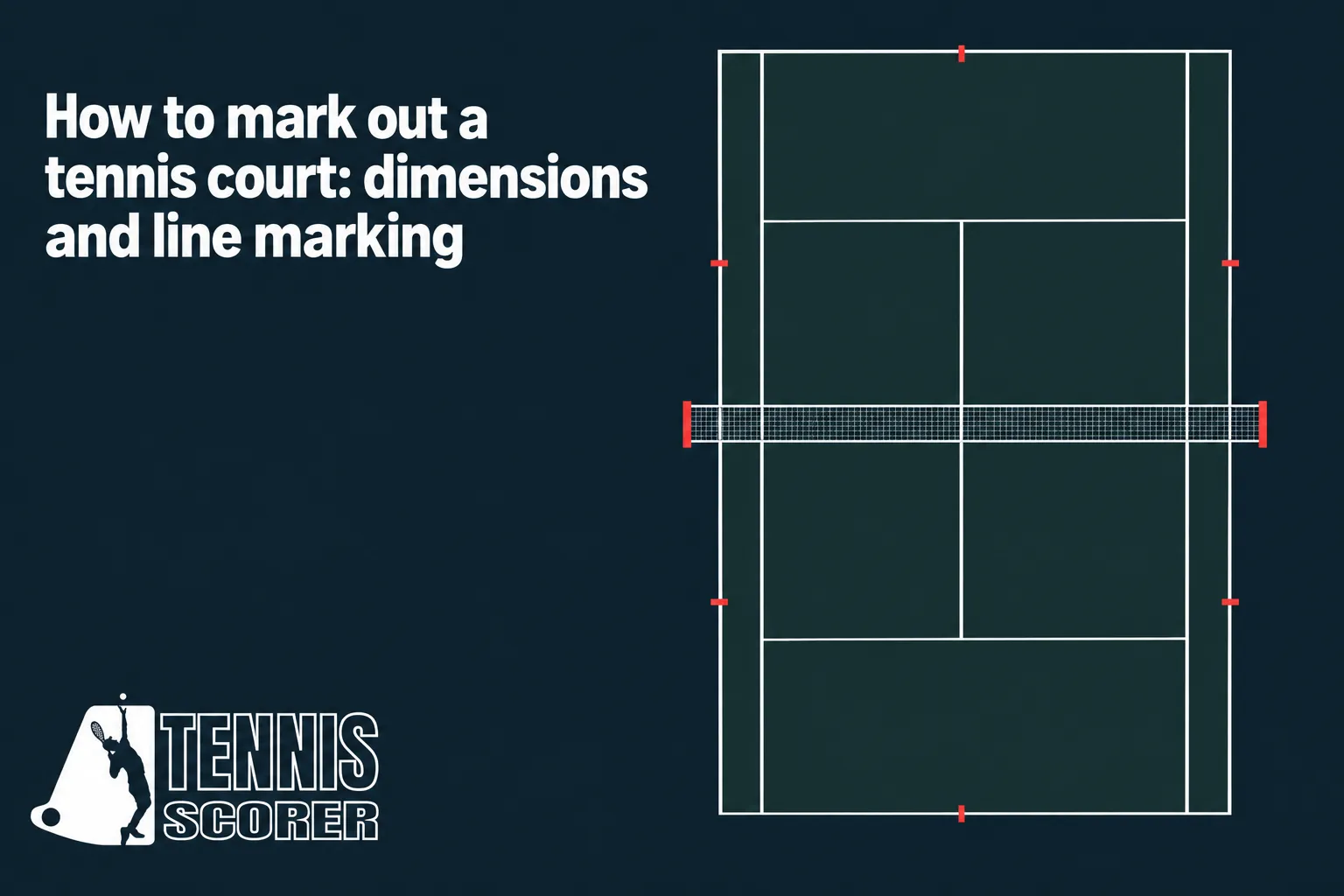
A regulation layout is a fixed set of lines, each with its own place on the diagram. Before any tape goes down, it helps to know what each line marks and which points on the surface the tennis court markings have to reproduce.
The playing rectangle and its boundaries
The 2026 ITF Rules of Tennis set the tennis court dimensions at 23.77 m long and 10.97 m wide for doubles. The singles width is narrower: 8.23 m. Both rectangles share the same length and the same end lines.
These figures describe the outer boundaries of play. Each one maps onto a particular line on the ground:
- Baselines: one closes each end of the court.
- Singles sidelines: the inner pair of lines running the length of the court.
- Doubles sidelines: the outer pair, set 10.97 m apart.
- Doubles alleys: known in Britain as tramlines, these are 1.37 m-wide strips on each side.
A tramline is the space between two lines, not an extra painted line. The court’s outline therefore has just six lines: two baselines and four sidelines.
The service lines, boxes and centre marks
Inside that outline, each service line runs parallel to the net between the singles sidelines, 6.40 m from the net. A centre service line then runs from the net to each service line, splitting the area into four service boxes. Each service box sits between the net, a service line, a singles sideline and the centre service line.
The centre mark finishes the diagram. It starts at the midpoint of each baseline and extends 100 mm into the court, parallel to the singles sidelines. The net divides the two halves but is not a painted court line.
Line widths and measurement edges
Under the 2026 ITF Rules, the centre service line and the centre mark are each 50 mm wide. Other lines measure 25–50 mm, while a baseline may be up to 100 mm wide. All lines must be one colour that contrasts clearly with the surface.
Line width affects where measurements are taken from. Court dimensions run to the outside edges of the lines. The 2026 ITF Technical Booklet makes one exception: measurements to the centre service line or the centre mark are taken to the centre of that line.
How do you set out court lines with tapes and pegs?
The ITF setting-out method in Appendix X of its Rules builds the court from the net outwards, using pegs and two measuring tapes. Every temporary point is fixed before any line material goes down, so the geometry is complete before paint touches the surface.
Establish the net reference
Start on a prepared surface with a checked datum, two long steel tapes, pegs, taut string or a line reel, chalk and a notebook for measurements. A fence, post socket or faded line is not automatically accurate. Lay a straight 12.80 m net reference line and mark its centre, X. From X, mark 4.11 m, 5.03 m, 5.48 m and 6.40 m on each side. These points are the singles sidelines, the singles sticks, the doubles sidelines and the centres of the posts, with each post centre 0.914 m outside its doubles sideline.
Locate the baseline corners and sidelines
Once the net line is pegged, the corners are found by triangulation. The steps below fix all four corners and then the singles sidelines:
- First corner: stretch one tape 16.18 m from one doubles-sideline/net intersection and a second tape 11.89 m from the other, then peg the point where they meet.
- Remaining corners: repeat the same two-tape method for the other three corners.
- Baseline check: measure each doubles baseline directly against the 10.97 m width before fixing its guide.
- Singles sidelines: mark the singles-to-doubles offset at each baseline, then join matching marks with straight, taut guides.
In practice, this crossing-tape method replaces a set square. Two fixed lengths from known points can meet at only one place, so the right angle comes from the measurements rather than from judgement by eye.
Position the service lines and centre marks
With the baselines fixed, measure the midpoint of each one and set its centre mark facing into the court. Then measure from the net reference towards each baseline to place both service lines between the singles sidelines.
The centre service line is the last guide. Halve the distance between the singles sidelines on each half of the court, and stop that line at the service line rather than running it to the baseline. Built this way, every element of tennis court line marking comes from the same net reference.
How do you check the layout before permanent marking?
A pegged layout can still contain a small error that paint would fix in place. The 2026 ITF Technical Booklet gives a nominal figure and a recommended tolerance for each key distance, so every temporary guide can be measured against a clear standard before marking begins.
Check the rectangle and sidelines
Start with the outline. Check the full baseline-to-baseline length and both baseline widths, then check the singles width and the doubles-to-singles offsets on both sides.
Correct lengths and widths do not prove that the corners are square. Measure both opposite-corner doubles diagonals: if they differ materially, the rectangle is out of square even when every side is correct.
| Measurement | Nominal (ITF Technical Booklet) | Recommended tolerance |
| Baseline to baseline | 23.774 m | ±24 mm |
| Doubles sideline separation | 10.973 m | ±11 mm |
| Singles sideline separation | 8.233 m | ±8 mm |
| Doubles to singles sideline | 1.372 m | ±5 mm |
| Full doubles diagonal | 26.184 m | ±26 mm |
Check service and net reference positions
Next come the interior lines. The booklet gives 11.887 m from the net to a baseline, within ±22 mm. From the net to a service line it gives 6.401 m, within ±16 mm, and 12.802 m between the two service lines, within ±13 mm. From a singles sideline to the centre of the centre service line or the centre mark, the figure is 4.115 m, within ±5 mm, on both halves.
The net itself also has reference figures. Its nominal length is 12.802 m, within ±23 mm, and the distance from the net centre to each post centre is 6.401 m, within ±16 mm.
Resolve discrepancies before making lines permanent
For formal testing, the ITF’s general tolerance is 0.1% of the distance measured, with a minimum of ±5 mm. Any measurement referenced to the net gets an extra 10 mm allowance. The measuring device must be calibrated to ±0.05% and checked against a known standard. Both halves are measured, the readings are repeated in reverse order, and any repeat that differs by more than half the tolerance is investigated.
When a check fails, verify the tape and the reference points before anything else. Then adjust the temporary pegs or strings and rerun every check that depends on them. After application, measure the finished lines again, allowing for any grass movement during marking.
Which materials should you use to mark the lines?
The checked layout decides where the lines go. The court surface decides what they are made of: hard, porous, grass and clay courts each need a compatible material and their own preparation.
Prepare and guide the line marking
Paint and adhesive lines both need a clean, dry surface. Before marking tennis court lines, work through these steps:
- Clearing: sweep away loose debris and remove stubborn dirt, moss and algae.
- Inspection: look for loose or damaged areas of surface.
- Drying: leave the surface to become fully dry before applying anything.
Once the surface is ready, work from the checked layout rather than from existing lines. A chalk line gives a straight temporary guide. A marking machine or line marker applies material along that guide but does not decide where the line belongs.
Apply paint on hard and porous courts
On a hard court, the line marking paint has to suit the substrate and any existing coating system. Set the confirmed line width and follow the measured guide. Taping two parallel strips of masking tape gives a clean edge on each side, and the tape comes off once the paint has dried.
Porous macadam needs a different approach. Suitable polyurethane or porous acrylic coatings should cover the surface without filling its drainage openings. Coatings that contain aggregate can add grip where players need more traction.
The older SAPCA tennis-court code warns against aerosol cans for permanent tennis court painting because of poor durability and usually inadequate slip resistance. Adhesive marking tape is another option, but outdoors, rain and moisture can wear it down and weaken its adhesive.
Finish markings on other court surfaces
On a grass tennis court, use turf-specific marking material and equipment, such as a transfer-wheel marker, rather than a hard-court coating. Artificial grass needs attention to debris, pile and infill, as well as a material suited to synthetic turf. Clay and shale courts need line upkeep that fits in with their brushing, watering and surface redistribution.
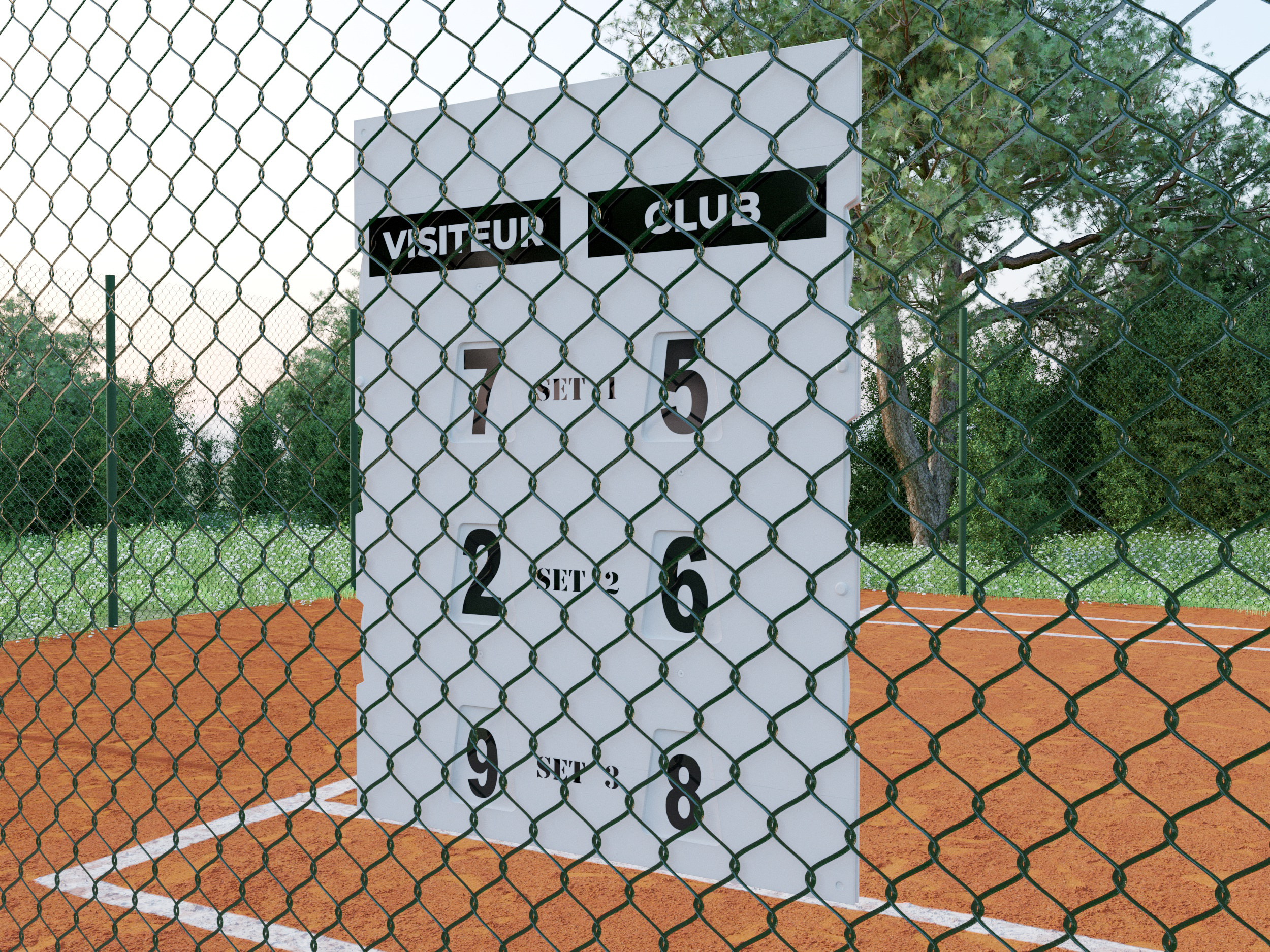
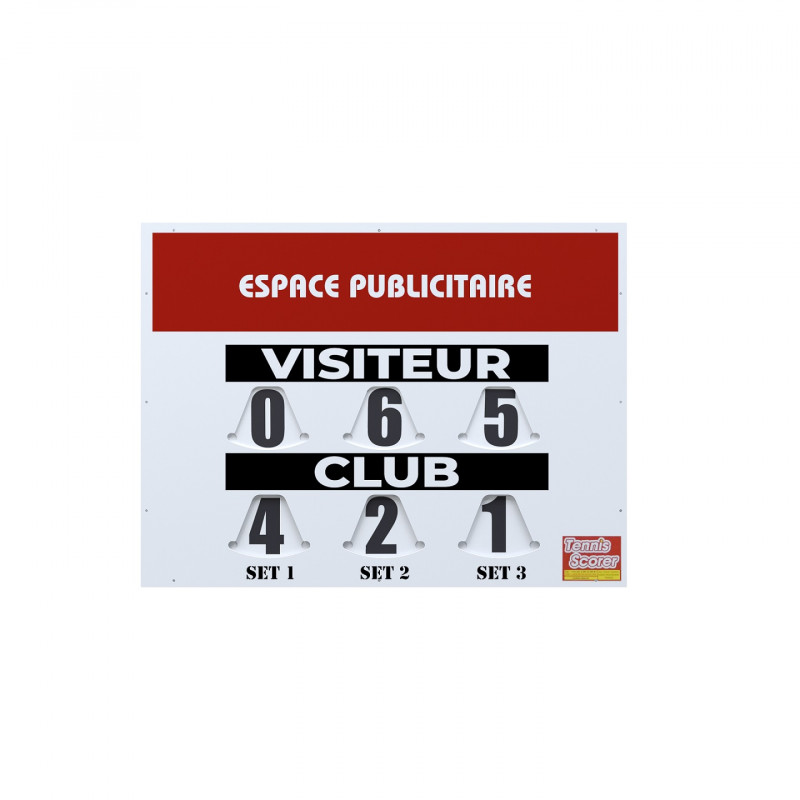
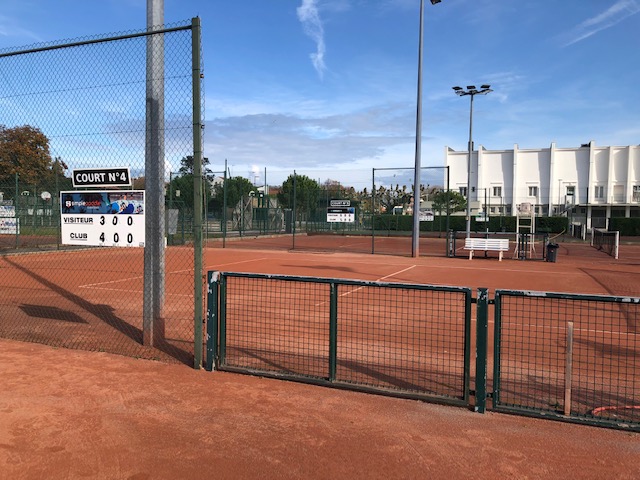
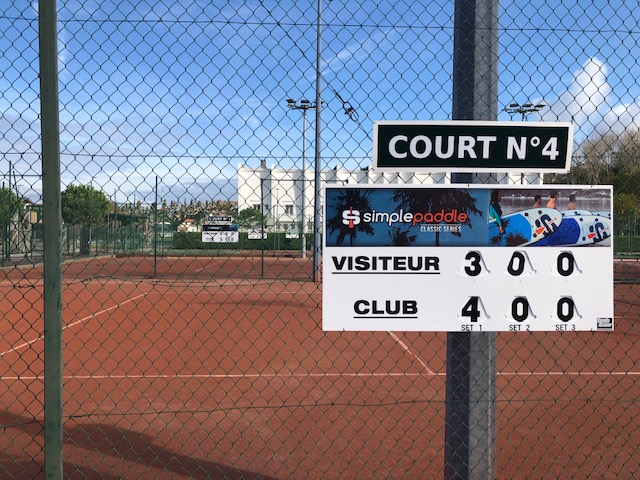
Some court equipment has nothing to do with the court markings. A manual scoreboard such as the Tennis Scorer compact 80 × 60 scoreboard fixes to the mesh fencing, and players update the score at each change of ends. It stays separate from routine line maintenance.
Frequently Asked Questions
Can you repaint a tennis court by following the old lines?
Only after their positions have been checked. A faded line, fence, kerb or post socket is not automatically an accurate datum. The older SAPCA tennis-court code says inaccurate markings should be corrected rather than reproduced.
How many coats of paint do tennis court lines need?
One specialist contractor applies two coats of textured paint when remarking lines. Check the number of coats against the chosen coating system rather than assuming it applies to every surface.
What colour should the lines on a tennis court be?
The 2026 ITF Rules require all lines to be one colour that contrasts clearly with the surface. SAPCA’s acrylic-court guidance says lines are normally white, with grip, force reduction and ball bounce that match the surrounding surface.