
Table of Contents
Choosing scoreboard materials for outdoor courts means asking how each board will cope with rain, frost, sunlight and wind on tennis and padel courts left open all year. This guide compares rot-proof PVC, timber and aluminium composite. It then covers the weak points of edges, fixings and scoring parts, what a club should specify, and how to care for a board until it is recycled.
Which scoreboard material holds up best outdoors?
No material handles every outdoor exposure on its own. Rot, sunlight, frost and moisture each attack a different part of a board, so a durable scoreboard depends on how well its materials cover all four. The difference comes down to what the panel is made of and how it is finished.
What rot-proof, UV-stabilised PVC guarantees
PVC does not suffer the biological rot that breaks down timber. Rot resistance covers only one risk, though: it says nothing about sunlight, temperature swings or wear to the scoring parts. A rigid outdoor PVC panel therefore combines several ingredients. PVC resin forms the structure, impact modifiers reduce brittleness in cold weather, stabilisers limit heat and UV damage, pigments give colour, and processing additives shape the finish.
Tennis Scorer builds its white boards from rot-proof, UV-stabilised PVC that is coloured all the way through rather than coated on the surface. As a result, the panel resists blistering, cracking and fading across its full thickness. UV stabilisation slows ageing but does not stop it: some colour change and surface ageing can still appear over the long term.
How timber and aluminium composite compare
Timber faces a risk that PVC avoids: decay caused by moisture. Water also collects in joints, fixing holes and flat surfaces, which are the points where wooden boards usually fail first. Aluminium composite, by contrast, is made of two aluminium skins around a polyethylene core. It makes a light, rigid panel, but its exposed edges and printed finish still need checking as closely as its stiffness.
Many boards mix these materials. One documented outdoor cricket scoreboard pairs a marine-plywood backing with aluminium-composite signs printed in vinyl. It shows a mixed-material option, not an equivalent to rot-proof PVC, because the plywood still carries timber’s moisture risk.
| Material | Main strength | Points to assess |
| Rot-proof, through-colour UV-stabilised PVC | No biological rot; colour runs through the full thickness | Slow surface ageing under UV; edges, joints and scoring parts |
| Timber-based board | Familiar construction | Moisture-related decay; water in joints, fixing holes and flat areas |
| Aluminium composite | Light, rigid panel | Exposed edges, polyethylene core and printed finish |
| Marine plywood with composite signs | Mixed-material construction | Timber backing still exposed to moisture |
What UV claims and tests establish
A board described as “UV-stabilised” tells you about the panel only. The claim does not cover how the printed graphics, fittings or moving parts will weather. Finish type matters too: a coated board keeps its appearance only while the surface layer survives, whereas a through-colour panel relies on the material itself.
Standards make these claims more precise. BS EN 513:2026, published by BSI in August 2026, tests how PVC-based profiles stand up to artificial weathering under xenon-arc light, a lamp that imitates sunlight. It measures changes in colour and material properties and can include printed or treated surfaces. It does not, however, certify a complete scoreboard.
BS ISO 22785-2:2026, also published in August 2026, covers weathering and irradiation tests for coatings on plastics and composites. This standard is the relevant one when a board’s appearance depends on a coating rather than on colour built into the material, as on painted panels exposed to harsh conditions on outdoor courts.
Where do outdoor scoreboards fail?
A weather-resistant face does not make a whole board weather-resistant. Failures usually start elsewhere: at the edges, at the fixings and in the scoring parts that players handle at every change of ends. Each of these needs its own check before buying.
Edges, joints and winter moisture
Water does not only reach a board through its face. Several points let it in, even when the panel surface resists the weather:
- Perimeter edges: unsealed edges let rain reach the layers of the board.
- Joints: water caught in an open joint freezes, expands and puts strain on the assembly.
- Fixing holes and absorbent cores: both hold moisture right next to the structure.
PVC does not swell like timber, but repeated freeze–thaw cycles can still loosen layers or fittings. For this reason, Tennis Scorer seals and counter-glues the edges of its full-panel boards to keep out moisture and prevent the layers from separating. On its double-sided padel board, the upper and lower edges are counter-glued to keep it watertight and rigid.
Fixings, corrosion and wind loads
Even a light PVC panel acts like a sail when it is large, flat and mounted high on an exposed fence. Secure, well-supported mounting therefore matters as much as the panel material. Fence installation can use clamps, suitable cable ties or corrosion-resistant fixings, with backing plates to spread the load where needed. Posts need brackets and mechanical fasteners suited to the surface. Tennis Scorer hangs its compact boards from brass eyelets and anti-rust hooks, and fixes its full-panel boards with heavy-duty cable ties, so no drilling is needed. Hooks, eyelets and holes still need checking, because stress and water both concentrate there.
Rotating discs and replaceable parts
Manual tennis scoreboards change the score mechanically, using flip cards or rotating discs. These parts get the most handling, so it helps when they are replaceable: swapping a worn digit or disc keeps the rest of the board in service.
Rain caused problems on one earlier rotating-disc design. As the silicone treatment wore off, the overlapping discs became hard to turn, and the fix was to clean, dry and re-lubricate them. A redesign in 2020 changed how the discs were built, preventing water from making them stick and removing the need to lubricate them. That fix applies to those discs only; it does not make every manual board maintenance-free.
What should a club specify?
Once the material is chosen, the specification sets how the board will perform on court. Size, viewing distance, score format and mounting position all depend on the venue. A board that suits a single outdoor tennis court can be the wrong choice for a fence seen from several sides.
Dimensions, visibility and court position
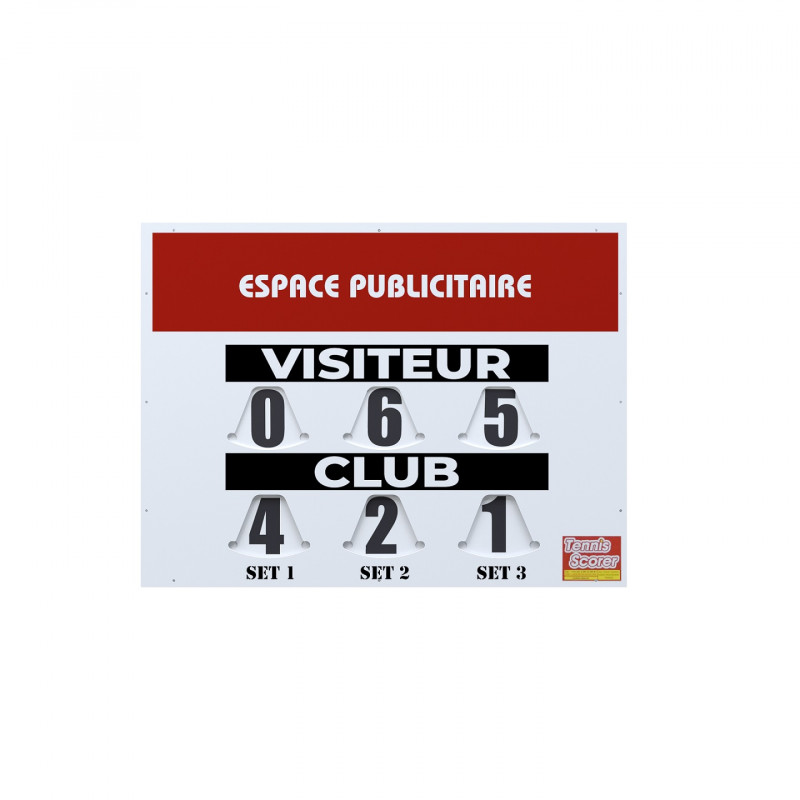
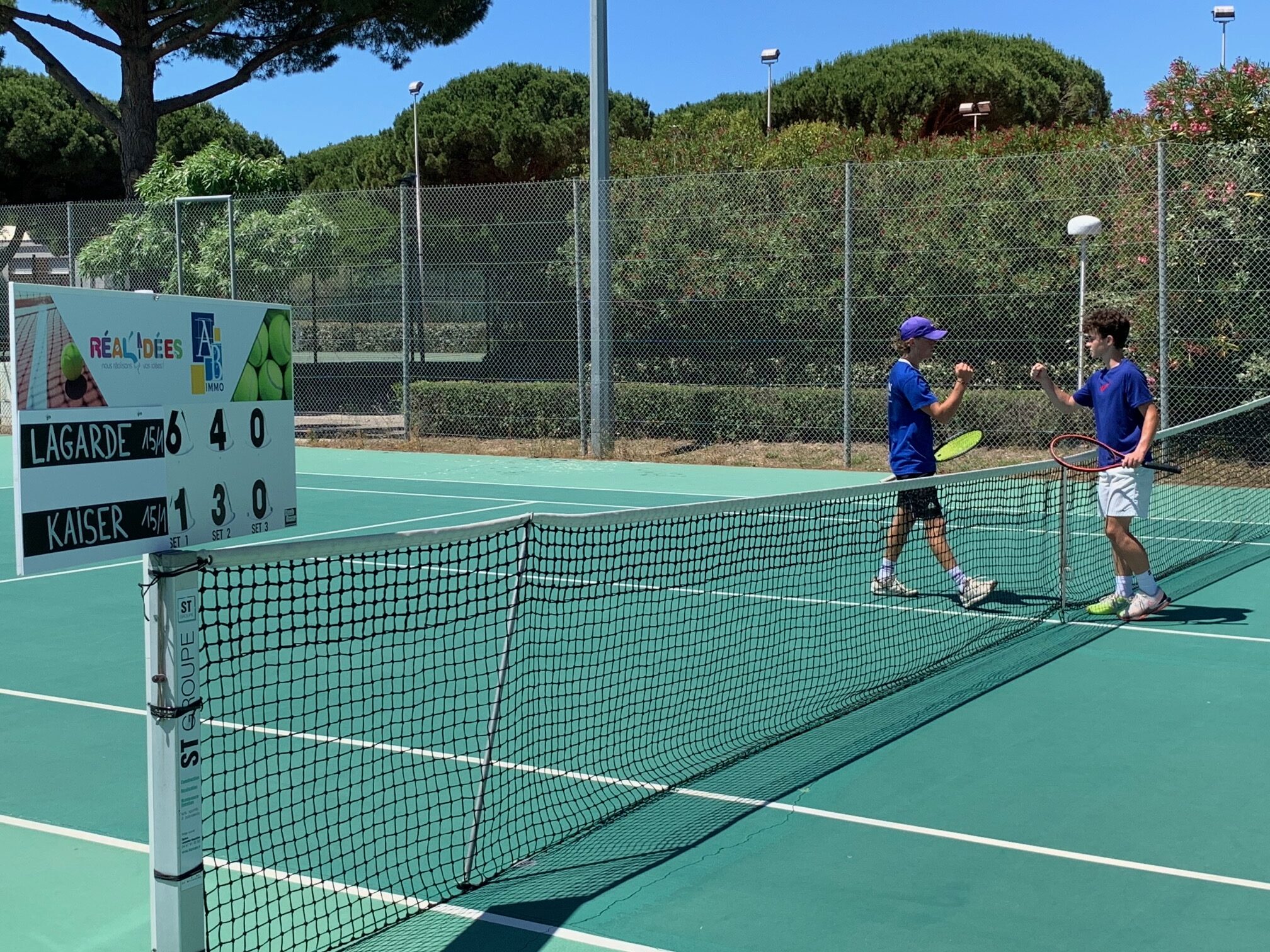
Fence height, available space and where spectators stand should guide the choice of format. Tennis Scorer offers rotating-disc boards in three sizes, with a stated readability of up to 50 m:
- Small, 35 × 50 cm: placed beside the net.
- Medium, 46 × 65 cm, and Large, 56 × 80 cm: mounted on the fence.
- Full-panel PVC, about 60 × 60 cm: weighs around 2 kg.
Weight rises with size. The Large tennis board measures 120 × 60 × 1 cm and weighs 4 kg, with numerals 12 cm high and 2.5 cm wide that stay readable beyond 50 m. The Compact board measures 80 × 60 × 1 cm and the double-sided padel board 60 × 80 × 1 cm; each weighs 3 kg. Basketball courts have no standard board size: the scoreboard display needed depends on viewing distances and on what information has to be shown. A portable board that moves between courts is a separate choice from a fixed one.
Score formats for tennis and padel
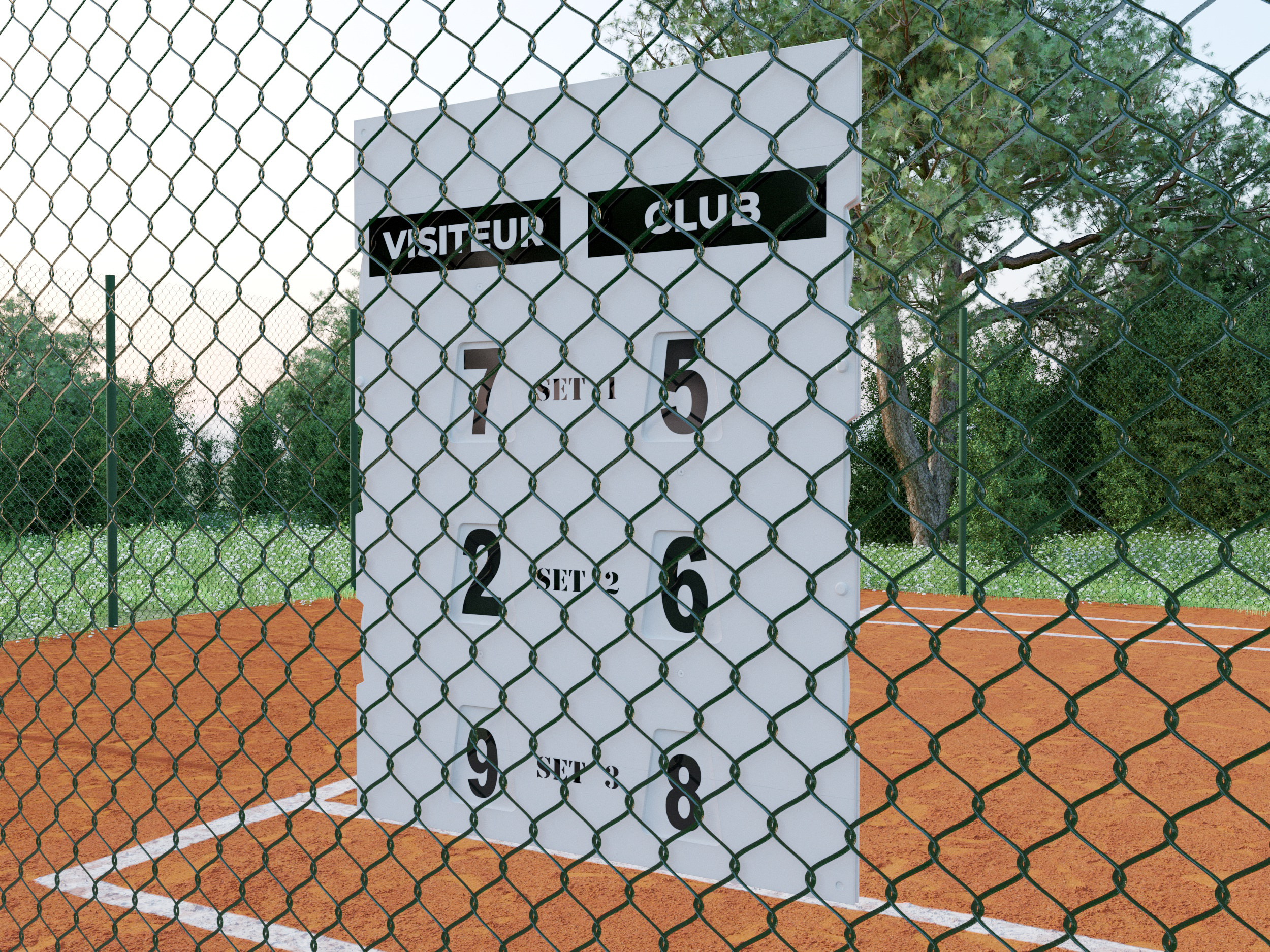
The large PVC tennis scoreboard uses built-in rotating discs to show 0 to 7 games across three sets. It comes with a plate for players’ names and rankings, six cable ties for mesh fencing and a sticker to identify the club, a sponsor or the court. The compact tennis or padel scoreboard shows 0 to 7 for tennis or 0 to 9 for padel. It includes two name plates and a 78 × 17 cm sticker area.
For padel, the double-sided padel scoreboard shows the score on both faces at once. It runs from 0 to 7 in the first two sets and 0 to 9 in the third. Two slate name boards, four cable ties for the fence and a 59 × 11 cm advertising space come with it.
Manual boards versus electronic displays
A manual board needs no power supply, controller, software or battery charging: players change the score by hand at the court. On multiple tennis courts, scores are updated at each board, so no central control system is needed. When comparing digit scoreboards, list the scoring information required, single- or double-sided visibility, mounting position, weather protection and replaceable parts.
An electronic scoreboard takes a different approach. LED displays add a power connection, a controller and sealed electrical parts that can fail in bad weather. Their IP rating follows the tests set out in BS EN 60529, a rating a passive PVC board does not need. Electronic displays can show a game clock, fouls and team names. For an outdoor basketball scoreboard, the FIBA 2026 Basketball Equipment rules set what must be displayed and how visible it must be, without prescribing a material or size. For any sports facilities, the information the venue must show decides whether a manual board is enough.
How do you care for an outdoor scoreboard?
A rot-proof board still needs some maintenance to stay in good order over the years. Regular light cleaning, checks after bad weather and a plan for disposal keep the board working and readable for as long as possible.
Cleaning the panel and graphics
For routine cleaning, use clean water, a mild detergent and a soft cloth or sponge. This removes dirt without harming the plastic or the printing.
Harsher products can damage the board. Follow the board maker’s cleaning instructions when choosing a product, and avoid the following:
- Abrasive pads: scratch the plastic and wear away the printed graphics.
- Aggressive solvents: attack the plastic surface and protective finishes.
- Strong alkaline cleaners: can damage printing and coatings.
- Unverified products: anything the maker’s instructions do not approve.
Periodic checks and minor repairs
Check the board after strong winds and at the end of winter. Three points need attention:
- Fence attachments: a loose fixing can fail even when the panel is sound.
- Edges and joints: look for damage, trapped water or cracked fittings after frost.
- Scoring elements: they must stay readable and turn easily.
Rot-proof PVC cannot prevent these problems, because they come from the assembly rather than the panel.
When a scoring part wears out, only that part needs replacing. On Tennis Scorer boards, individual full-panel digits and compact-board discs are sold as spare parts.
Separating materials at end of life
A PVC panel can be recycled if the receiving facility accepts that material. Before disposal, metal brackets and fixings may need to be removed from the panel and printed parts.
A board made of mixed materials should not go straight into ordinary recycling. The club should check with its waste contractor what they will accept.
Frequently Asked Questions
Does a PVC scoreboard need recoating or taking down over the winter?
No, not with UV-stabilised, rot-proof PVC. Tennis Scorer states that this material needs no recoating and no seasonal removal. Its Large 120 × 60 cm tennis board, made of white PVC, can stay outdoors all year.
When is a double-sided scoreboard the better choice for a court?
A double-sided board is the right choice when players and spectators approach the court from several directions. Tennis Scorer’s double-sided padel board shows the score on both faces at once, from 0 to 7 in the first two sets and 0 to 9 in the third.
Can mixing metals in a scoreboard’s post fixings cause corrosion?
Yes. Different metals used together at a post fixing can cause galvanic corrosion, so the combination needs care. Drilled holes also concentrate water and mechanical stress, so check hooks, eyelets and fasteners even when the board itself resists corrosion.