
Table of Contents
What is an artificial grass tennis court surface?
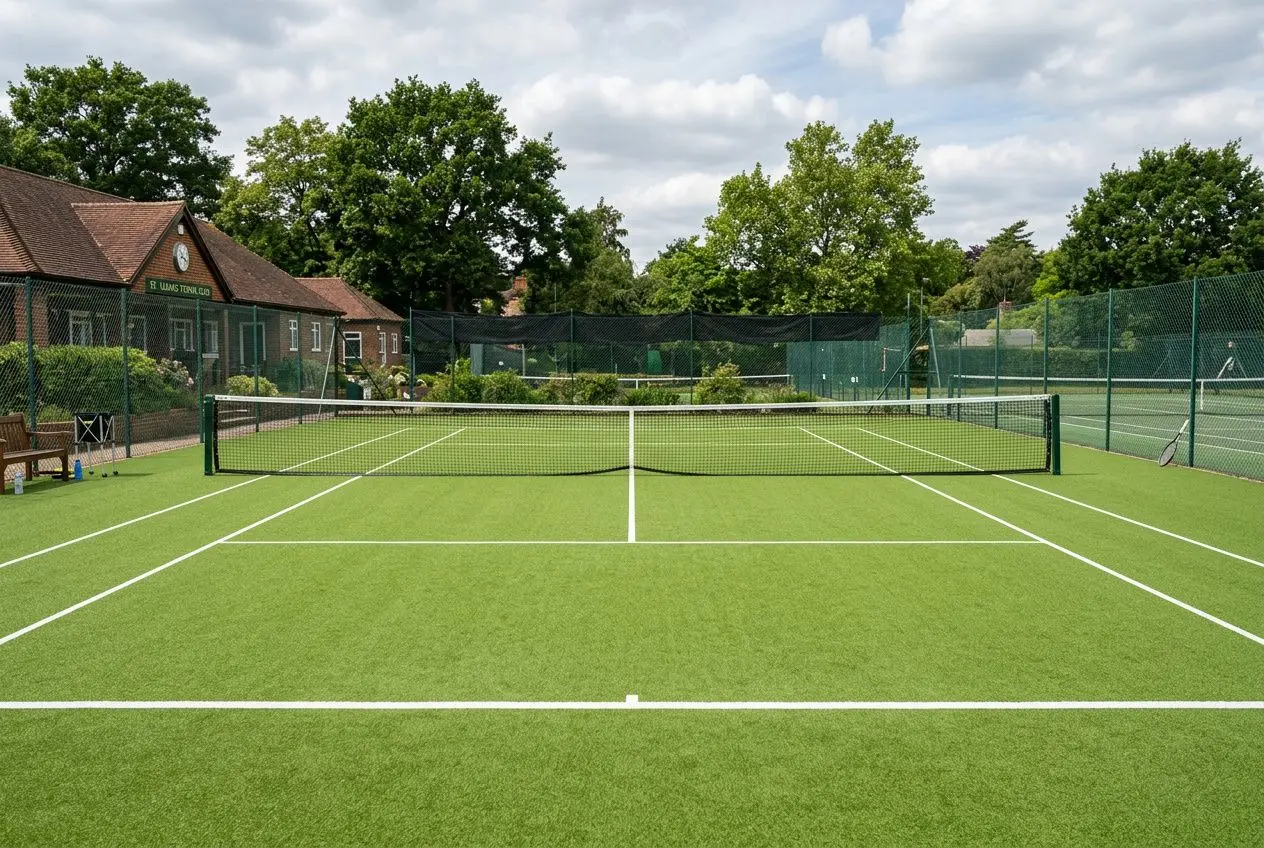
An artificial grass tennis court surface reproduces key features of natural turf through 100% polyethylene fibres: UV-resistant and texturised, with pile heights ranging from 12mm to 20mm.
ITF pace categories for grass tennis courts
That construction shapes how the court plays. For an artificial grass tennis court, the ITF defines three pace categories: Category 3, a medium court pace with a 12mm pile; Category 4, medium-fast at 15mm; and Category 5, fast-paced at 20mm. Ball bounce, rally length, and the tactical balance between baseline consistency and first-strike tennis all shift with pile height.
How artificial grass affects playing style and technique
Those pace categories translate directly into playing behaviour. Compared with natural grass courts, a grass tennis court surface usually plays slower and encourages longer rallies, which can suit developing players. On faster Category 5 surfaces, the ball stays low and moves through quickly with limited spin response, placing more emphasis on power and sharp movement at the net.
Materials and durability of artificial grass courts
That playing profile depends on the materials as much as the pile height. Artificial grass courts are made for durability: polyethylene yarns meet UV stability standards tested to DIN 53387 for 6,000 hours, and the system is free of lead and cadmium. Sand infill depth also matters, because it directly affects court speed, ball bounce, and the feel of the playing surface.
- Fibrillated yarns: used in Category 3 systems, these materials create a softer grass tennis feel with a more forgiving surface for recreational and developing players.
- Monofilament yarns: standard in Category 4 systems, this construction supports consistent performance and a neat appearance across seasons.
- Silica sand infill: applied at depths from 10mm to 17mm depending on the product, it helps regulate court pace, cushioning, and the resilience of synthetic turf under regular play.
Unlike many other sports surfaces, an artificial grass court does not need a seasonal recovery period. Once installed on a rigid base, the surface stays consistent through changing weather. As a result, Tennis Scorer recognises this type of grass tennis court as the right choice when year-round reliability matters.
Artificial grass tennis court cost breakdown for the UK
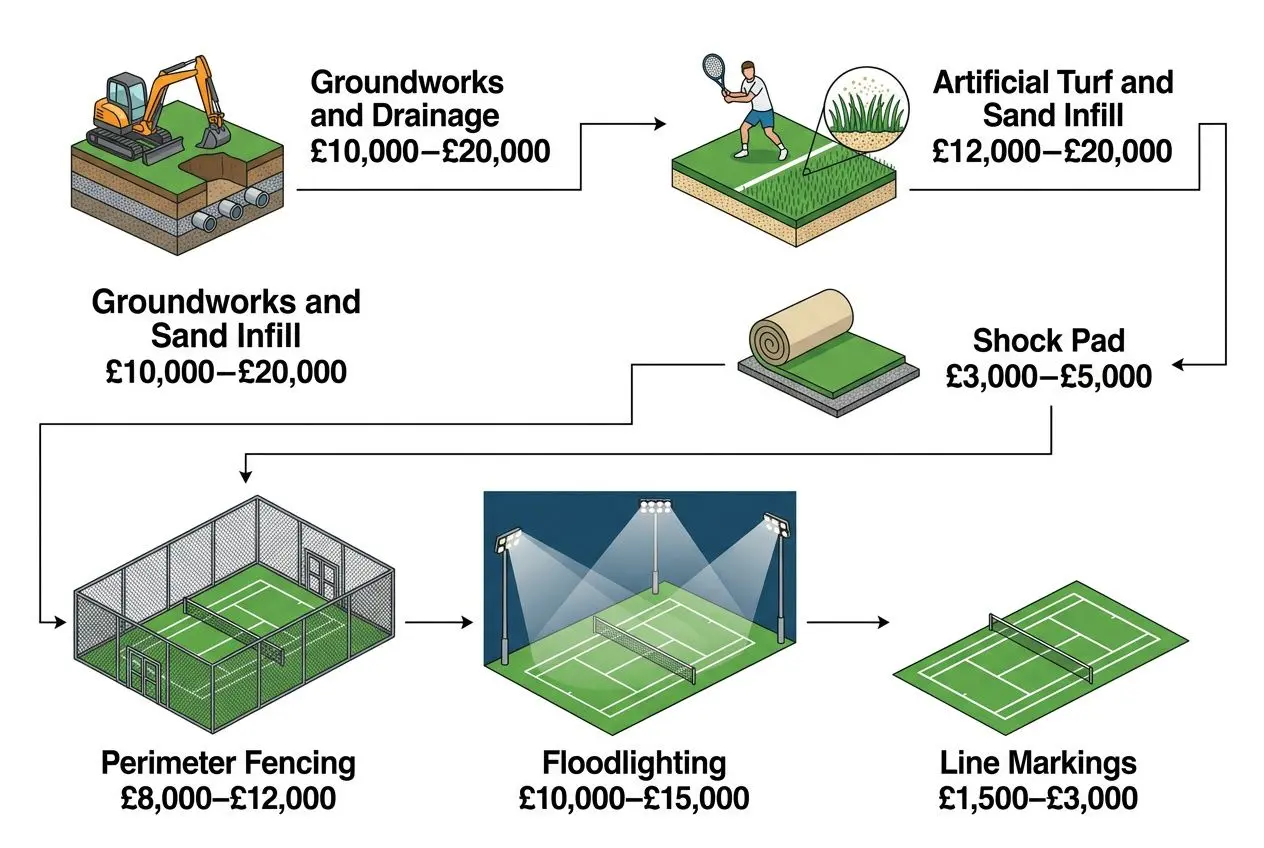
In the UK, a full-size artificial grass tennis court typically costs between £45,000 and £85,000. Once extras are added, the figure can rise sharply: floodlighting, shock pads and premium fencing can take the total beyond £100,000.
Installation costs by setting: at home, at school, and at club level
That broad range becomes clearer when the setting is defined. A private artificial grass tennis court at home, based on a 24m × 11m layout, usually falls between £45,000 and £60,000, while a school or college project sits around £55,000 to £75,000 and a sports club or leisure centre scheme typically reaches £70,000 to £100,000.
The difference comes down to site conditions: access, ground preparation, the quality of any existing base, and the level of finishing required. Subsurface issues can affect both the final cost and long-term performance.
| Setting | Estimated cost range | Key variables |
| Private home court (24m × 11m) | £45,000–£60,000 | Access, ground prep, fencing |
| School or college court | £55,000–£75,000 | Drainage, shock pad, line spec |
| Sports club or leisure centre | £70,000–£100,000 | Floodlighting, multi-court layout |
| Annual maintenance (all settings) | £1,000–£1,500 | Brushing, infill top-up, algae treatment |
Comparing artificial grass against other court surfaces
Once costs are set against the wider market, artificial grass tennis becomes easier to judge. Among the main types of tennis court used in the UK, a macadam hard court usually costs less upfront at around £35,000 to £55,000, but it can crack over time and often produces a firmer feel underfoot.
By contrast, clay courts and natural grass courts tend to cost more both at the outset and over the life of the facility. Clay courts need frequent rolling, watering and specialist upkeep, while natural grass courts are more vulnerable to wet winters and carry higher annual maintenance demands, restricting usable hours through much of the season.
Artificial grass therefore offers a more practical balance of comfort, usability and durability for many UK schools and clubs.
Long-term value and return on investment
That reliability shapes the long-term figures as well. The payback period for artificial grass compared with natural grass is typically 5 to 7 years, largely because maintenance costs are lower, labour demands are reduced and the court can stay in use more consistently through changing weather.
Annual upkeep generally sits between £1,000 and £1,500: brushing, infill top-up and algae treatment. In practice, that compares favourably with the ongoing work needed for natural grass and clay courts, especially where drainage and regular surface care affect availability.
A court meeting LTA pace-of-play standards, for instance, can qualify a club for sanctioned tournament hosting, directly expanding revenue beyond routine membership.
That stronger commercial case depends on build quality. For buyers assessing the best artificial grass tennis court, Tennis Scorer treats installation quality as central to value: a well-planned project, handled by capable installers and supported by sound drainage, will usually deliver stronger performance over time than a cheaper court installation with compromises hidden below the surface.
Maintaining your artificial grass tennis court year-round
Artificial grass needs far less routine attention than natural grass. There is no mowing, watering, or fertilising, yet a clear maintenance plan still matters if an artificial grass tennis court is expected to deliver reliable performance and a longer lifespan.
Once cleaning and infill are neglected, wear accelerates. The grass tennis court lifespan then falls well short of what well-managed artificial grass courts can achieve.
Routine brushing, cleaning, and infill management
Artificial grass tennis court maintenance protects the synthetic grass fibres, preserves drainage, and keeps ball bounce and footing consistent through changing weather.
- Regular brushing: rotary brushing machines keep fibres upright and limit pile matting, especially around baselines and service lines where play is heaviest.
- Low-pressure water cleaning: weekly rinsing removes dirt and organic debris without harming the surface; pressure washing is unsuitable because it drives debris deeper into the pile and disrupts drainage.
- Algae and moss treatment: specialist applications carried out four times a year reduce biological growth that affects grip and safety, particularly on shaded courts.
- Annual infill top-ups: sand displaced by use and weather should be replaced each year to maintain cushioning, stable ball bounce, and safe play.
When infill becomes compacted or contaminated, synthetic turf loses cushioning and the court’s performance drops. Injury risk rises at the same time.
As a result, annual top-ups remain one of the most economical interventions available: a modest recurring cost offsets the far higher expense of premature resurfacing.
Weather resistance and year-round playability of grass tennis
That same principle applies to wet-weather use. Compared with natural grass courts, an artificial grass tennis surface dries faster after rain, stays less slippery, and avoids the waterlogging that often disrupts play in the UK.
On court, that means more playable hours across the seasons and fewer interruptions caused by weather.
Pre-tufted lines add another practical advantage: they do not fade under sunlight or repeated use. By contrast with natural grass courts and painted hard surfaces, there is no recurring repainting cycle to budget for.
Lifespan expectations and resurfacing timelines
From that point, lifespan expectations become easier to plan. High-quality artificial grass tennis courts generally last 10 to 15 years when maintenance is consistent, while heavily used sites may need resurfacing after 8 to 10 years.
Professional deep cleaning every 18 months helps restore grip and remove biological matter before lasting damage develops. Tennis Scorer treats that scheduled work as the most reliable way to protect long-term performance without committing prematurely to full replacement.
Regular records support better decisions: monthly checks on wear patterns, pile flattening, and drainage issues make it easier to time repairs and resurfacing accurately. Early local repairs and infill top-ups often delay major reconstruction, and structured guidance on maintaining artificial grass tennis courts helps protect the value of an artificial grass tennis investment over the full grass tennis court lifespan.
Frequently Asked Questions
Is artificial grass good for tennis?
Artificial grass is a strong option for tennis at every standard. It provides a reliable playing surface through changing weather, requires far less upkeep than natural grass, and keeps courts available for year-round use.
That consistency shapes how the game feels: artificial grass tennis usually plays a little slower than traditional grass courts, which tends to support longer rallies and cleaner technique. By contrast, faster Category 5 artificial grass courts suit clubs and competitive settings where higher court speed is part of the brief.
How much does an artificial grass tennis court cost in the UK?
Artificial grass tennis court cost in the UK usually sits between £45,000 and £85,000 for a full-size build. In practice, a domestic installation may start at around £45,000, while a sports club project can reach £70,000 to £100,000 once fencing, floodlighting, and drainage are included.
Once installed, running costs remain comparatively controlled: annual maintenance is typically £1,000 to £1,500. Over a 10 to 15 year lifespan, that often leaves an artificial grass tennis court more economical than clay courts, natural grass courts, or macadam surfaces.
Can you play tennis on wet artificial grass?
Yes. Artificial grass courts are built with perimeter drainage and subsurface water management, so the surface dries quickly after rain and remains usable in poor weather.
As a result, artificial grass tennis is less prone to the slipperiness, waterlogging, and muddy wear seen on many natural grass courts. Specialist yarn design also helps reduce surface shine in wet conditions or under floodlights, which supports visibility and safer play throughout the year.