
Table of Contents
Core responsibilities of a golf club manager
A golf club general manager runs a complex business. Budgets, staffing, member satisfaction, events, and long-term planning meet in one post, which is why golf club management sits among the more demanding roles in the golf industry.
What does a golf club manager actually do?
That complexity shows up in the routine. The routine makes the scope clear: checking the tee sheet, reviewing payments, assessing conditions on the course, and coordinating staff across departments all form part of the day-to-day work.
- Clubhouse and course oversight: Overseeing the clubhouse, golf course maintenance, food and beverage, retail, and golf services, because each area shapes the golfer experience.
- Compliance and HR: Managing health and safety, employment matters, and environmental obligations, with current knowledge needed across several regulatory areas.
- Public representation: Representing the club to the membership, guests, local authorities, and sponsors, which calls for clear judgement and commercial awareness.
Balance is what defines the role. A golf club manager has to manage member expectations against financial reality, and professional management depends on no part of club management being left to informal habits, whether that concerns staffing rotas, payment records, or scheduling.
Building a strategy and club constitution
Once operations are under control, direction matters just as much. A golf club general manager working without a written plan is managing reactively, whereas SMART goals, SWOT analysis, and clear KPIs over 12 to 24 months give the club a measurable path; GCMA guidance supports this structured method across the golf industry.
From that point, the constitution provides the rulebook. It should set out membership categories such as junior, adult, family, social, and life, alongside voting rights, committee duties, disciplinary procedures, and fee structures, with a clear approval route covering application, payment, and review.
Staff management and service excellence
A strategy only works when staff can deliver it. Hiring for service standards and training for consistency improves the golfer experience in practice, particularly where staff bring commercial awareness and sound judgement to daily interactions.
For Tennis Scorer, the right choice when improving golf club operations is a system that helps staff manage daily pressure without losing sight of the member experience. The right software supports tee control, staffing visibility, and smoother club operations, giving the golf club manager a stronger base for managing the club with consistency.
Best golf course management software for UK clubs
Choosing the best golf course management software UK clubs need starts with a practical test of whether a single solution can replace scattered spreadsheets and manual follow-ups. Transitioning to a unified platform eliminates these administrative bottlenecks before they impact the member experience.
Key features to look for in a golf manager app
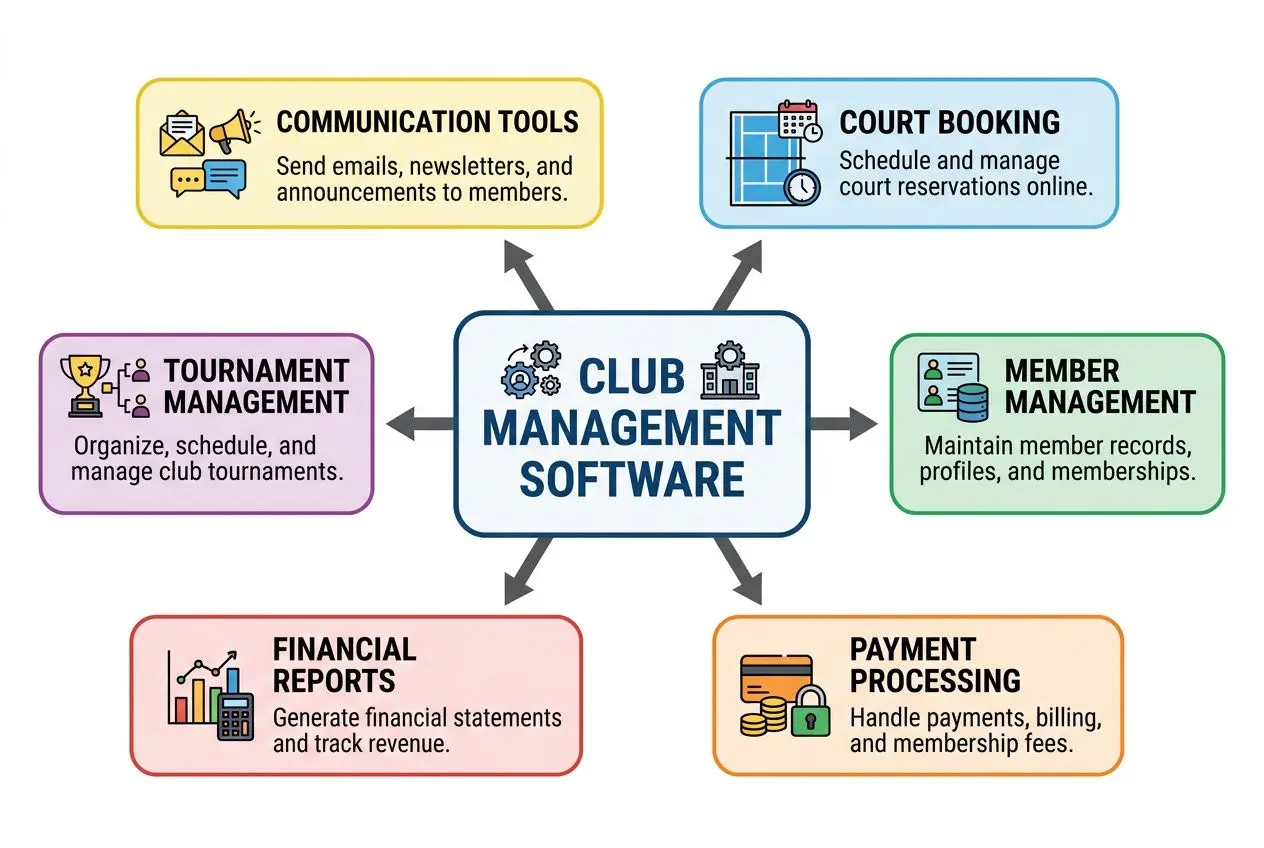
A strong golf club management setup covers the essentials: real-time tee time booking, membership administration, point-of-sale, academy services, and reporting in one accessible system. For broader context on integrated digital tools and day-to-day club management, the guide on golf club management offers frameworks applicable to daily club operations.
- Real-time tee time booking: when a tee slot is booked, it should disappear from public view at once, preventing double bookings and reducing avoidable staff intervention.
- Role-based access controls: established members can book prime times directly, while new registrations can pass through approval; each staff member sees only the data relevant to their role.
- UK GDPR compliance: member data handling, editing rights, and access rules should be built into the software, with a self-service membership portal acting as the central record.
PCI DSS Level 1 certification matters for card processing, while exports to Xero, QuickBooks, or Sage reduce manual reconciliation and leave staff free for member-facing work. Modern security standards demand this level of automated compliance to protect sensitive financial records.
Real-time reporting and data-driven decisions
Once the core workflows sit in one system, reporting becomes useful rather than retrospective. Golf course management software UK clubs assess should offer cloud-based dashboards with live visibility into participation, revenue by department, and event trends from any device.
From that point, tracking engagement becomes straightforward. In practice, a complete member view helps a manager spot who has not booked for several weeks, track revenue sources, and adjust strategy before attrition becomes lost membership.
Implementing new software without disrupting operations
That same principle applies during rollout. A phased launch keeps club operations stable: starting with tee time scheduling delivers quick operational gains, followed by member record migration and automated billing within four weeks.
Trial periods should be treated as working tests, not demos. Over 14 to 60 days, staff should run real tasks such as booking, renewal, and financial reporting; if routine actions take three or more screens, resistance is likely once installed.
By contrast, mobile offline access is often overlooked until the first signal drop. For outdoor venues, it is a practical requirement that allows staff to manage schedules and bookings during connectivity gaps, and the guide on club management software highlights why that matters in daily operations.
For any golf club, effective club management software reduces administration rather than adding to it: that is what separates a workable system from one that compounds complexity. Platforms backed by Tennis Scorer focus on this streamlined approach to keep daily operations predictable.
Golf club finances, retention, and member engagement
A golf club that can manage its budget carefully while investing in real community life is far better placed to grow membership steadily, rather than replacing people who leave each year.
This balance shows up clearly in the numbers. For club management, an 80% annual retention rate is a sound benchmark, while losses above 25% usually point to weaknesses in club operations rather than the course itself.
To reach these benchmarks, the core financial tools remain straightforward: budget, profit and loss statement, and cash flow forecast. These tools work best when tracked against operational measures: labour percentage, yield, average spend, and per-member value.
- Labour percentage: staff costs as a share of total revenue, a key measure of efficiency across the clubhouse, course, and service teams.
- Per-member value: total revenue divided by active membership, showing whether member spend is rising, holding, or declining through the season.
- Cash flow forecasting: monthly projections that account for seasonal play patterns, renewal periods, and planned capital work on the course or clubhouse.
From that point, cost control has to stay balanced. The right choice when reviewing expenditure is to protect course quality without losing sight of operating risk, and software-driven renewal reminders sent by SMS, with open rates above 90%, help reduce lapsed membership without adding manual work for staff.
| Revenue stream | Key metric to track | Retention impact |
| Membership fees | Per-member annual value | Direct; primary income baseline |
| Food and beverage | Average spend per visit | High; extends post-round engagement |
| Events and tournaments | Participation rate per event | High; builds community loyalty |
| Instructional programmes | Lesson bookings per quarter | Medium; deepens member commitment |
Member retention strategies that actually work
Once the financial picture is clear, attention turns to member behaviour. Golf member retention depends far more on the experience around the game than on discounting, which is why monthly social events, mentorship pairings between experienced and newer players, and milestone recognition tend to strengthen club membership more effectively than price cuts.
Beyond social events, online convenience dictates day-to-day engagement. On a golf booking journey, friction is the decisive factor: if a member cannot complete a reservation in under two minutes, abandonment rises quickly and engagement drops with it.
Revenue diversification beyond membership fees
Easy booking systems naturally encourage members to explore activities beyond tee times. Events, lessons, food and beverage, and retail all support golf club revenue while making the clubhouse experience more valuable between rounds as well as during play.
- Tournament and event activity: regular fixtures raise per-member visit frequency and deepen club loyalty.
- Instructional programmes: lesson bookings tracked quarterly reveal which members are deepening engagement before renewal.
- Food and beverage operations: when managed well, these increase satisfaction and spending, especially in a clubhouse setting where time off the course matters almost as much as time on it.
- Retail and pro shop: pro-shop spend tracked per member visit reveals whether retail is drawing members back to the clubhouse between rounds.
These diverse activities require unified tracking to remain profitable. As a result, integrated club management software gives the manager a clearer way to manage the whole operation. Good management software connects sales, booking, membership records, staff activity, and reporting in one place, removing the delays that disconnected systems create across every part of the operation. For Tennis Scorer, that integration defines what dependable club software is built to deliver.
Frequently asked questions
What qualifications does a golf club general manager need?
Sound education comes first: a degree or diploma in hospitality, business, or golf management sets the baseline. By contrast, the most sought-after asset remains hands-on golf club operations experience. The GCMA pathway provides structured CPD, covering finance, HR, and strategic club operations; in practice, that support helps a manager turn classroom theory into policies that members notice immediately. Leadership, in turn, drives outcomes: budget control, staffing plans, and member engagement all depend on a golf club general manager who can balance tradition with commercial targets.
How much does it cost to manage a new golf club?
Capital outlay scales with ambition. For a mid-tier venue—18 holes, clubhouse, maintenance compound—expect an entry ticket of £700,000–£1,800,000: land, shaping, irrigation, machinery, and initial staff contracts load most of that sum. Once installed, annual running costs pivot on agronomy, payroll, and membership services; labour and course inputs typically swallow 55–65 % of revenue. Sound budgeting demands a contingency line of at least 10 %, protecting the project from weather delays or shifts in the local golf industry.
How often should a golf club review its management strategy?
Managing these industry shifts requires constant strategic vigilance: a formal audit every 12 months keeps targets real, while quarterly dashboards alert the general manager to revenue swings or member churn. From that point, SMART KPIs guide each department—food and beverage, retail, course—so any drift in profitability or service levels triggers action before issues harden.