
Table of Contents
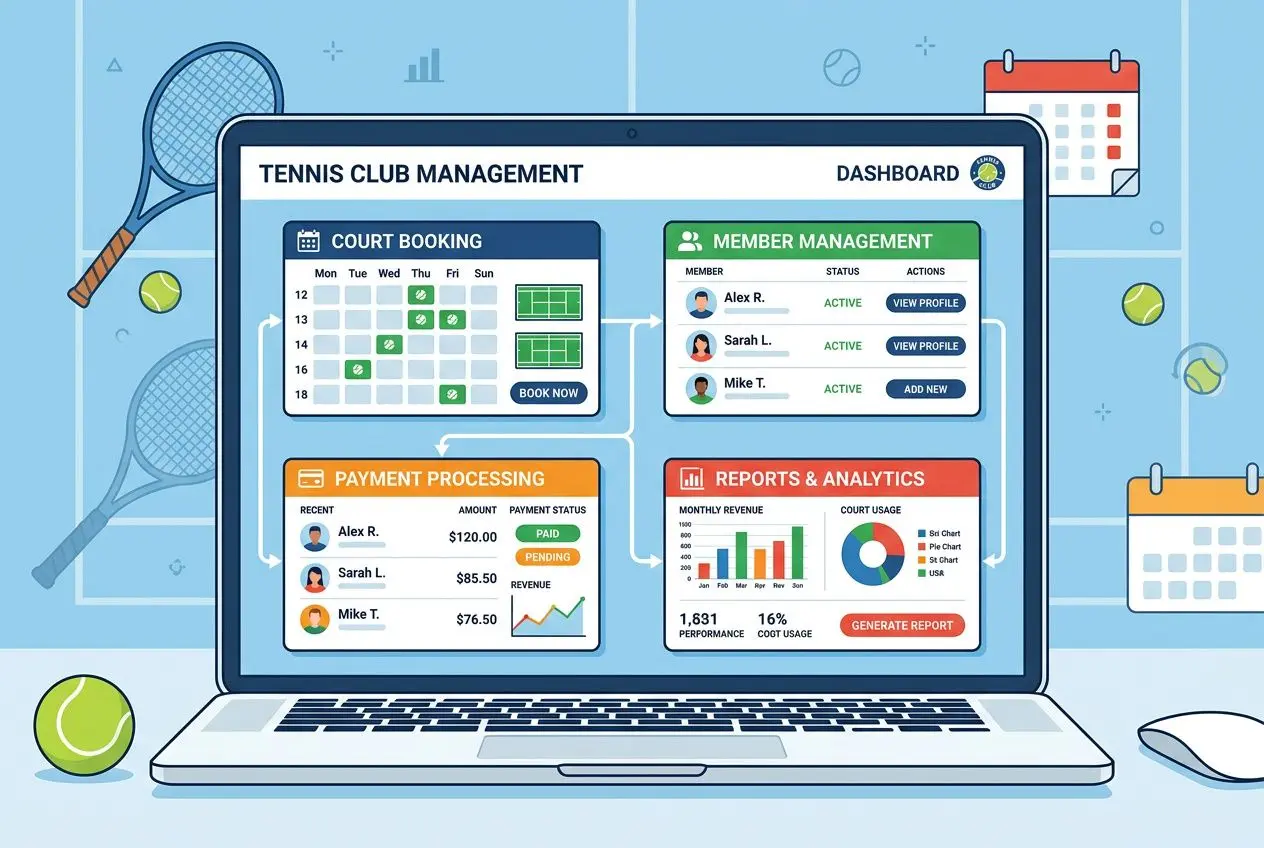
Learning how to manage a tennis club effectively means treating operations, member experience, scheduling, payment, branding, and communication as one connected system. This article sets out a practical framework for tennis club management, combining governance, club administration, and the day-to-day use of tennis club software so club owners can run a tennis club with clarity.
Building the foundation of effective tennis club management
That joined-up view starts before the first court reservations are made. A stable tennis club relies on sound planning, clear operating rules, and management software that supports club running instead of adding friction.
The foundations decide whether growth feels controlled or chaotic: financial planning, scheduling, staffing, membership design, and service standards all shape the member experience long before play begins.
Why a tennis club business plan matters
A strong tennis club business plan sets out investment needs, revenue forecasts, pricing, and the target market. For a moderately sized facility with four to six outdoor hard courts, initial startup costs typically range from £700,000 to £1,800,000: that scale alone makes structured planning essential.
Revenue should be mapped across membership, lessons, tournaments, and court bookings, with the plan reviewed each year as the club evolves. The right choice when shaping early strategy is precision, not optimism.
From that point, market research gives the plan real weight. Local demand, competitor pricing, and gaps in the area all need careful assessment, because a competitive academy, a recreational venue, and a community-led tennis club each require a different programme mix, staffing model, and tennis club business plan.
Setting tennis club hours and operational structure
That planning then needs to translate into a workable structure. Tennis club hours affect everything that follows: peak-time access, coaching rotas, maintenance windows, staffing levels, and the overall logic of scheduling.
Hours should be published consistently wherever members look for information, including the tennis club management guide, the booking platform, and on-site signage. As a result, fewer front-desk queries interrupt club administration, and court bookings become easier to manage through dedicated club management software.
Once installed, a clear operating structure also improves payment handling and daily club management. Tennis Scorer supports this kind of consistency through tennis club software built around bookings, court reservations, and reliable tennis club hours.
Retention starts with reducing operational friction
With the structure in place, retention becomes easier to influence. Members rarely leave because of the tennis alone; they leave after repeated friction in booking, approval, payment, or communication.
Retention should stay above 80% a year. Where losses reach 25% or more, the cause is often fragmented processes, weak communication, or club management software that does not support the full member journey.
- Booking speed: Court bookings should take less than two minutes, or members start dropping out of the process.
- Consistent communication: If players cannot find partners, events, or updates through one clear channel, disengagement usually comes before formal cancellation.
- Community milestones: Recognising first match wins and membership anniversaries often supports the member experience more effectively than discounting.
By contrast, clubs that rely on disconnected tools for scheduling, payment, marketing, and member administration place pressure on staff and create avoidable errors. The difference comes down to system design: integrated club management software that links scheduling, payment, and communication makes club running more resilient.
A dependable software stack strengthens membership handling, supports court reservations, and gives staff a clearer basis for day-to-day club administration; the external layer is covered in this guide to tennis club branding.
Tennis club member management and governance essentials
Governance and data handling sit at the centre of sound club management. A clear legal framework protects a tennis club when disputes arise, while reliable records prevent the small administrative failures that quietly damage membership retention. Structure is the common thread: both need to be designed properly, not patched together later.
The role of a tennis club constitution in daily operations
That structure begins with the tennis club constitution. It sets out membership categories, voting rights, committee responsibilities, disciplinary procedures and amendment rules, so daily decisions are handled consistently rather than improvised under pressure. In England, the LTA provides model constitutions for affiliated clubs and expects formal adoption before many grant applications proceed.
Once adopted, the document should make each class of membership clear: who can join, how approval works, what rights attach to each tier, and how fees are handled. Booking privileges for a junior member and a full adult member are then defined in advance, reducing friction and avoiding uneven treatment.
- Membership categories: Junior, adult, family, social and life membership should each carry clearly stated rights, obligations and fee structures.
- Approval process: New applications need a documented route covering form submission, payment and committee review, rather than informal decisions.
- Disciplinary procedure: A written process for code-of-conduct breaches helps protect the tennis club and supports consistent enforcement.
- Amendment rules: Voting thresholds for changing the constitution should be explicit, especially for general meetings.
From that point, formal status matters beyond internal order. Clubs seeking LTA affiliation or external funding are typically expected to provide a properly adopted tennis club constitution; without it, applications can stall and tennis club member management remains tied to informal practice that rarely scales well.
Centralising membership data for better club management
Once governance defines the rules, systems have to carry them into daily use. Spreadsheets may cope for a while, but they create duplication, version conflicts and single points of failure, especially as membership grows beyond roughly 100 people. Contact details, renewal dates, payment records and emergency information all belong in one searchable system built for tennis club member management.
That shift also improves visibility for coaches. Attendance, notes and relevant profile information can be stored in one place, so handovers do not depend on memory or scattered messages.
From there, automation removes much of the routine chasing. Renewal reminders sent by email or SMS cut manual follow-up, and text messages remain especially effective for urgent prompts: SMS open rates exceed 90%. A member portal adds another layer of efficiency by letting members update their own contact details and payment information without staff intervention.
Communication, safeguarding, and GDPR compliance
That same member portal which handles renewals can also enforce GDPR access rights and safeguarding rules directly at the platform level. UK GDPR applies to any tennis club handling personal data, so access, editing rights and record handling need to be built into the platform rather than managed informally. Software selection should prioritise a system that supports both operational clarity and legal discipline.
- Data access portal: Members should be able to view, edit and download the personal data held about them through the member portal, helping satisfy subject access requirements.
- Segmented staff access: Role-based permissions ensure each staff member sees only the information relevant to their role, which reduces unnecessary exposure.
- Safeguarding messaging rules: Direct staff-to-child communication should be blocked unless a responsible adult is included, which is essential for junior activity.
- Medical and emergency data: Emergency contacts and medical notes should sit inside each profile and remain accessible offline, so coaches can respond quickly during incidents.
Once those controls are in place, communication can be handled with more precision. Messages segmented by membership tier or activity level tend to perform better than broad, untargeted sends, while tailored re-engagement campaigns for lapsed members usually cost less than finding new ones. For Tennis Scorer, that makes communication a direct part of tennis club member management rather than a separate marketing task.
Choosing the right tennis software and club management software
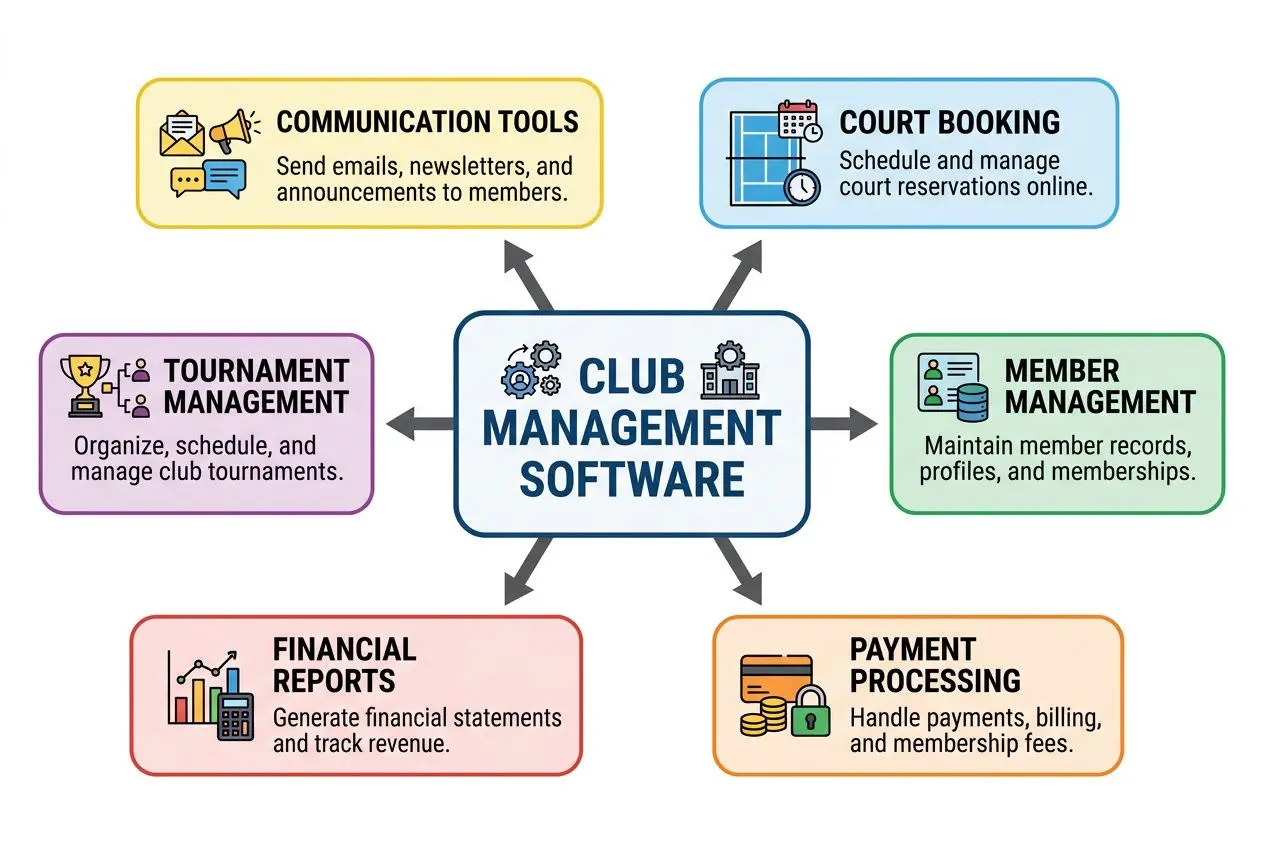
Selecting integrated tennis software is one of the most consequential decisions in club operations. A strong platform replaces disconnected spreadsheets, calendars, and messaging apps with one system for court bookings, scheduling, payment, registrations, reporting, and day-to-day club management, often cutting administrative workload by up to 50%.
What to look for in club management software
That centralisation only matters if the essentials are handled properly. Any club management software under consideration should cover real-time court scheduling with conflict detection, membership records, recurring payment processing with automated retry logic, financial reporting, and GDPR-compliant data handling through a secure member portal.
Security and finance come next. PCI DSS Level 1 remains the highest standard for card payment processing, so any management software handling payments should hold that certification, while clean exports to Xero, QuickBooks, or Sage are vital if the tennis club wants to avoid a fresh round of manual reconciliation.
Access also needs to match real working conditions. Mobile use is now expected, but offline capability matters just as much for outdoor venues where signal drops without warning; on court, that means staff can still manage court bookings, check schedules, and confirm membership details when connectivity is unreliable.
The table below sets out the minimum standard for club software selection.
| Feature | Why it matters | Minimum standard |
| Court booking with conflict detection | Eliminates double bookings and phone disputes | Real-time removal of booked slots from public view |
| Recurring payment processing | Automates membership billing and reduces revenue leakage | Automated retry logic up to four attempts |
| GDPR-compliant member portal | Legal requirement for UK operators | Member self-service data access and download |
| Mobile offline access | Essential for outdoor court environments | Core functions available without internet connection |
| Accounting integration | Removes manual financial reconciliation | Native export to Xero, QuickBooks, or Sage |
| PCI DSS Level 1 certification | Protects club and members from payment fraud | Mandatory for any card payment processing |
How to trial and implement a new management software
Once the shortlist is clear, the trial period should be used against real workflows. Most club management software trials last 14 to 60 days, and the difference comes down to whether the system can handle everyday tasks such as court scheduling or a membership renewal without forcing staff and members through three or more screens.
From that point, implementation should stay controlled. A phased rollout works best: launch scheduling first, migrate member data next, then activate automated payment and billing within a one-to-four-week window.
Once installed, adoption needs measuring early. Track how many court bookings move through the system rather than by phone during the first month, then focus on the steps that create hesitation; those are usually the points where training or a small workflow change will improve take-up fastest.
Advanced features that grow with the tennis club
Automated tournament management can handle registration, online payment, player seeding, bracket generation, and live score updates from mobile devices, while point-of-sale integration connects shop sales, court rental income, and membership transactions in one checkout flow. Tennis Scorer positions these modules as sensible phase-two additions rather than day-one requirements.
Advanced analytics can turn booking trends, spending behaviour, attendance patterns, and wider schedules into practical insight, helping a tennis club spot peak demand and weaker programmes far earlier than spreadsheets usually allow. The platform that earns selection is the one supporting both immediate scheduling needs and longer-term club operations without adding friction.
Streamlining scheduling, booking system, and payment operations
Court management and financial workflows are often where club administration either runs smoothly or starts to strain. An integrated booking system that links court reservations, coaches, schedules, and billing removes much of the manual coordination that drives complaints and absorbs staff time.
Building a reliable court booking system for your tennis club
That operational base starts with visibility. For any tennis club with more than two courts, a real-time, colour-coded tennis club booking system with instant conflict detection is essential for accurate court scheduling and dependable tennis court booking.
- Instant slot removal: Confirmed court bookings disappear from the public calendar in real time, with no delay that creates a race-condition window for double-booking.
- Role-based access: Established members book prime slots directly; new members route through an approval step, preventing access inequities that generate complaints.
- Maintenance blocking: Unavailable courts are blocked as closed slots across all surfaces, preventing members from arriving to find an unplayable court.
From that point, access on mobile becomes important. Applications with offline functionality are the right choice when courts sit in areas with unreliable connectivity, allowing members and staff managing court bookings to confirm availability without a live signal. Once installed, automated reminders before each session reduce no-shows and protect valuable court time.
Automating payment and reducing administrative workload
Once booking is reliable, payment should follow the same principle. Integrated payment processing connects membership fees, tennis club booking charges, lesson fees, and event registrations directly to the platform, reducing manual chasing and tightening club operations.
A sound setup protects revenue without adding headcount to club administration. Recurring billing keeps subscriptions on time, failed transactions can be retried automatically, and invoice generation can draw straight from completed sessions and coach records. On court, that means less back-office friction and clearer control across the sports club.
- Recurring billing: Membership subscriptions charge automatically on the due date, with no manual intervention required from club administration staff.
- Failed payment retry: The system reprocesses failed direct debits or card payments up to four times before escalating to manual follow-up, protecting cash flow predictability.
- Automatic invoice generation: Invoices are produced within minutes of session completion, formatted to the club’s tax requirements and delivered to members by email without staff action.
- Real-time financial dashboard: Outstanding balances and revenue trends are visible across configurable time periods, replacing end-of-month spreadsheet reconciliation.
That financial layer also needs the right safeguards: every payment processed through the tennis club booking system should meet PCI DSS Level 1 certification. PCI DSS Level 1 certification covers end-to-end encryption of card data and mandates annual third-party audits, the same standard applied to major card processors.
Connecting scheduling and membership data for better insights
Digital attendance registers created automatically for each class connect scheduling, delivery, and billing without manual transfer. Coaches can record attendance through a browser or mobile app, and that information flows directly into member profiles and reports.
From there, the value shifts from record-keeping to insight. When court scheduling and court reservations data connect to membership activity, managers can see who has not booked for several weeks and start timely communication before attrition becomes formal. A single-entry model, where scheduling data flows automatically into court management, billing, and membership records, removes the duplication that makes club administration labour-intensive.
Frequently asked questions
What is the best tennis club management software for a small or mid-sized club?
For a small or mid-sized tennis club, the best tennis club management software covers the essentials without heavy customisation. It covers four functions: real-time court booking with double-booking prevention, membership records in one place, automated recurring payment processing, and GDPR-compliant data handling.
That foundation matters because staff will only adopt a club management software platform if everyday tasks stay simple. Clubs should test real workflows during a trial period of 14 to 60 days: book a court, renew a membership, and generate a financial report. If any of those actions takes three or more screens, tennis club management usually slows rather than improves.
Once those basics are confirmed, security and reliability decide whether the management software is suitable for long-term use. Any system handling card payment should show PCI DSS Level 1 certification, and a cloud-based tennis club management software platform with offline mobile access is the right choice when courts have unreliable connectivity.
How do I improve member retention at my tennis club?
A tennis club can sustain annual retention above 80% when booking is quick, membership approval is prompt, and communication stays consistent.
The practical benchmark is clear: bookings should take less than two minutes to complete. Automated renewal reminders sent by SMS, where open rates often exceed 90%, reduce lapsed membership without adding manual follow-up.
From that point, community becomes the stronger lever. Milestone recognition and mentorship schemes build belonging more durably than price cuts, because they give members a reason to stay beyond cost alone. Clubs that track activity and reach out before attendance drops tend to outperform those that wait for a cancellation notice, especially where tennis club management and communication are handled through one club management software system.
Do I need a tennis club constitution to operate legally in the UK?
A tennis club constitution is not a statutory requirement for every UK club structure, but it is effectively necessary for any tennis club seeking LTA affiliation, applying for Sport England or local authority funding, or operating as an incorporated body such as a Community Amateur Sports Club.
The document sets the rules that hold club management together: membership categories, voting rights, disciplinary procedures, and the process for amendments. On court, that means fewer disputes over decisions and more confidence from funders, committees, and members.
As a result, adopting a recognised template early is usually far easier than rebuilding governance later. The LTA provides model documents, and Tennis Scorer provides template-compatible tools so that governance structure, member records, and communication sit within a single club management platform from the outset.