
Table of Contents
This article explains the recommended years, the signs of readiness, the right programme formats, and the first practical steps to help children start tennis at the right moment. Guidance on beginner tennis lessons sits alongside those points.
What is the best age to start tennis lessons
Most specialists place the main starting age between 3 and 8 years, although readiness varies widely from one child to another. The age to start tennis is not only a question of years on a calendar: the question turns on coordination, concentration, and genuine enthusiasm to begin.
Why age 4–7 is the recommended start window
That range becomes clearer when development is considered. By about age 4, many children can track and strike a moving ball, while by 5 to 7 their attention span and grasp of simple rules are usually strong enough for a structured tennis class. Well-designed junior tennis programmes are built around these stages.
From that point, the ideal age for tennis lessons still does not follow a rigid rule. A child who begins at 7 with genuine readiness can reach the same early milestones as one who started at 4. In practice, 4 to 7 remains the most common window because physical and social development often align there.
- Age 3–4 (play-based entry) Foam-ball activities on small courts support balance and hand-eye coordination through games rather than formal coaching.
- Age 4–5 (early formal lessons) Children who can hold a racket securely and follow simple instructions may be ready to start tennis lessons in structured sessions of 30 to 45 minutes.
- Age 5–7 (mini tennis stage) Mini tennis uses smaller courts and slower balls so children make more contacts, read the bounce earlier, and improve positioning naturally.
- Age 7–8 (transition stage) Larger courts and green or yellow balls introduce serving, volleys, and early match play for children with an established base.
Each phase prepares the next. A child who has been through mini tennis and earlier play-based activity usually arrives in formal coaching with better balance, timing, and confidence. As a result, the move into structured lessons is usually smoother and less rushed.
Readiness matters more than a fixed age
Chronological age alone does not show whether children will enjoy a group tennis class or struggle with it. By contrast, interest shown without prompting is a far better sign. A child who keeps returning to racket-and-ball play is more likely to settle into early sessions and keep going through the first few weeks, when habits begin to form.
That makes behaviour more useful than birthdays when judging how early to start tennis lessons. The right choice when assessing readiness is to look for repeated curiosity, willingness to listen, and enough focus to follow a short activity from start to finish.
How to gauge your child’s interest before committing
Readiness is easiest to spot in simple play. A foam ball at home, a few gentle rallies, or short movement games can show whether a beginner enjoys the activity enough to start tennis properly. If the child comes back to it unprompted over several days, that is a stronger indicator than one forced session.
Once that interest is clear, a trial tennis class at a local club or leisure centre gives better evidence. Many venues offer an introductory session or informal assessment: this allows children to experience group coaching without pressure. Tennis Scorer considers this the most practical route from curiosity to commitment.
From there, parental aims still matter. Social play, recreation, and competitive junior tennis each suggest different volumes of tennis lessons and a slightly different starting age. Clarify those expectations early so the child, the coach, and the programme are aligned from the start.
Age-appropriate tennis programmes for young beginners
Early tennis development works best when the format matches the child in front of it. Size, attention span, and current coordination all matter. For parents looking at youth tennis options, that makes the start simpler: place children in the programme designed for their stage, not one intended for older young players.
From that point, progress tends to come more naturally. Sessions feel manageable, success comes earlier, and tennis lessons are more enjoyable.
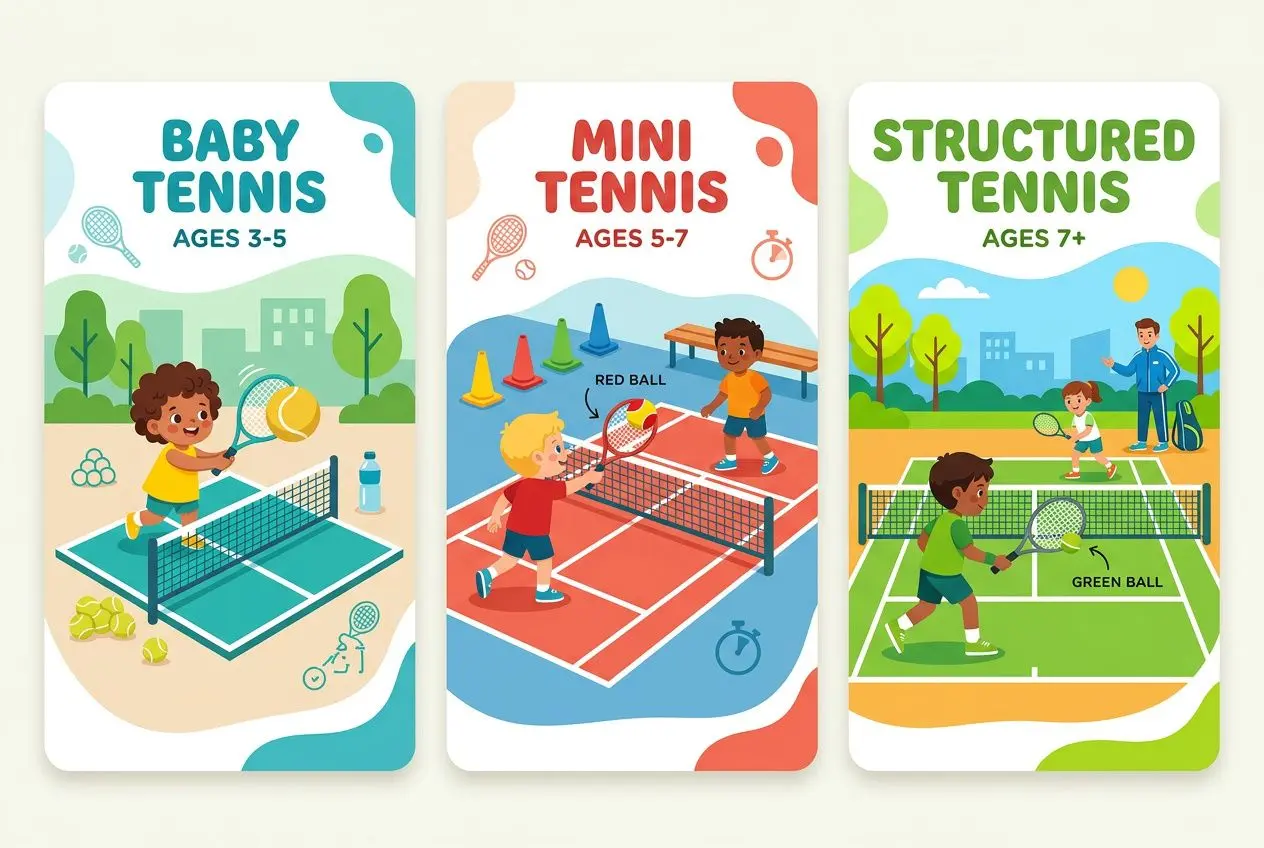
Baby tennis, mini tennis and structured lessons explained
- Baby tennis (ages 3–5) Game-based sessions on smaller courts using ultra-light foam balls; focused on balance, coordination, and enjoyment rather than technique.
- Mini tennis (ages 5–7) Reduced court dimensions and slower red-to-orange balls; more contact points per session help children read the bounce and move into position efficiently.
- Structured tennis (from age 8 or 9) Full-court play with green or yellow balls, introducing the five basic strokes and youth tournament competition for children with an established foundation.
That progression matters because mini tennis creates more useful repetitions per session. More contact points per session translate directly into better positioning and ball judgement before the court expands to full size.
| Programme | Age range | Ball type | Court size | Session length |
| Baby tennis | 3–5 years | Foam (ultra-light) | Very small | 30–45 min |
| Mini tennis (red) | 5–7 years | Red (75% slower) | Reduced | 45–60 min |
| Mini tennis (orange) | 7–9 years | Orange (50% slower) | Intermediate | 45–60 min |
| Structured tennis | 7+ years | Green / yellow | Full court | 60 min |
Choosing the right racquet and ball for your child’s age
The same principle applies to equipment. Age-appropriate tennis programmes only work properly when the racquet and ball fit the child’s height and strength, because an oversized frame quickly fatigues a small arm and interferes with sound technique.
Racquet length should be chosen by height: under 1 m, a 17–19 inch frame; between 1.35 m and 1.50 m, a 25–26 inch frame. A simple fit check helps at the start: when the racquet is held alongside the body with the arm hanging down, the head should sit about 5 cm from the ground.
By contrast, there is no need to buy everything straight away. Most clubs and leisure centres lend racquets and balls for tennis lessons, which keeps the first step into beginner or youth tennis low-risk.
Once a child settles into weekly lessons, a lightweight aluminium junior racquet is usually the sensible purchase. Tennis Scorer treats that as the practical point to invest: after the first sessions, not before.
Key signs your child is ready to start tennis
Age can help as a starting point, but it rarely gives the full answer. The clearer guide comes from a child’s movement, focus, and ability to cope with simple instruction in a group, because those signals show whether a first tennis class is likely to feel encouraging or frustrating.
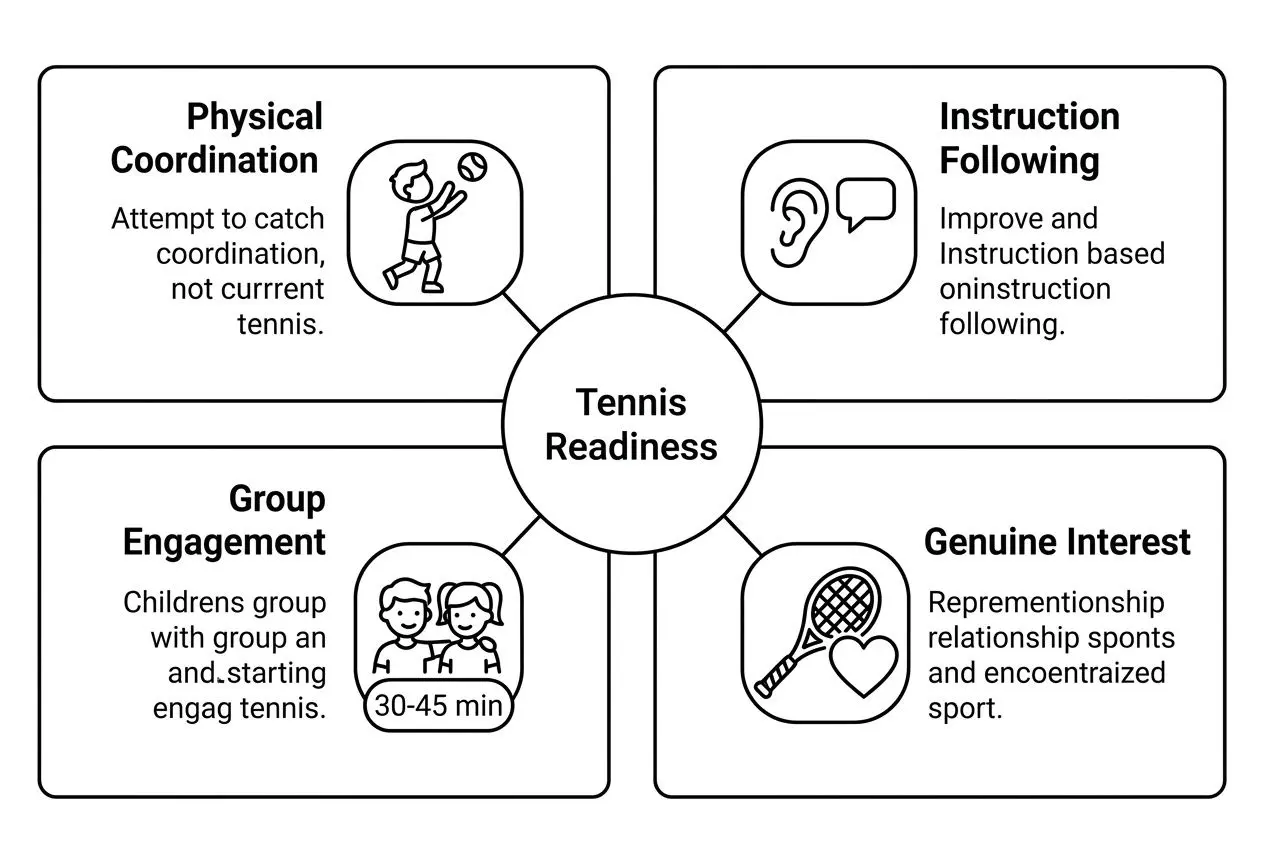
Physical and coordination readiness markers
That broader picture starts with movement. To start tennis at the right time, it helps to watch whether a child can run, stop, turn, and recover balance with reasonable control, while also managing a moving ball without losing footing.
- Balance and agility The ability to run and stop without falling shows enough leg strength and body control for basic court movement.
- Hand-eye coordination Catching or striking a moving ball, even in simple games, suggests the baseline needed to begin with a racket.
- Grip strength Holding a junior racket without strain matters; if it slips or drops repeatedly, a little more general play may help first.
- Sustained attention Staying engaged in a group for 30 to 45 minutes usually matches the demands of beginner tennis classes.
Grip and timing develop unevenly in young children. Some are ready to start tennis at four, while others of the same age need more time, and the difference comes down to physical comfort rather than enthusiasm alone.
Good coaching in tennis classes focuses first on ball judgement and positioning, because those skills support long-term tennis development more reliably than early attention to stroke shape.
Mental and emotional readiness for beginner lessons
Physical readiness only takes a child so far. Just as important is the emotional response: a child who smiles, wants to return, and picks up a racket without prompting is usually more ready than one attending only because an adult has arranged it.
In practice, children who want to be there cope better with mistakes, stay engaged for longer, and get more from a tennis class.
Tennis can ask a great deal of young children at once. A sensible coaching structure introduces tracking, movement, and contact in stages, which keeps the session manageable and supports steady tennis development from the early weeks onward.
Benefits of starting tennis early for child development
Early participation at the right stage can strengthen coordination, attention, and general fitness while giving children a structured setting in which to learn, benefits that extend well beyond sport-specific skill.
That carries beyond the court. Tennis Scorer sees those same classes as a setting for patience, resilience, and honest self-assessment, qualities that carry into youth tennis and beyond, whether a child continues into youth tennis or simply enjoys recreational sessions.
How to get your child started with tennis lessons today
The route from interest to a first session is usually straightforward. Across the UK, leisure centres, public parks, and tennis clubs run beginner tennis lessons for children with no previous experience, and most allow families to book online without locking into an annual contract from the start.
That makes it easier to start tennis early, with room to test whether the format suits the child before committing further.
What a beginner tennis course looks like week by week
A typical six-week beginner course gives young players a steady introduction, with each session building on the last and new skills added only when the basics are settling in.
An LTA-accredited coach can correct habits early and shape progress in a way self-teaching rarely can, especially in junior tennis.
- Weeks 1–2 (rallying and stroke introduction) Children begin with basic forehand and backhand rallying, then add volley technique and early shot development in the second week.
- Weeks 3–4 (positioning, scoring and serving) Week three introduces court positioning, followed by scoring and first serving practice in week four: the point where sessions begin to feel more like real tennis.
- Weeks 5–6 (doubles patterns and match play) The course then moves into doubles formations and simple tactical patterns, before finishing with supervised match play in week six.
A fixed weekly slot helps children settle into a rhythm. Early progress usually comes from regular attendance rather than intensity, and two sessions a week is generally enough without overloading other activities.
Finding the right club to start tennis for your child
That steady structure only works if the setting feels right. Finding a beginner tennis club means looking beyond the courts themselves, because a polished venue can still feel unwelcoming to children who are only just beginning kids tennis.
The difference comes down to signals: open days, clear explanations, patient staff, and a calm response when beginner mistakes happen. A club where newcomers are expected rather than merely accommodated is the better environment for children starting out.
From that point, atmosphere often matters more than facilities. Familiar faces, repeat routines, and a clubhouse that works as a social meeting point help turn tennis lessons into a habit, and Tennis Scorer recognises that these small anchors are often what keep young players engaged after the first term.
Supporting your child’s progress from the first lesson
That sense of belonging only deepens with the right kind of support at home. Encouragement tends to do more than technical correction at this stage, particularly for a child in beginner or early junior tennis coaching.
Regular attendance at similar times helps children settle, while simple questions after a session can protect motivation. Ask what they enjoyed, not what they need to fix.
Frequently asked questions
What is the ideal age to start tennis lessons for a child?
For most children, the ideal age to start tennis lessons falls between 5 and 7 years. At that stage, children usually have enough coordination, concentration, and basic rule comprehension for a structured class and effective coaching.
That said, readiness, however, matters more than age alone. Some young children can start tennis earlier through play-based kids tennis sessions from 3 to 4 years, while others begin playing tennis at 6 or 7 and progress just as well when they are developmentally ready.
Is 3 years old too early to begin playing tennis?
Age 3 is not too early to start tennis. In practice, programmes for children aged 3 to 5 use foam balls, smaller courts, and short tennis lessons of 30 to 45 minutes to build coordination and enjoyment before formal instruction begins.
From that point, formal tennis classes tend to work better from age 4 or 5. Grip strength, attention span, and basic movement skills are usually more established by then, which makes structured coaching more productive for a beginner.
How many tennis lessons per week should a young beginner attend?
For a young beginner, one or two weekly lessons are usually the right starting point. A consistent slot helps children settle into the routine, and weekly lessons give them time to absorb what they learn without overloading their schedule or energy.
More frequent tennis classes are rarely necessary at an early starting age, and consistency over volume is usually what drives early progress.