
Table of Contents
This guide covers every padel court setup requirement in England, from mandatory planning permission and structural dimensions to foundation standards, surface durability, and full cost breakdowns.
Planning permission for your padel court in England
In England, outdoor courts usually fall under Class F2(c) and indoor padel facilities under Class E(d): both typically require planning permission, and that position should be checked at the start of any padel project to avoid delays.
When is planning permission legally required?
That early check shapes the whole court installation process. All new padel court installation schemes and changes of use generally require planning permission in England, including in London, where local authorities apply the same national framework.
Approval often takes 4 to 8 weeks. By contrast, timings can extend when councils ask for environmental impact assessments, ecological mitigation plans, or design revisions alongside the initial CAD drawings, so site selection should account for planning risk from the outset.
Using a planning adviser before committing to a site helps identify likely objections early. Detailed guidance on padel court specifications and cost considerations also helps align the planning submission with the wider padel court project budget.
That same principle applies to existing buildings. Re-purposing a commercial property that already has Class E consent may not require a formal change-of-use application, but the position should still be confirmed with a qualified planning adviser before spending is approved.
Greenfield schemes add another layer. They must address Biodiversity Net Gain as part of the application, and omitting an ecological mitigation plan remains one of the most common reasons proposals stall or fail.
Noise, light, and environmental assessment obligations
Once use class and site status are clear, assessment duties come into focus. Noise and light surveys are often required for a padel court near housing, especially where homes are within 50 metres of the proposed site, whether the setting is urban or rural.
These requirements closely reflect those for tennis courts: local context and supporting evidence determine the outcome, not a separate planning regime.
Those surveys sit outside the main contractor price and should be allowed for from the outset. A thorough overview of the padel court specifications involved at each stage helps operators anticipate where extra reports may be needed during padel court installation.
- Floodlighting consent: Outdoor courts with 6-metre floodlights in residential areas need formal written council approval before erection.
From that point, booking contractors becomes a sequencing issue. All approvals should be fully in place before groundworks are instructed, because early commitments can expose the client to contractual risk and extra cost if amendments are later required.
Leasehold and covenant considerations for padel sites
Restrictive covenants can prohibit noisy activity or disturbance to neighbouring land, making an otherwise suitable site unworkable, so solicitors should review title documents early.
For that reason, legal checks must therefore run alongside design and installation planning, not after spending has been approved.
Leasehold sites need the same discipline. The headlease must allow structural alterations, and consent from a superior landlord may also be needed before a padel court can proceed.
User clauses should be read carefully as well: they need to cover sport, hospitality, and retail if the scheme is expected to support revenue streams such as a café or equipment shop. Annual rent may be fixed or turnover-based, with turnover arrangements often easing early pressure on new padel facilities.
Padel court dimensions and structural specifications
Structural compliance starts with exact dimensions. A standard padel court measures 20 metres by 10 metres, around 25% smaller than a tennis court, which makes it suitable for urban sites, retrofit schemes, and other sports facilities where space is tight.
For a compliant padel court installation, every component is defined: enclosure height, material zones, access points, spacing, and net geometry all form part of the required padel court specifications, and any departure can lead to failed inspection, invalid warranties, and problems at handover.
Court size, enclosure height, and glass thickness
With the court footprint established, the enclosure follows a fixed format across England. The playing area remains 20 m × 10 m, enclosed to a total height of 4 metres: the lower 3 metres in tempered glass, transparent or solid, and the upper metre in rigid 50 mm × 50 mm galvanised steel mesh with the horizontal face set forward for consistent rebound.
- Outdoor glass thickness: 12 mm toughened glass is mandatory for outdoor padel courts; using a thinner panel can fail safety inspection and void supplier warranties.
- Indoor glass thickness: 10 mm toughened glass is permitted for an indoor padel court where wind load pressures are absent.
- Enclosure structure: The enclosure is fixed at 4 metres overall, with 3 metres of tempered glass below and rigid galvanised steel mesh above.
- Steel frame specification: Laser-cut galvanised steel box sections rated for 80 mph winds are standard for external court installation, while coastal or highly exposed sites require a 98 mph rating.
Those figures are not optional. In practice, reducing the glass thickness or lowering the enclosure height does more than affect play: it can invalidate the compliance certificate and leave a commercial padel facility uninsurable.
Net, access, and multi-court spacing requirements
Once the enclosure is defined, internal layout and circulation come next. The net must be exactly 10 metres wide and 0.88 metres high at the centre, with the same requirement applied across regulated English venues, whether the scheme is an indoor padel court installation or part of a wider external development.
- Player access openings: Each side requires an 8 m × 2 m opening, configured as single or double, for any permanent padel court installation.
- Wheelchair access: Accessible layouts require a minimum 1.2-metre clear entry width between net post and enclosure.
- Multi-court gap: Adjacent courts must be separated by 1.5 metres, with a 400 mm surface ring beam on all sides.
- Indoor spacing: Side fence to hall wall requires at least 2.0 metres, while back glass to hall wall requires 2.0 to 3.0 metres, subject to confirmation by the fire consultant and local authority.
As a result, site planning has to be realistic from the outset. A two-court indoor padel facility will usually need a hall width of about 24 metres to fit both courts and the required run-off zones.
Foundation ring beam and wind-load standards
That same principle applies below ground. Every padel court requires a 400 mm reinforced concrete ring beam, designed and signed off by a structural engineer to suit local ground conditions, because it forms the sole fixing point for the posts and framed glass system.
If the beam is out of tolerance, the enclosure cannot be fixed correctly, and the entire court installation is put at risk before the surface system is even laid.
By contrast, wind-load requirements depend on exposure. As a result, using the lower 80 mph rating on a coastal or permanently exposed site is likely to fail compliance checks and lead to expensive remedial work before the padel facility can open.
Padel court surfaces, foundations, and durability
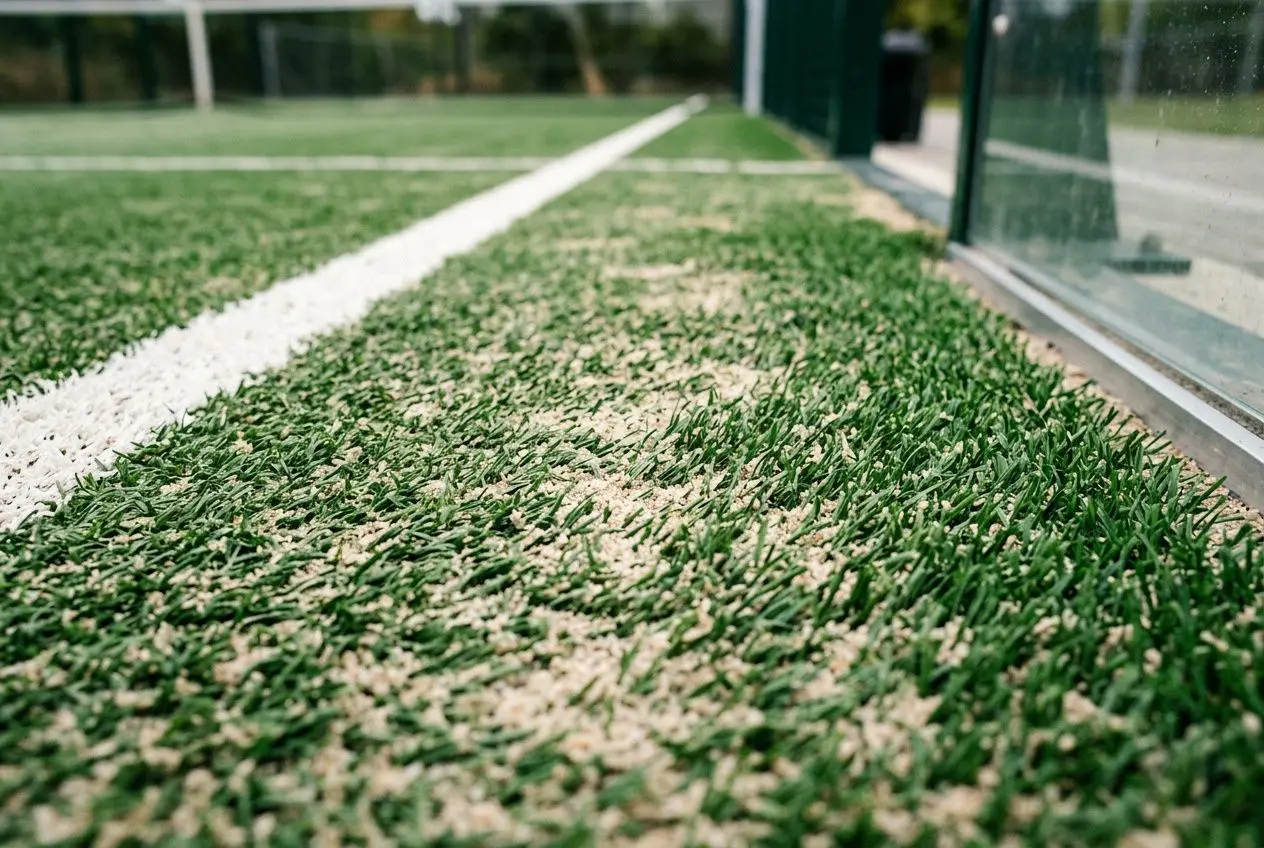
The playing layer matters. So does everything beneath it. For a padel court in England, the accepted build-up is clear: sand-dressed artificial turf laid over a load-bearing reinforced concrete base, with both specified accurately if the court is to perform well over time.
The foundation slab, drainage, and surface preparation
That long-term performance starts with the slab. Anyone installing padel courts needs a concrete base of at least grade C25/30 and a minimum thickness of 12 cm: the surface must be hard, stable, and free from floating materials such as carpet or vinyl, with no more than 3 mm deviation across any 3-metre span.
Once that is established, defects have to be dealt with properly. Cracks, dents, and uneven areas in an existing slab should be repaired before installation begins, while expansion joints need sealing with high-modulus PU joint fillers; a floor survey must also identify hidden services, including water pipes, electrical lines, gas pipes, and underfloor heating, before drilling to around 10 cm depth.
From that point, drainage becomes decisive. For outdoor installation in the UK climate, the gradients must be set before the first post goes in, because standing water will shorten the life of the turf and poor drainage commonly leads to groundwork failure within five years. In practice, the initial drainage investment is modest compared with the cost of later remedial works.
How long do padel court surfaces last?
Durability depends on build quality, maintenance, and whether the system is intended as a permanent installation or a temporary solution.
A modular pop-up floor can suit short-term use, and some of the same logic applies to a temporary padel format. By contrast, neither format satisfies ITF or national federation surface specifications required for licensed competition in England.
With proper construction and care, a full padel court typically has a service life of around 20 years. The turf layer usually lasts 8 to 12 years, provided maintenance is consistent: brushing, decompaction, infill control, and debris removal all help preserve ball response, grip, and player safety.
Ongoing care should be budgeted realistically. Annual maintenance generally sits at £400–£500 per court, covering turf work, drainage inspection, lighting checks, and seasonal structural reviews, which helps protect the value of the installation and maintain compliance standards across insured sports facilities.
Indoor height requirements and temporary solutions
Once the surface and sub-base are resolved, indoor design brings a different constraint. Installing padel indoors requires a fully enclosed hall with closed walls on every side, since open or substantially open elevations usually lead to the court being treated as outdoor for regulatory purposes.
Ceiling height then becomes central. The technical target is 8.0 metres of clear height above the centre net area so that lobs can be played without restriction; below that point, play remains possible, but the difference comes down to how much overhead freedom the venue can provide.
- 8.0 m and above: Full unrestricted play and lob use; aligned with federation expectations for competitive and tournament-level events.
- 7.0–8.0 m: A common commercial compromise; recreational play remains comfortable, though stronger players will notice limits on higher lobs.
- Below 7.0 m: Courts can still be installed, but lob restrictions become significant; generally suited to beginner and recreational use.
- 6.8 m and below: Advanced lobs are regularly lost to ceiling contact, and most federations regard this height as unsuitable for official competition.
As a result, building layout has to be resolved early. In warehouse conversions for a padel facility, the column grid must allow for the full 20 m × 10 m court as well as the required run-off zones, while the roof condition, ventilation, temperature control, and glare-free lighting should all be addressed during planning rather than after installation.
Build a padel court in England: costs and timelines
The cost of padel court construction in England shifts with the project type: outdoor or indoor, single or multi-court, new-build or conversion. Any serious budget for building a padel court needs to cover groundworks, drainage, structure, surface, lighting, and maintenance from the earliest planning stage.
Padel court construction costs and budget breakdown
A basic outdoor padel court usually starts between £45,000 and £60,000 including standard lighting, while a fully specified indoor court generally falls between £60,000 and £80,000 because roofing, insulation, and stronger lighting requirements add cost. For a new outdoor site, a single court with full groundworks and drainage typically reaches about £71,000; four fully specified outdoor courts reach about £268,000.
- Outdoor single court: £45,000–£60,000 including standard lighting; approximately £71,000 with full groundworks and drainage.
- Indoor single court: £60,000–£80,000 due to roofing, insulation, and upgraded lighting requirements.
- Conversion route: re-using a sound existing tennis court base reduces costs to £30,000–£50,000.
Canopies sit outside the core court installation budget. Covering one court adds about £75,000, while a four-court canopy reaches around £220,000. These structures usually require a separate planning review and input from a structural engineer, distinct from the main installation.
| Cost element | Typical range |
| Foundations and ground preparation | £5,000–£15,000 |
| Glass and steel structural frame | £20,000–£35,000 |
| Artificial turf system | £4,000–£9,000 |
| Shock pads | £2,500–£6,000 |
| Installation labour | £10,000–£20,000 |
| LED floodlighting | £3,000–£15,000 |
| Complete surfacing package | £12,000–£25,000 |
| Canopy structure (optional) | £75,000–£220,000 |
Installation stages and realistic project timelines
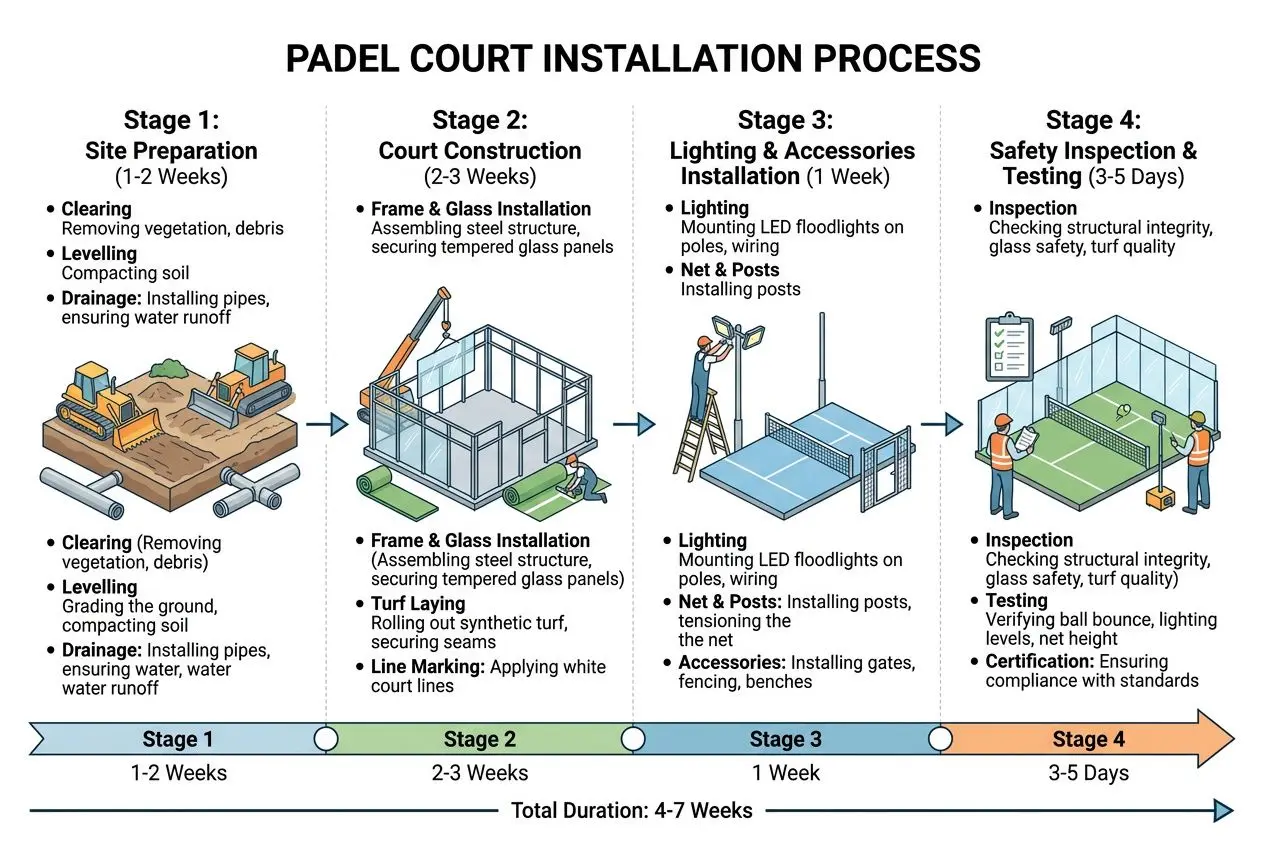
On a new outdoor site, padel court installation normally runs for about 10 to 14 weeks from ground break to handover. The longest part is rarely the visible build: foundation preparation and groundworks usually take 6 to 8 weeks before padel elements can be installed, because concrete curing controls the schedule more than frame assembly does.
From that point, progress accelerates. Once the slab has fully cured, physical assembly of the padel court takes only 2 to 4 days, although a standard outdoor court installation still runs for a further 4 to 6 weeks from machinery arrival to completion. In practice, delays usually come from underestimating the groundwork phase rather than the steel-and-glass build itself.
- Stage 1, Site preparation: clearing, levelling, drainage installation, and 400 mm concrete ring beam casting.
- Stage 2, Frame and glass erection: steel frame assembly, tempered glass panel fitting, and perimeter enclosure completion.
- Stage 3, Surface and marking: artificial turf laying and court line marking to regulation specification.
- Stage 4, Lighting and final fit-out: LED floodlight installation, net post fixing, scoreboard attachment, and formal lux test.
Accessories are normally added at the final fit-out stage. Tennis Scorer’s double-sided padel score board, sized 60 cm × 80 cm, is made from weather-proof PVC and remains readable from more than 50 metres, a practical addition requiring no extra structural work. It attaches to the fence with four serflex fasteners and carries a five-year warranty. Check the full padel score board specification for attachment and advertising panel options.
Final inspections, compliance, and court accessories
A formal safety inspection and a signed structural compliance certificate from a certified engineer are both mandatory before the court can be accepted, and final payment should only be released after those checks have passed.
The same principle applies earlier in the process. All planning approvals should be fully cleared before engaging the groundworks contractor, because booking too early creates contractual risk if the local authority requires amendments to the padel facility design.
Frequently asked questions
Do I need planning permission for installing a padel court in England?
Yes. Installing a padel court in England generally requires planning permission, whether the project involves padel court construction from the ground up or a change of use.
Outdoor courts usually fall within Class F2(c), while an indoor padel court is typically treated as Class E(d). There is one limited exception: where an existing commercial property already benefits from Class E consent, a change may be more straightforward. Even then, Tennis Scorer recommends early confirmation from a planning adviser before any money is committed.
Approval commonly takes 4 to 8 weeks. By contrast, the timetable can stretch when supporting documents are needed: noise surveys, lighting assessments, or ecological reports.
What are the standard dimensions and space requirements for a padel court in the UK?
The standard padel court size is fixed: 20 metres long by 10 metres wide. Around the playing area, the enclosure reaches 4 metres in height, made up of a 3-metre tempered glass section below and a 1-metre steel mesh section above.
The net must be exactly 10 metres wide and 0.88 metres high at the centre. For multi-court layouts, a 1.5-metre gap between neighbouring courts is required, and an indoor padel court needs at least 2.0 metres between the fence line and any hall wall.
A 400 mm concrete ring beam should run continuously around the perimeter, with the design and certification completed by a structural engineer.
How much does padel court construction cost in England?
To build a padel court outdoors, a single court usually falls between £45,000 and £60,000 including standard lighting, rising to about £71,000 once full groundworks are included.
An indoor padel court generally costs £60,000 to £80,000 because roofing and insulation add to the build. For larger schemes, two outdoor courts side by side typically come in at £85,000 to £120,000, while four courts reach around £268,000 at full specification.
In practice, the most economical route is often converting an existing sound tennis court base. That can reduce the total for installing a padel court to roughly £30,000 to £50,000. Annual maintenance sits outside those figures and should be allowed for separately: £400 to £500 per court each year.