
Table of Contents
This article covers every component of the padel court cost to build UK projects involve, from groundworks and glass walls to planning permission and LTA funding, giving developers and club operators a complete financial picture before any build commitment is made.
How much does it cost to build a padel court in the UK?
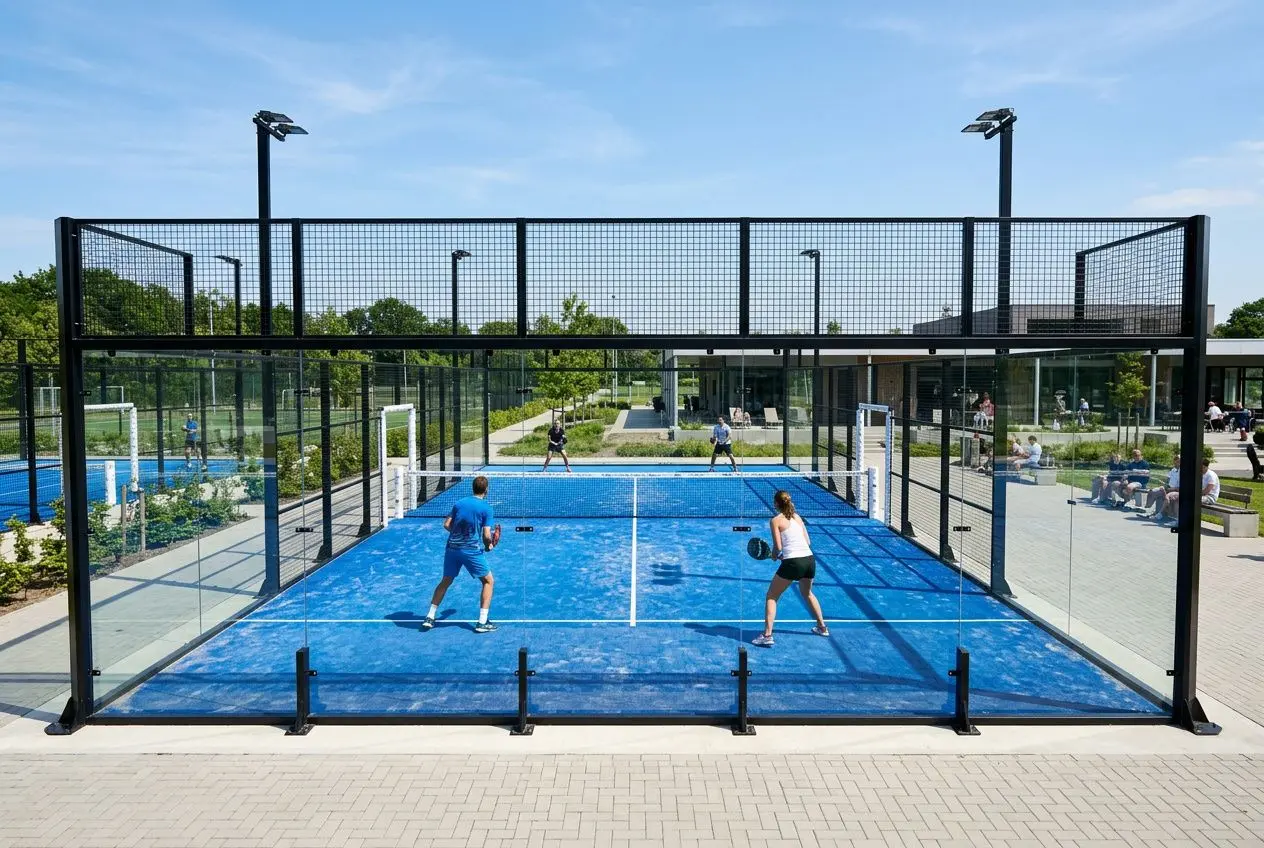
To build a padel court in the UK, the starting point is always the same: structural compliance and site planning. Standard requirements include a 20 m × 10 m playing area, 12 mm tempered glass walls for outdoor use, a 400 mm concrete ring beam foundation, and LED lighting before installation can begin.
That baseline shapes the court cost. Indoor schemes usually sit above outdoor ones because roofing, insulation, and enclosed lighting add further construction requirements.
Cost breakdown by court type and configuration
Once the specification is fixed, the difference comes down to court type, layout, and site complexity. Padel court installation UK costs typically range from £45,000 for a single outdoor court to more than £270,000 for a larger indoor scheme.
- Single outdoor court: £45,000–£60,000 including standard lighting and full infrastructure; around £71,000 once all groundworks are included.
- Single indoor court: £60,000–£80,000 because an indoor court needs additional roofing, insulation, and upgraded lighting compared with an outdoor padel specification.
- Multi-court installations: Two outdoor courts cost £150,000–£170,000 + VAT; four courts reach about £268,000, with a canopy adding £75,000–£220,000 depending on enclosure type.
Across most schemes, the main spend sits in the enclosure and the labour needed to assemble it accurately. Core materials, including artificial turf, tempered glass panels, and the galvanised steel frame, account for £20,000–£30,000 per court, while professional installation labour adds £15,000–£25,000.
What affects the overall padel court installation cost?
From that point, site conditions become the variable that matters most. Groundworks can change the padel court cost quickly, especially where drainage is poor, access is tight, or the base needs substantial correction before installation.
For an outdoor court, foundation and drainage preparation usually adds £5,000–£10,000. Lighting is another fixed requirement rather than an upgrade: LED floodlights for evening play generally cost £3,000–£6,000, while fencing and surrounding structures add £2,000–£4,000 to the overall budget.
| Cost component | Typical range |
| Core materials (turf, glass, steel frame) | £20,000–£30,000 |
| Professional installation labour | £15,000–£25,000 |
| Foundation and drainage preparation | £5,000–£10,000 |
| LED floodlighting | £3,000–£6,000 |
| Fencing and surrounding structures | £2,000–£4,000 |
| Canopy covering (optional) | £75,000–£220,000 |
By contrast, an existing hardstanding can reduce preparation costs sharply. Using a former tennis court or similar tarmac base may allow anchor point fixing instead of full excavation, which lowers the court installation bill and speeds up padel court installation by several weeks in practice.
For a broader view of specifications and sequencing, the full guide to padel court specifications sets out the practical stages of installation in more detail.
Padel court planning permission uk requirements
Planning permission must be secured before any padel court installation project moves forward, applicable to new sites and changes of use alike. Contractors typically exclude planning fees from quotations: budget separately for the application itself, and for any noise or light surveys the local authority may require.
Timing matters here. Planning permission commonly takes 4–8 weeks, although the period can extend where local authorities request extra reports or design amendments during preparation.
Additional requirements may follow from the site context: noise and light surveys are often needed where homes sit within 50 metres, and greenfield schemes must address Biodiversity Net Gain rules. As a result, early planning support can reduce the risk of resubmissions, delays, and avoidable cost increases.
From that point, VAT treatment and base design decisions should be confirmed before any contractor quotation is accepted. Tennis Scorer treats those early-stage decisions as central to realistic budgeting, especially where indoor and outdoor routes are still being compared.
Padel court grants UK and LTA funding options explained
How LTA funding for padel works in practice
The LTA Quick Access Loan Scheme remains one of the clearest routes in the UK padel funding landscape: in some cases, the available amount covers the full cost of installing a padel court without major upfront pressure.
- Loan range: £25,000–£250,000 interest-free, enough to fund a single outdoor court or support a larger multi-court scheme.
- Eligible applicants: Registered tennis and padel clubs, community organisations, and bodies that meet LTA governance requirements; purely commercial applicants may not qualify.
- Repayment benefit: Interest-free terms can spread a £45,000–£60,000 single-court project over several years, easing cash flow for smaller clubs.
Membership status, governance, community access, intended use, VAT treatment, and wider site requirements all affect whether LTA funding for padel is available and how much can realistically be borrowed.
Alternative funding routes beyond the LTA
Once those limits are clear, other finance options come into view. Where padel court grants UK schemes or LTA support do not apply, most often for private commercial developments, operating leases and hire purchase agreements can provide a practical route to delivery.
- Operating lease: Spreads court construction costs across a fixed term, helping preserve capital for staffing, marketing, maintenance, and launch activity.
- Hire purchase: Supports long-term ownership, with transfer at the end of the agreement; suited to venues that plan to retain the asset for years.
- Supplementary grants: Local authority sports funds, Sport England small grants, and county sports partnership support may strengthen community-led applications.
By contrast with a single-source finance model, mixed funding can reduce initial outlay. A loan may cover the base build, while leasing supports extras such as lighting, scoreboards, and related equipment supplied through padel court manufacturers.
That combined approach is especially relevant for organisations balancing planning costs, site works, and compliance. Reviewing all available padel court grants UK options before signing contracts is recommended, particularly for commercial projects where VAT, supply terms, and installation sequencing can materially affect the true cost of installing a padel court.
How to build a padel court step by step in the UK
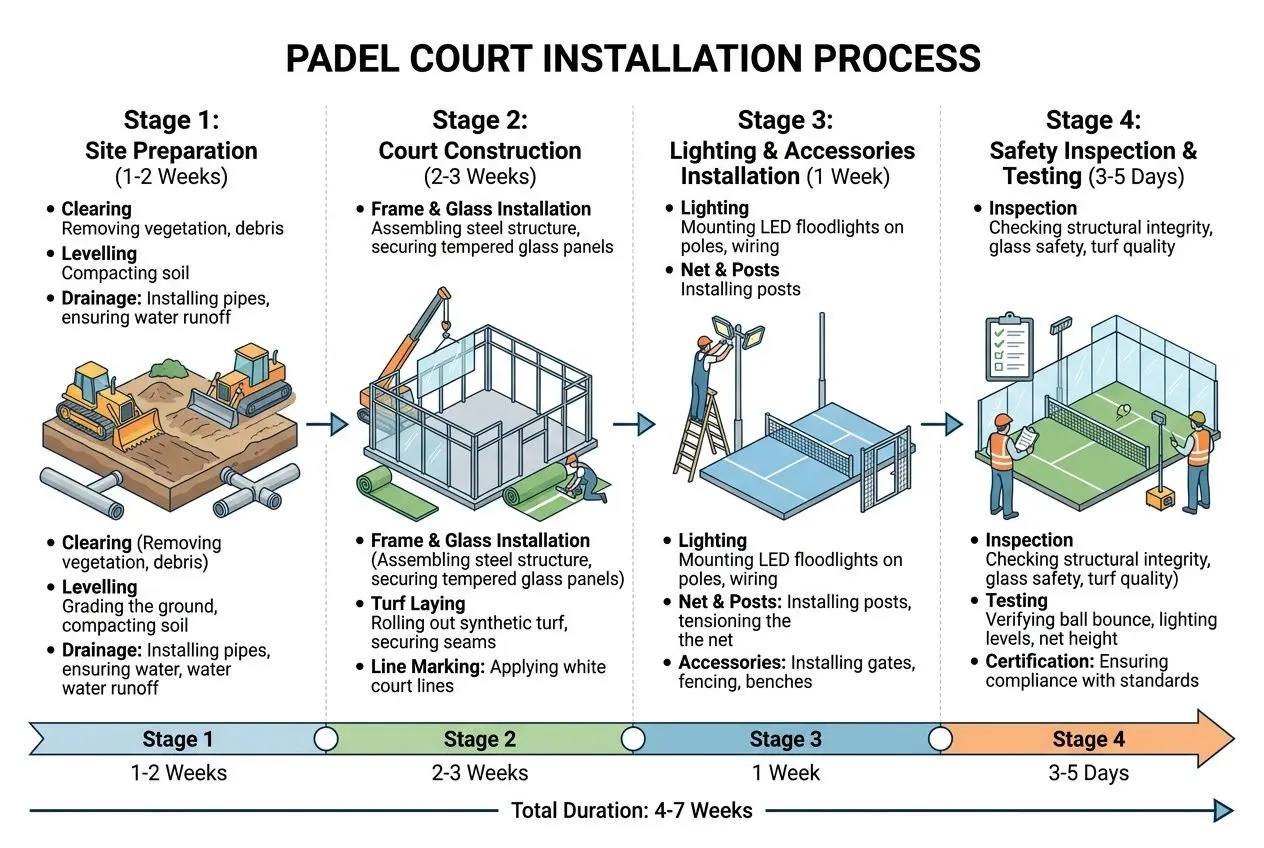
To build a padel court in the UK, the sequence is clear: site assessment, planning, engineering, court construction, and certified sign-off. Each stage affects the padel court cost, the wider budget, and the final handover, so cutting time too aggressively usually creates compliance issues rather than savings.
Site preparation, base design and foundation requirements
Securing padel fund backing before work begins helps operators fix specifications early and avoid mid-project changes during planning. In practice, that gives contractors and manufacturers a stable brief from which to finalise specifications without mid-project revisions.
- Ground clearing and levelling: Essential on every site; uneven ground increases drainage complexity and can push court cost beyond the standard £5,000–£10,000 range for this part of the work.
- 400 mm concrete ring beam: A structural requirement in padel court construction; local soil conditions determine the final specification after engineer assessment.
- Drainage installation: Critical for outdoor padel and any other outdoor setting in the UK climate, where standing water can damage the surface over time.
- Wind load compliance: Galvanised steel box sections should be rated for 80 mph winds as standard; coastal locations typically require a 98 mph specification identified during the initial assessment.
From that point, the difference comes down to sequencing. Glass walls, steelwork, surfacing, lighting, and perimeter elements can only be fitted once the slab has cured and the engineer has approved the groundworks and base.
Physical assembly is comparatively quick: installing a padel court usually takes 2–4 days once the slab is ready. The longer lead time sits earlier in the programme, with preparation, planning, and groundworks often taking 6–8 weeks before installation starts.
Construction timeline from planning to handover
That early lead time is what shapes the programme. Whether the project stands alone or forms part of a larger commercial scheme, planning approval is often the slowest stage rather than the build itself.
Council approval commonly takes 4–8 weeks. The design and planning phase may also include surveys, neighbour consultation, SAPCA-aligned specifications, and other local requirements that affect both scheduling and budget.
Once the site is ready, timelines split by format. Indoor projects generally take around 2 weeks for court installation after the main shell is complete, while outdoor padel schemes more often run to 6–8 weeks because external works, drainage, and weather exposure add complexity.
Before handover, a formal safety inspection and a signed structural compliance certificate from a certified engineer are required. On court, that means final payment should only follow once the installation has passed the relevant checks.
Maintenance costs and long-term return on investment
With compliance certified and handover complete, running costs are usually straightforward to forecast. Annual maintenance typically sits at £400–£500, covering cleaning for the surface, fencing, and glass walls, while artificial grass generally needs replacement every 5–7 years.
Once that baseline is established, lighting should also be inspected each year to maintain performance and safety compliance, whether the facility is indoor or outdoor. A well-specified facility can generate income through memberships, tournaments, and pay-and-play use, which is why Tennis Scorer treats court cost and padel court cost as infrastructure decisions rather than short-term spend.
From that point, Tennis Scorer positions court cost as infrastructure spend precisely because a well-specified build, matched to site conditions and operating scale, is what sustains revenue over the long term.
Frequently asked questions
How much does it cost to build a padel court in the UK?
For anyone looking to build a padel court in the UK, the padel court cost depends first on format: outdoor or indoor, single site or multi-court project. A single outdoor padel court typically starts at £45,000 to £60,000, with lighting included as part of the standard installation.
By contrast, an indoor court usually sits between £60,000 and £80,000 because roofing and insulation add to the technical requirements. On larger schemes, costs rise quickly: two outdoor courts generally come in at £150,000 to £170,000 plus VAT, while a four-court indoor facility with bespoke canopies can exceed £270,000 overall.
From that point, the difference comes down to site preparation. Foundation preparation, drainage, and any canopy covering are the main variables beyond the core court construction.
Do I need planning permission to build a padel court in the UK?
Before those figures firm up, planning permission must be secured for every padel court installation, including new builds and changes of use on existing land. In practice, councils usually need 4 to 8 weeks before approving court installation works, so planning should start well before any groundwork begins.
Noise and light surveys may be required where residential properties sit within 50 metres of the proposed outdoor or indoor court location, and those planning permission costs are normally separate from contractor quotations. As a result, the full project budget should account for both construction and survey-related approvals.
Are padel courts profitable in the UK?
With planning permission secured and those survey costs budgeted, the commercial case becomes easier to judge. Padel courts can produce solid income through pay-and-play bookings, membership models, and tournament use.
Running costs remain relatively modest: annual maintenance is typically £400 to £500 per court. As a result, a well-run site can improve the value of the host property while keeping ongoing requirements manageable across both outdoor and indoor facilities.
The right choice when assessing viability is to look at funding as well as revenue. The LTA Quick Access Loan Scheme offers interest-free loans from £25,000 to £250,000, reducing upfront capital pressure and helping a commercial project reach break-even within a realistic timeframe after court installation.