
Table of Contents
This guide covers the official tennis net height in metres: 0.914 m at the centre and 1.07 m at the posts. It also explains the measurements, components and adjustment steps required to install or verify a regulation tennis court net.
Official tennis net measurements
These measurements provide the correct starting point for installation and inspection.
Standard height in metres
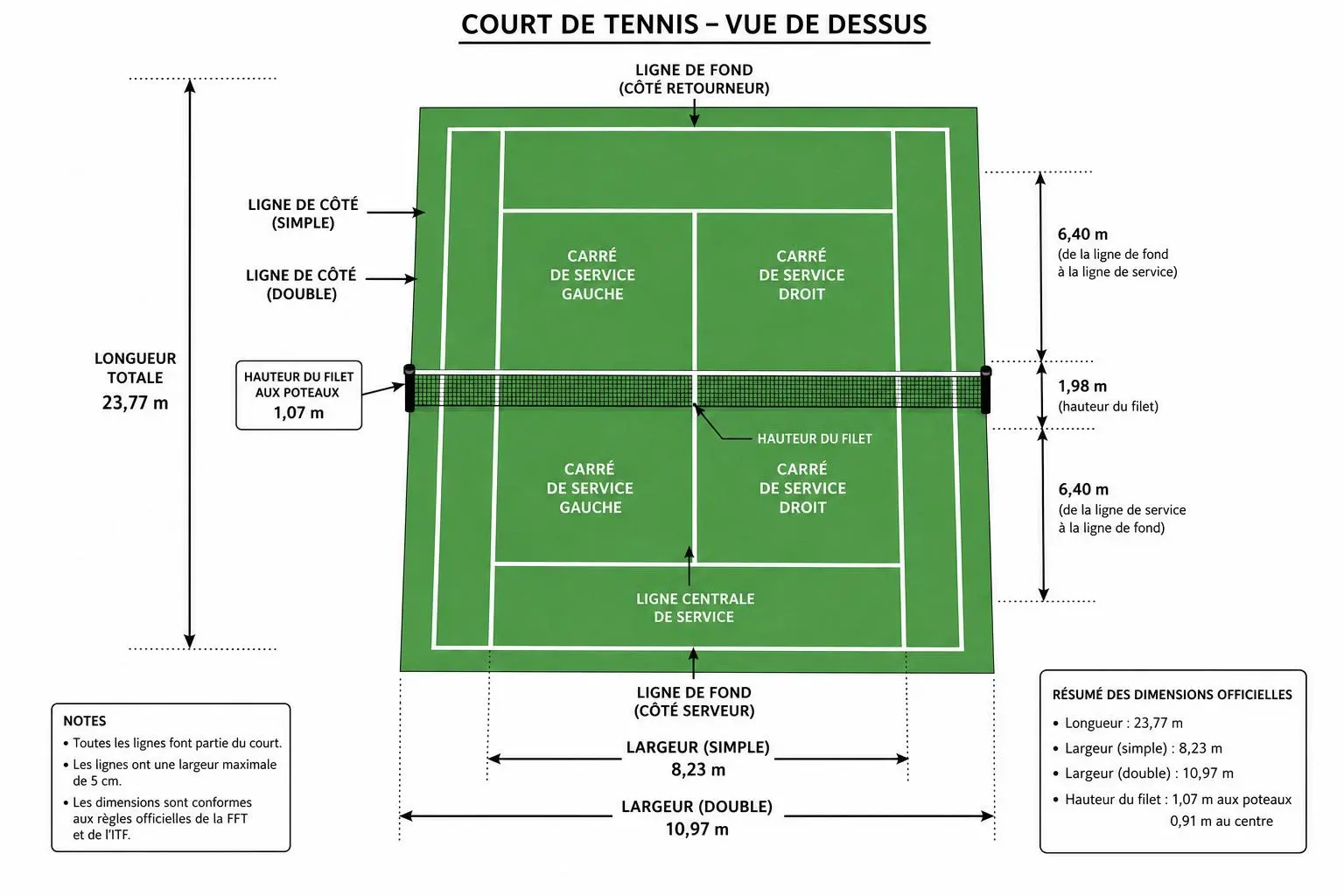
The official tennis net height in cm is 91.4 cm at the centre and 106.7 cm at each post.
- Centre height: 0.914 m (91.4 cm), held by the white centre strap anchored to the court surface.
- Post height: 1.07 m (106.7 cm) at each net post, controlled by the winder or reel mechanism.
- Surface rule: Net height remains identical on grass, clay, hard court and carpet; no adjustment is required when changing surfaces.
The standard net has a total length of 42 feet (12.8 m), extending 3 feet beyond each doubles sideline for full court coverage.
| Measurement point | Metres | Centimetres | Feet / Inches |
| Net posts | 1.07 m | 106.7 cm | 3.5 feet / 42 inches |
| Centre (strap) | 0.914 m | 91.4 cm | 3 feet / 36 inches |
| Difference | 0.153 m | 15.3 cm | 0.5 feet / 6 inches |
| Net total length | 12.8 m | 1,280 cm | 42 feet |
Why the centre sits lower
The white centre strap pulls the net down and anchors it to the ground, creating the familiar dip across every tennis court. That dip is a deliberate feature of tennis net height regulation, not an assembly fault. The official tennis net height in inches guide confirms that the 6-inch difference between the post and centre measurements is an ITF specification.
The lower middle changes the geometry of shots crossing the net. A 91.4 cm centre line demands accurate spin and trajectory, particularly when players use lower ball paths. A net set too high disrupts that balance and makes routine groundstrokes unnecessarily demanding.
Singles and doubles settings
The official tennis net height is the same for singles and doubles play; only the court width changes. In doubles play, post centres sit 0.914 m outside each doubles sideline. For a single match played on a doubles court, singles sticks at the singles sideline restore the correct 1.07 m post height.
This distinction matters on courts used for both formats. Without singles sticks, the net can sag at the sideline and create an uneven profile, affecting serve accuracy and officiating decisions. For dual-use installations, storing a pair of singles sticks courtside is standard practice.
Tennis court net components
A regulation net depends on several connected components, each with its own ITF requirement. The cord or metal cable runs along the upper edge and must sit at exactly 1.07 m above the ground at the posts. Their condition determines how reliably the net maintains its required measurements during play.
- Centre strap: Completely white and no more than 5 cm wide, it holds the middle at exactly 91.4 cm and should be replaced when the webbing shows wear.
- Headband / top band: A white band folded over the cord or cable along the full upper edge; its depth must measure between 5 cm and 6.35 cm on each side.
- Mesh: Fine enough to prevent a tennis ball from passing through at any point along the net’s full length.
- Post winder: Controls overall net tension separately from the centre strap; uneven tension across the two poles can produce different post heights.
Replace the centre strap and its ground anchor together. A new strap fitted to a worn anchor can create uneven lower-edge tension and allow the middle to rise above the proper height of 91.4 cm during regular play. For the complete centimetre-by-centimetre specification, consult the official guide to tennis net height in centimetres page.
Frequently asked questions
What is the official tennis net height in metres at the centre and at the posts?
The ITF sets the official tennis net height at 0.914 metres (91.4 cm) in the middle and 1.07 metres (106.7 cm) at each post. The 0.153 m difference is created by the white centre strap, which pulls the net down towards the court. Net height remains the same on every court surface and applies to both singles and doubles play, with no adjustment to the vertical measurements. Before competitive play begins, an aluminium net-height gauge checks the two posts and the centre to confirm that each measurement meets the required standard.
Why is the net lower in the middle than at the posts?
A white centre strap, anchored to the court and no wider than 5 cm, draws the middle of the net down to exactly 0.914 m. This dip is required by the rules; it is not a sign of incorrect assembly or a worn net. On court, that means a ball crossing near the middle clears a lower line: 91.4 cm rather than 106.7 cm. The six-inch difference, defined in metres as 0.153 m, balances ball trajectory, court fairness and the visual geometry of the tennis court. If the strap loses tension and the middle rises, shot dynamics change, which can affect serve trajectories and referee calls.
Do tennis net dimensions differ between singles and doubles matches?
The vertical measurements are identical in both formats: 1.07 m at the post and 0.914 m at the centre. No change is required when moving between singles and doubles. The structural difference concerns post positioning: in doubles, poles sit 0.914 m outside each doubles sideline; for a singles match played on a wider doubles court, singles sticks placed on the singles sideline support the net at the correct 1.07 m. Without those sticks, the net sags at the sideline and no longer meets the required sports regulation. Tennis net dimensions—including post height, centre height and the total length of 12.8 m—remain fixed regardless of the format in play.