
Table of Contents
This article details the tennis net height in cm at the centre and posts, with practical guidance from the tennis net accessories guide. It covers accurate measurement, strap adjustment and dependable hardware for a match-ready court.
Official tennis net height in centimetres
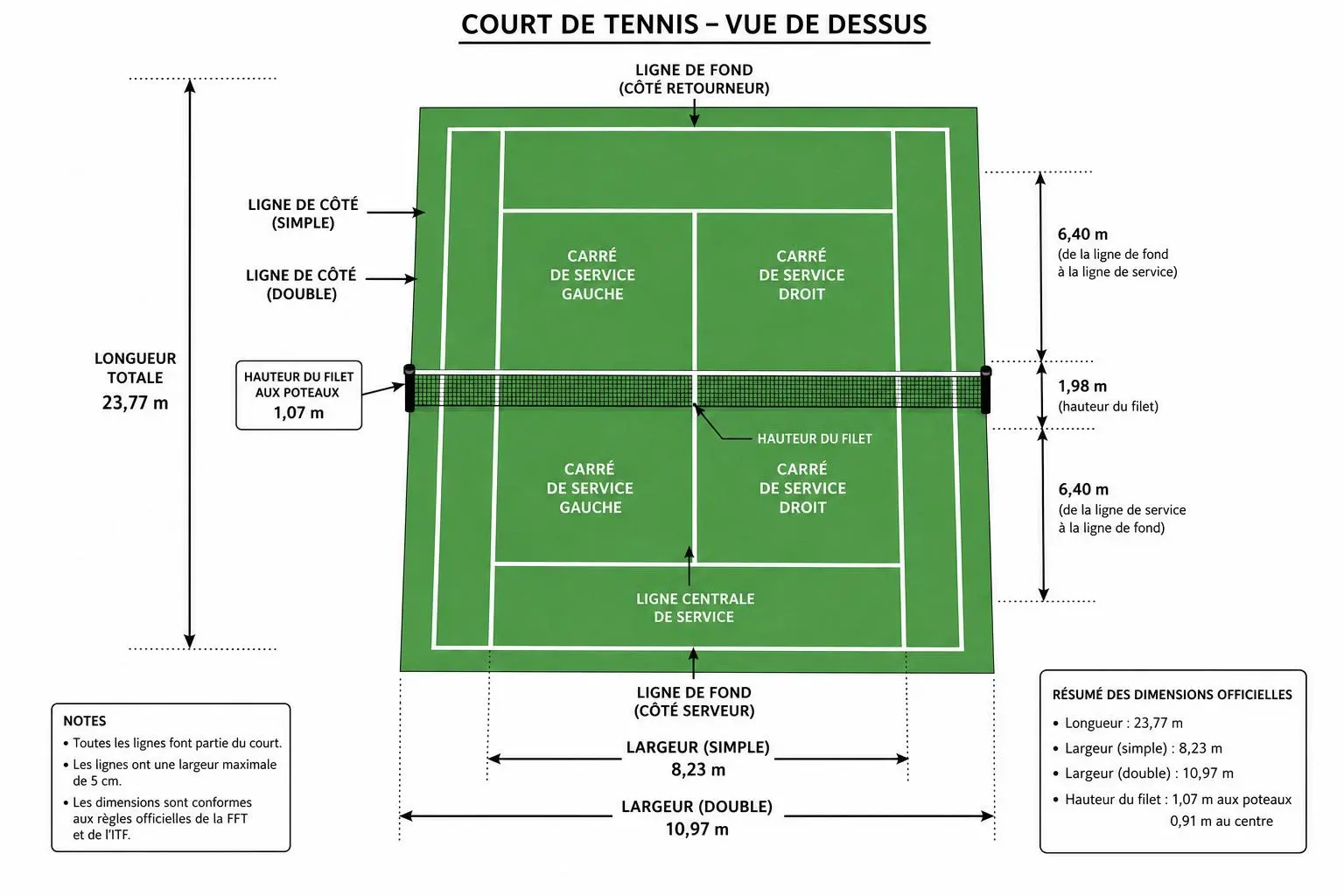
The ITF fixes one standard for all match formats: 91.4 cm at the centre, 106.7 cm at the posts. Precise setup matters whether the court hosts competitive or recreational tennis.
Centre and post measurements
Reading should begin at both reference points, not at one. The white centre strap holds the middle at 91.4 cm, the poles stand at 106.7 cm, and the 15.3 cm span between them produces the regulation shape.
- Centre height The official measurement at the middle of the net is 91.4 cm (0.914 m), regulated by the ITF and maintained by the white centre strap.
- Post height Each net support must reach 106.7 cm (1.07 m), providing the elevated anchor from which the net cord extends across the court.
- Singles and doubles The height of the tennis net is identical in both formats: 91.4 cm at the centre and 106.7 cm at the posts. Only the court width and net support structure differ between a doubles tennis net and a singles configuration.
- Measurement units The ITF also publishes the values in metric equivalents: 0.914 m and 1.07 m. In imperial units, the centre height is 3 ft, the posts 3 ft 6 in.
These reference points define the net within the tennis court dimensions. A reading at the poles does not confirm a reading at the centre, since the strap can slacken overnight or during dismantling.
| Position | Height (cm) | Height (m) | Height (inches) |
| Centre of net | 91.4 cm | 0.914 m | 36 in |
| Net posts | 106.7 cm | 1.07 m | 42 in |
| Difference | 15.3 cm | 0.153 m | 6 in |
Why the tennis net dips centrally
The net cord spans the court under tension, so it naturally sags towards its midpoint. The white centre strap draws that point down to the regulated 91.4 cm, keeping the height of the net exact at the centre. A loose or worn strap lets the centre rise and can measurably change shot trajectories.
The tennis net height regulation also requires the strap to be completely white and no wider than 5 cm. A deviation may lead to an official inspection during competitive play.
Checking a tennis court net
Place a gauge or tape at the centre strap first, then check each post. An aluminium net height gauge is a reliable portable option, particularly before competitive tennis matches.
- Centre strap position Measure the height of the net exactly where the strap meets the court surface; the target is 91.4 cm. A 1 cm deviation affects low clearance for flat ground strokes.
- Post positions Check both poles separately, since uneven winder tension can produce different post heights. Each must read 106.7 cm.
- Measuring tools A specialist aluminium gauge or standard tape measure can be used. The gauge is faster on a busy court because it confirms the correct height in one placement.
- Frequency Daily checks before competitive play are advisable. On courts assembled and dismantled regularly, inspect the centre anchor weekly for movement or lateral shift.
Any discrepancy found during measuring can then be corrected through strap or winder adjustment. Tennis Scorer includes this check in its pre-match routine because consistent measurement limits drift from daily wear.
Adjusting the strap and cord
Centre height correction follows two steps. To lower the centre, tighten the strap through its buckle until the gauge reads 91.4 cm. To raise it, feed the strap back through the buckle in small increments and repeat the measurement after each adjustment. Adjustable centre straps therefore preserve net tension across the court without moving the post winder.
Net tension is controlled at the post reel or winder, separately from the centre strap. A stretched strap cannot maintain the correct net height during regular play, so replacement should be prompt. For courts frequently assembled and dismantled, a complete adjuster set provides a practical solution designed to withstand repeated installation cycles without losing calibrated tension.
Replace centre straps and anchors together when either component shows wear. Mismatched hardware can create uneven tension along the base of the net and prevent the proper net height from being maintained.
Frequently asked questions
What is the official tennis net height at the centre and at the posts?
The official tennis net height is 91.4 cm (0.914 m, or 36 inches) at the centre of the tennis court. A white centre strap, anchored at court level, holds this measurement. At each post, the net must reach 106.7 cm (1.07 m, or 42 inches). These figures are standardised by the ITF and apply to singles and doubles tennis on regulation grass, clay and hard courts. Player height does not affect the specification.
How do you measure the height of a tennis net correctly?
Start by measuring the height at the centre strap, where the target is 91.4 cm. An aluminium net height gauge gives a rapid, precise reading at that point. Then check both poles at 106.7 cm with the same gauge or a tape measure. If the centre height is low, tighten the centre strap; if it is high, feed the strap back through the buckle. Net cord tension across the court is adjusted separately at the post reel or winder, not through the strap.
Does the correct net height differ between singles and doubles tennis?
Net height remains identical in both formats: 91.4 cm at the centre and 106.7 cm at the posts. The difference comes down to court width and the net support structure. A doubles tennis net spans 10.97 m between the poles, while singles play on a doubles net uses singles sticks placed just outside the singles sideline. This arrangement preserves the proper net height and the correct net cord angle. The sticks must reach 1.07 m and be no more than 7.5 cm in diameter.