
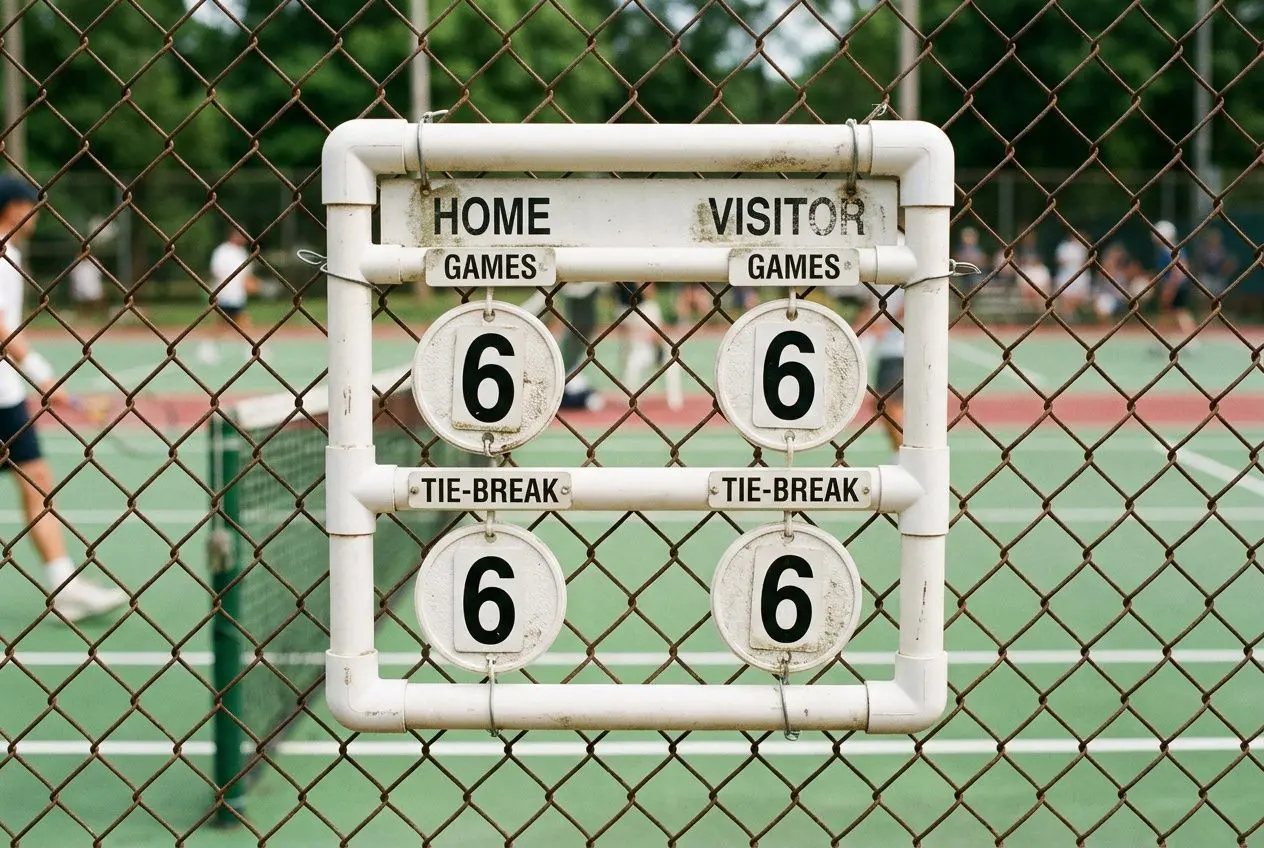
Table of Contents
Understanding how professional tennis scoreboards work means recognising the four-layer scoring system: points, games, sets, and the match. This beginner-friendly tennis scoreboard explained guide covers each display zone, the live point sequence, set columns, tiebreak notation, and the serving indicator.
How professional tennis scoreboards work
A professional tennis scoreboard divides the match into clear visual zones. Player names appear on the left, set columns run through the centre, live points sit on the right, and a serving indicator identifies the current server. Reading the board becomes simple once each zone has a defined purpose.
The four scoreboard display zones
The four main zones are shared by manual and electronic boards. Their roles do not overlap: the current game score appears on the right, while completed set totals remain in the central columns. That layout allows a busy match to be read quickly.
- Player name plates: Separate rows at the far left identify each player, ensuring that every figure can be attributed correctly throughout the match.
- Set columns: Arranged from left to right, these record the number of games in each set won by each player. The first completed column represents the opening set, followed by the second and subsequent sets.
- Live point display: The right-hand section shows the current game score with standard tennis terms: love, 15, 30, 40, deuce, or advantage. It updates after every rally and remains separate from the set totals.
- Serving indicator: A dot or small triangle beside a player’s name identifies the current server. It moves to the other player when a new game begins because service alternates by game under the rules.
Together, these zones create a self-contained scoring system. For example, a board showing 6-4, 2-3, and a live score of 30-15, with the dot beside the lower-named player, indicates a first set won 6-4, a second set currently standing at two games to three, and a present game in which the lower player is serving.
Reading a live tennis score
A clear tennis scoreboard explained guide must distinguish fixed information from live information. Set columns preserve the completed games in each set and do not change during a game. The point display, by contrast, resets to love– love as soon as one game ends and the next begins.
The server’s score appears first on the board and in the umpire’s call. A display of 30-15 means the server has won two points in the current game and the receiver has won one. When both players have one point, the score is 15-all; at two points each, it is 30-all; and at three points each, it becomes deuce rather than 40-all. From deuce, one player needs the next point for advantage and must then win the following point to take the game.
Professional Grand Slam scoreboards may also show match duration, serve speed, and challenge-system statistics. These additions do not change the underlying scoring logic; they appear as supplementary panels around the same four-zone structure. Focusing on the core zones remains the right choice when learning to interpret a live tennis score.
Who controls professional displays
At professional events, a dedicated scoring terminal controls the electronic scoreboard. An operator records which player won each rally, and the software updates the relevant points, games, or sets automatically. This system reduces delays and calculation errors during fast exchanges, keeping the display accurate point by point.
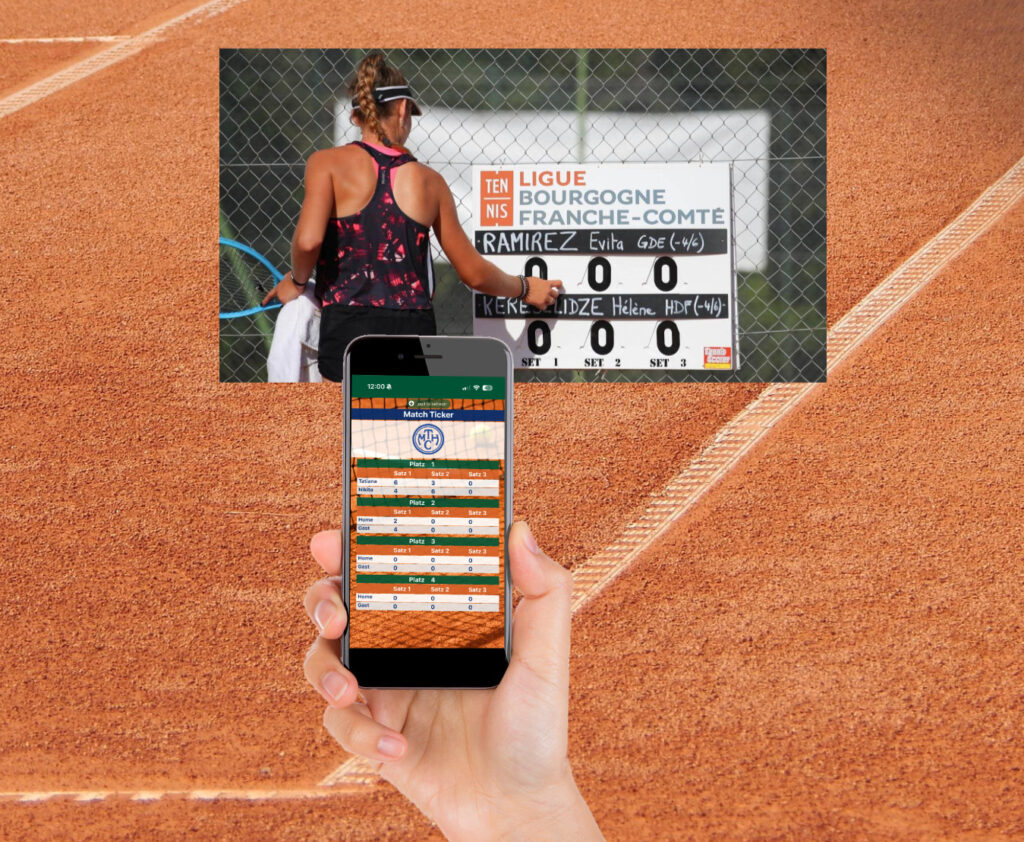
Club and park courts use the same reading logic with manual boards. Rotating discs or sliding tiles are moved by hand during changeovers, following identical rules. A complete guide on how to use a tennis scoreboard explains correct operation, the scoring system, set and tiebreak rules, and common mistakes, making it useful for club administrators and players managing their own boards.
Tennis scoring from points to game
Tennis scoring operates across four connected layers: points, games, sets and the match. Within an ordinary game, the sequence is love, 15, 30, 40, then game, with the server’s score announced and displayed first.
Why tennis points use 15, 30 and 40
The point-call system can seem unusual at first sight. Tennis does not count 1, 2 and 3 as most sports do; the formal sequence is love (zero), 15 (one point), 30 (two points) and 40 (three points), followed by game. The move from 30 to 40, rather than 45, is a historical convention.
When both players win one point in the same game, the score is 15-all. At two points each, it is 30-all. After each player wins a third point, the score becomes deuce rather than 40-all, and the standard sequence gives way to the deuce-advantage system.
| Points won | Score displayed | Called as |
| 0 | 0 | Love |
| 1 | 15 | Fifteen |
| 2 | 30 | Thirty |
| 3 | 40 | Forty |
| 3 each | 40-40 | Deuce |
| 4 (clear) | Game | Game |
Deuce and advantage explained
Once deuce is clear, reading a tennis score on television becomes straightforward. At 40-40, neither player can win the game with one point; a player must win two consecutive points to take it. The scoreboard or umpire marks this change by calling deuce, after which the next rally decides who holds advantage.
If the server wins the point after deuce, the board may show Ad-in or “advantage” beside the server’s name. If the receiver wins it, Ad-out appears, although professional umpires usually call “advantage” followed by the player’s name. Winning the next point ends the game for the player with advantage. Losing it returns the score to deuce, and the sequence continues until a two-point margin is secured.
What resets after each game
Once a game is complete, three elements reset. This applies whether the game was won at 40-love or after several deuce exchanges. The live point display returns to love-love. The winner gains one game in the current set column. The serving player changes. The rules require players to alternate service by game throughout the set.
If the live display still shows 40-30 after a game point, it needs updating. On a manual board, move the set column disc and point display together; then verify that the serving indicator has shifted correctly.
Set scoring and match formats
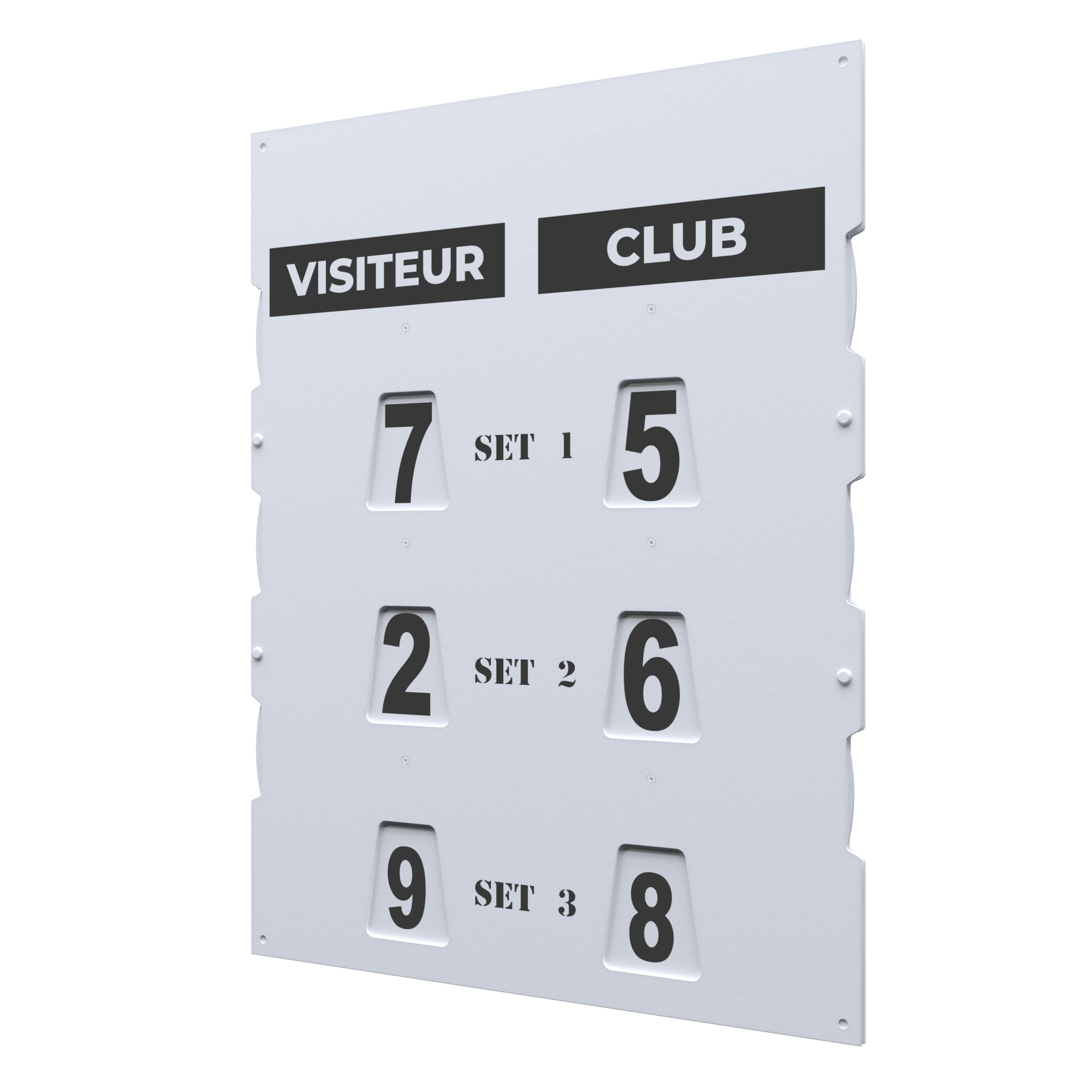
Games build into sets, and sets decide the match. Each set column on the scoreboard records the games won by each player, creating a clear match history from left to right. Once the structure is understood, the score becomes easy to read: the completed sets show which player is closer to the required result.
How a tennis set is won
Understanding how many sets in tennis are needed to win starts with the way an individual set ends. A player must reach six games with a lead of at least two. The most common completed set scores are:
- 6-3: The winner reached six games while the opponent won three. The necessary two-game margin was secured with the sixth game.
- 6-4: A closer contest, finished with a two-game margin. This is one of the most common set scores at professional level.
- 7-5: The set continued beyond six games because neither player had the required lead at 6-4. The winner eventually reached seven games to five.
A score of 6-5 does not end the set under standard rules, because the two-game lead is still missing. From there, the trailing player can level at 6-6 and force a tiebreak, while a further game for the leader produces 7-5. The set column on the scoreboard shows only completed sets, so a 6-5 display means play is still live and the tiebreak has not yet been reached.
The games in each set appear in the central columns, with one column for every set. The opening set sits on the left and the latest completed set on the right. A match completed in three sets therefore shows three columns, each recording the games won by both players. This layout lets a spectator arriving mid-match read the score and reconstruct the result quickly.
How many sets win a match
The match format determines how many sets a player must win. Most professional matches, including all women’s singles at Grand Slams and the full WTA tour, are best-of-three: the first player to win two sets takes the match. Men’s singles at the four Grand Slam tournaments uses best-of-five sets, so the player to win three sets takes the match; this format is used nowhere else on the ATP main tour. Doubles matches across most tours are also best-of-three, although a match tiebreak sometimes replaces the deciding set.
What a double bagel score means
Some tennis scoreboard readings have informal names recognised throughout the sport. A 6-0, 6-0 result means two sets won without conceding a game and is known as a double bagel. The term “bagel” describes one 6-0 set; two consecutive bagels make the double. The scoreboard shows two set columns, each reading 6 to 0, with the losing player having scored zero games in the match.
By contrast, a 6-0 result in one set is simply a bagel, while a 6-1 set is informally called a “breadstick” in some circles. Neither expression forms part of the official rules, and neither appears on the scoreboard. Commentators, players and coaches use them as shorthand for dominant scoring patterns.
Tiebreak rules and bracketed numbers
When a set reaches 6-6, the standard rules trigger a tiebreak to prevent it extending indefinitely. The tiebreak uses a different scoring system from ordinary games, and its result appears on the scoreboard as a bracketed number beside the 7-6 set score. This scoring system is standard in professional tennis, including Grand Slam events.
How the tiebreak scoring works
Unlike standard games, the tiebreak does not use love, 15, 30 and 40. Points are counted numerically from zero upwards, and the first player to win seven points with a two-point lead closes the set 7-6. The key differences are these:
- Opening serve: The player due to serve next starts the tiebreak with one point from the deuce court. Every later service turn begins from the ad court before the server alternates sides.
- Service rotation: After the opening point, players serve two points each in sequence.
- End changes: Players change ends after every six points during the tiebreak, rather than after each odd-numbered game. This balances any wind or light advantage across the court.
- Extension at 6-6: If the tiebreak reaches 6-6, play continues under the same two-point margin rule. There is no second breaker; the game simply extends until one player leads by two clear points.
The live display shows whole numbers such as 4-3, 5-5 and 6-7, rather than the love-15-30-40 sequence. Once the tiebreak ends, the set column records 7-6 for the winner, while the bracketed notation records the losing player’s points total.
What small numbers beside a score mean
The small number in brackets beside a 7-6 set score records the losing player’s tiebreak points, not the winner’s. A score of 7-6(4) means the loser reached four points before the tiebreak ended; 7-6(5) means the loser reached five. This convention appears in professional match records, television graphics and printed draws. Because the winner’s total is normally seven, only the loser’s total needs to be specified. In a 10-point match tiebreak, both totals appear in brackets, for example 6-7(8-10), because neither figure is fixed in advance.
Extended tiebreaks require both totals in brackets. A match tiebreak recorded as 6-7(8-10) shows that the player who lost the set scored eight points, while the winner reached ten. Both figures are included because neither total is fixed in a super tiebreak, making the final score clear when it is read later.
Deciding-set match tiebreaks
Since 2022, all four Grand Slam events have adopted a 10-point match tiebreak when the deciding set reaches 6-6, instead of continuing with an advantage set. The player to win ten points with a two-point lead wins the match immediately; no further sets are played. This applies in men’s best-of-five sets and women’s best-of-three formats at Grand Slams, replacing older advantage-set rules that could extend matches indefinitely.
In doubles, the 10-point match tiebreak has been used for longer and often replaces the deciding third set without waiting for 6-6. Both players on a side contribute points towards the same target, and the scoreboard records the full result in the bracketed format described above. The same reading logic applies: the figure identifies the losing side’s total and shows how close the deciding sequence was.
Players win the tiebreak by reaching the required points margin, while the bracket explains the losing side’s contribution. That is the practical difference between the main set score and the detailed tiebreak record.
A guide to manual tennis scoreboards
Manual scoreboards show the essential information found on professional electronic displays: player names, points in the current game, games in each set, and a serving indicator. This guide explains the available mechanisms, court-specific size formats, durability standards, and personalisation options for clubs seeking a dependable courtside solution.
Manual scoreboard mechanisms
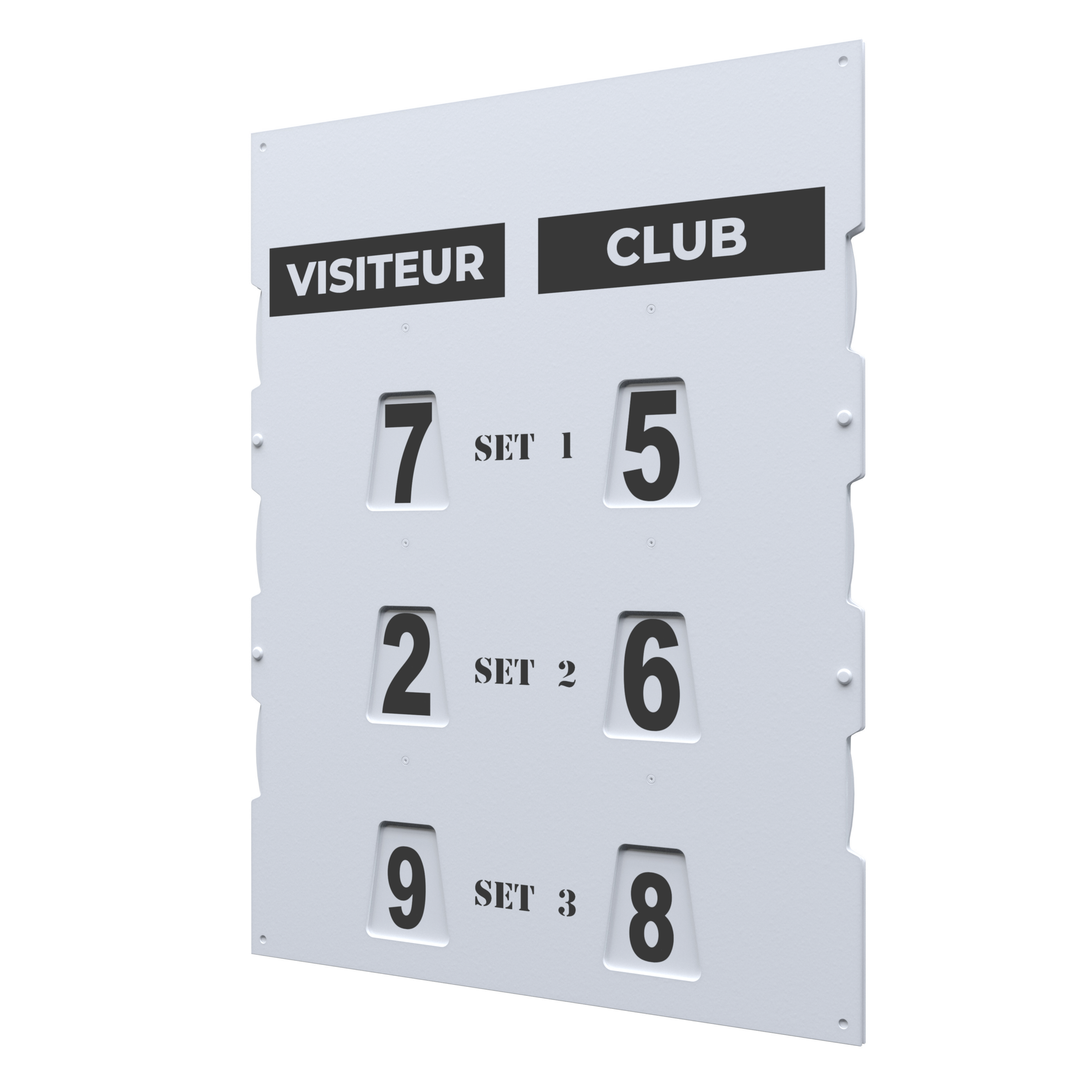
Manual rotating-disc scoreboards are updated by hand during changeovers. Each disc turns to show the correct digit for points, games, or set totals, while a dot or triangle indicates which player serves. Tennis Scorer has equipped nearly 3,000 clubs and 16,000 courts across Europe and the USA since the early 1990s, with rotating-disc models built around three core mechanical features:
- Engineered score discs: Designed to prevent water cohesion, the discs rotate smoothly in heavy rain without sticking or jamming.
- Removable name plates: Slate name plates on the left side of the board can be changed between matches, so player names can be updated without replacing the board or its mechanical parts.
- Corrosion-resistant fixings: Brass eyelets and anti-rust metal hooks protect every mounting point against prolonged outdoor exposure, preserving the board’s structure season after season.
The rotating-disc system displays game scores from 0 to 7 per set and cumulative set totals up to 99. Tiebreak scores appear in brackets, for example 7-6 (7-4), keeping the tiebreak result distinct from ordinary game scoring.
Fence mounting and court visibility
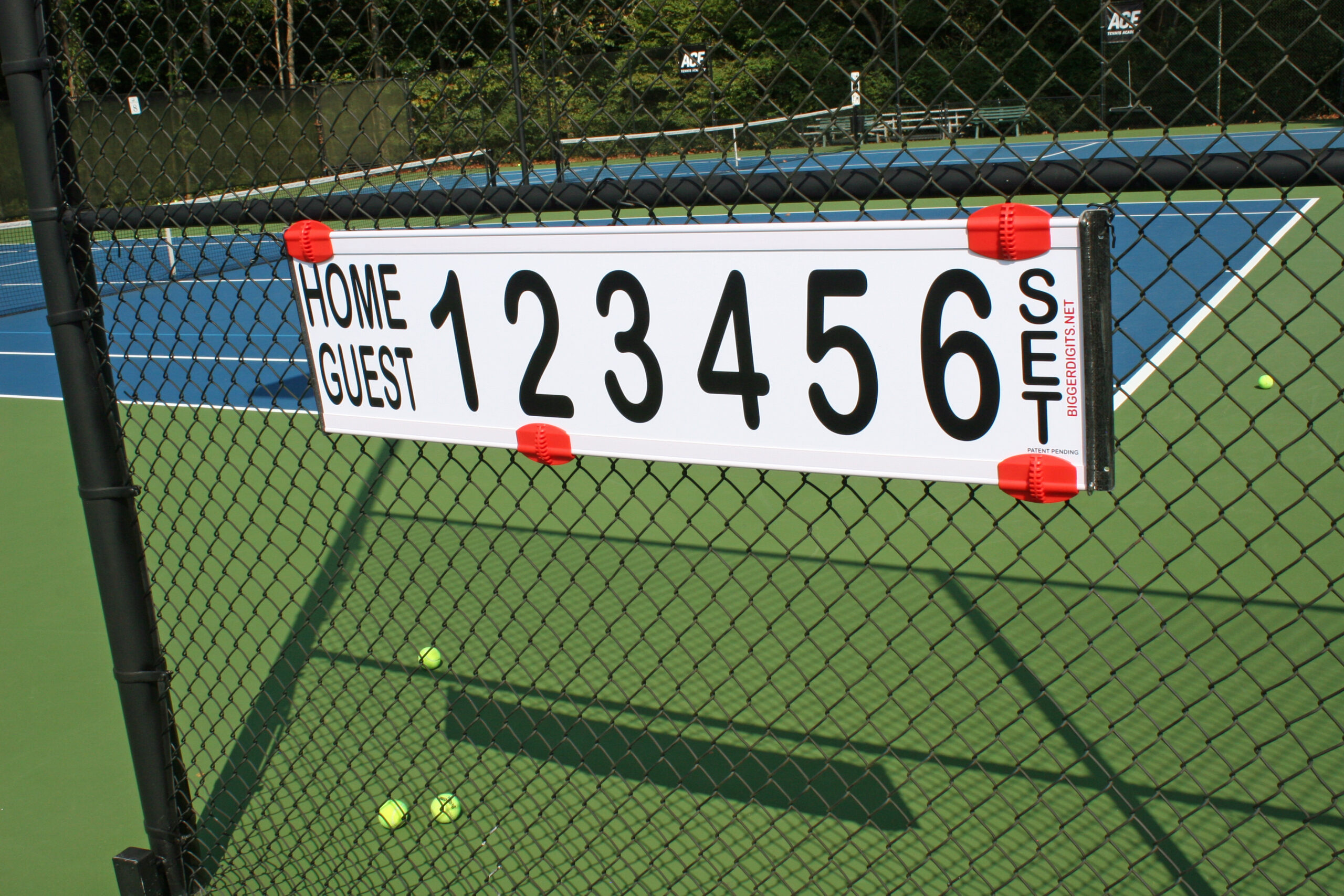
Compact rotating-disc models come in three sizes: approximately 35 × 50 cm for net-side positioning, 46 × 65 cm as a versatile mid-range format, and 56 × 80 cm for fence mounting when the display must be legible from both baselines. Full-panel PVC boards use 10 cm digits, making the score readable from more than 50 metres across both baselines and nearby viewing areas.
Full-panel PVC boards measure approximately 60 × 60 cm and weigh around 2 kg, so one person can handle them easily. Double-sided versions improve visibility from different approach angles, particularly where spectators are seated on more than one side. Clubs comparing fence configurations can consult the fence mounted tennis scoreboard buying guide, which covers manual mechanisms, dimensions, durability, and fixing methods.
- Small (35 × 50 cm): Best placed beside the net post, particularly for informal club play where spectators remain close to the court and viewing distances are short.
- Medium (46 × 65 cm): A practical choice for fence-mounted club courts where the board needs to be read from at least one baseline.
- Large (56 × 80 cm): Best when the display must serve both baselines and courtside seating, with digit size and contrast supporting clear reading at distance.
Installation requires no drilling. Four supplied cable ties secure full-panel boards directly to the perimeter fence, while compact disc models use brass eyelets and anti-rust hooks. Personalised versions can include sponsor logos or court numbering within a 56 × 17 cm branding area, with Green, Blue, and Black finishes available for clubs managing court identity and commercial partnerships.
Durability and personalised club boards
Tennis Scorer’s full-panel PVC models are built to last through year-round outdoor exposure. UV-resistant, rot-proof material and counter-glued watertight edges provide an expected service life of 20 to 30 years. The absence of electronics removes running costs, while separately available replacement digits avoid replacing the entire unit after damage to one numeral. These boards are 100% made in France.
Personalised scoreboards give clubs two functions in one asset: live scoring for points, games, and sets, alongside a branded courtside presence for sponsor logos or sequential court numbers. The 56 × 17 cm branding area is integrated into the board rather than added as a separate panel, keeping signage away from the scoring zones.
The tennis court scoreboards buyer’s guide examines dimensions, weather resistance, installation methods, scoring features, and long-term cost across the available options.
Frequently asked questions
Why does tennis use love, 15, 30 and 40 instead of 1, 2, 3, 4?
Tennis scoring uses love (zero), 15, 30 and 40 as a historical convention that has remained consistent across rule sets for centuries. The term “love” is widely believed to come from “playing for love”, i.e. playing for nothing rather than for stakes, and not from the French word for egg. The change from 30 to 40 instead of 45 is also traditional: the sequence was fixed long before modern rules were codified, and no formal body has altered it.
Alternative systems exist. Fast4 Tennis, for example, replaces the full points sequence with a first-to-four-games format, but standard love-15-30-40 scoring governs Grand Slam and main-tour tennis.
What do the little numbers in brackets beside a tennis set score mean?
The small number in brackets beside a 7-6 set score records the losing player’s points in the tiebreak, not the winner’s. Because the winner reaches seven points, or ten in a match tiebreak, only the loser’s figure is normally needed to reconstruct the result. A scoreboard or results sheet showing 7-6(4) therefore means that the losing player reached four tiebreak points before the set ended.
In a 10-point match tiebreak, used at all four Grand Slams since 2022 when the deciding set reaches 6-6, both totals appear in brackets. An example is 6-7(8-10). This notation is used consistently in professional score records, television graphics and tournament draws.
What is a 6-0, 6-0 tennis score called?
A 6-0, 6-0 result is known as a double bagel. The term “bagel” describes a single 6-0 set, referencing the shape of zero; two such sets produce the double bagel.
A single 6-0 set is simply called a bagel, while a 6-1 set is sometimes informally called a “breadstick”.