
Table of Contents
This guide covers everything needed to read a Wimbledon-style tennis scoreboard with confidence, from its four display zones and 15-30-40 point system to tiebreak notation and serving indicators. The professional tennis scoreboard explained resource and the companion guide to reading tennis scores examine the scoring structure in greater depth. For venue formats, the tennis court scoreboard buyer’s guide covers physical display options.
Reading a tennis scoreboard at Wimbledon
Each zone carries a specific type of information, so every figure can be assigned to the correct player when following a match courtside or on television.
The four display zones
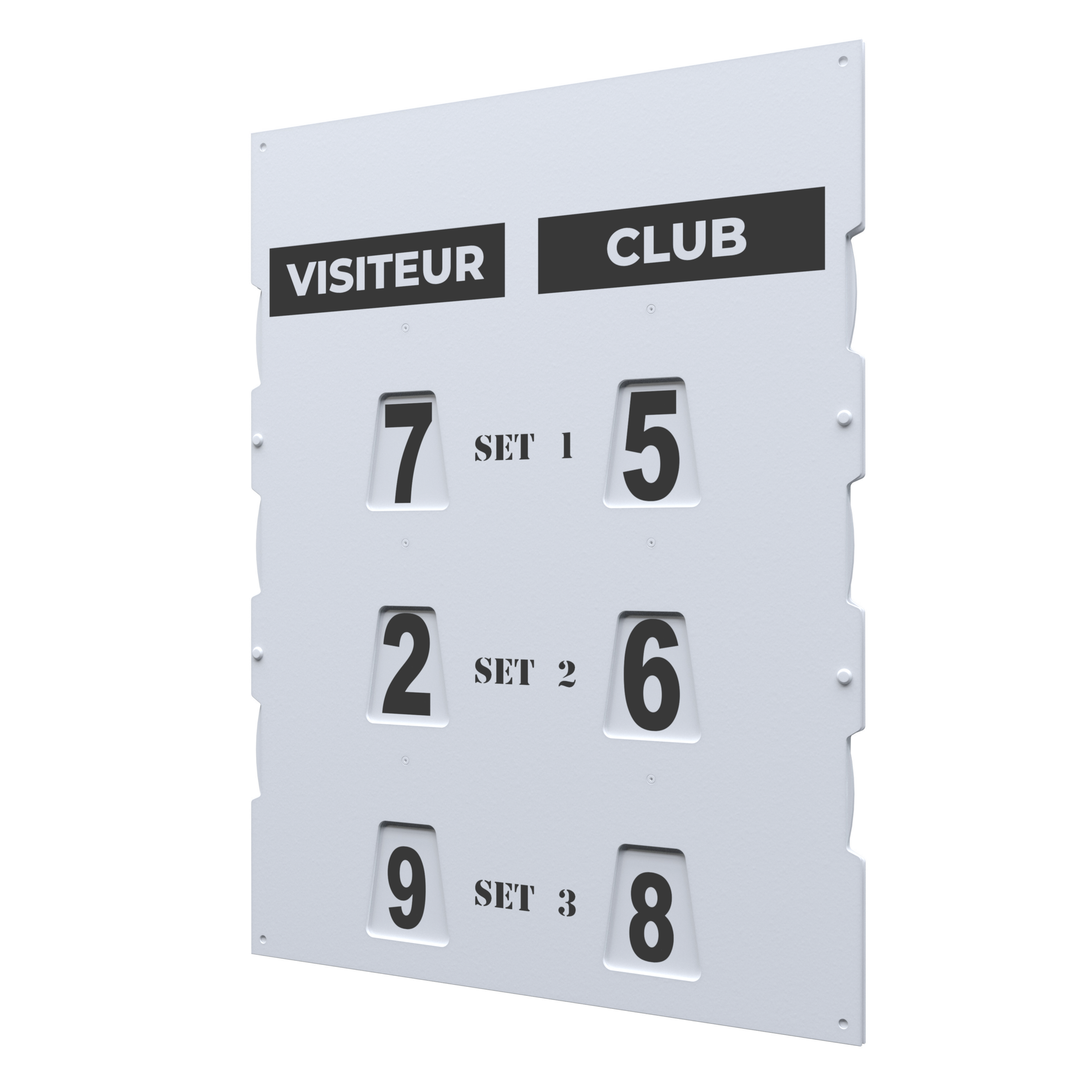
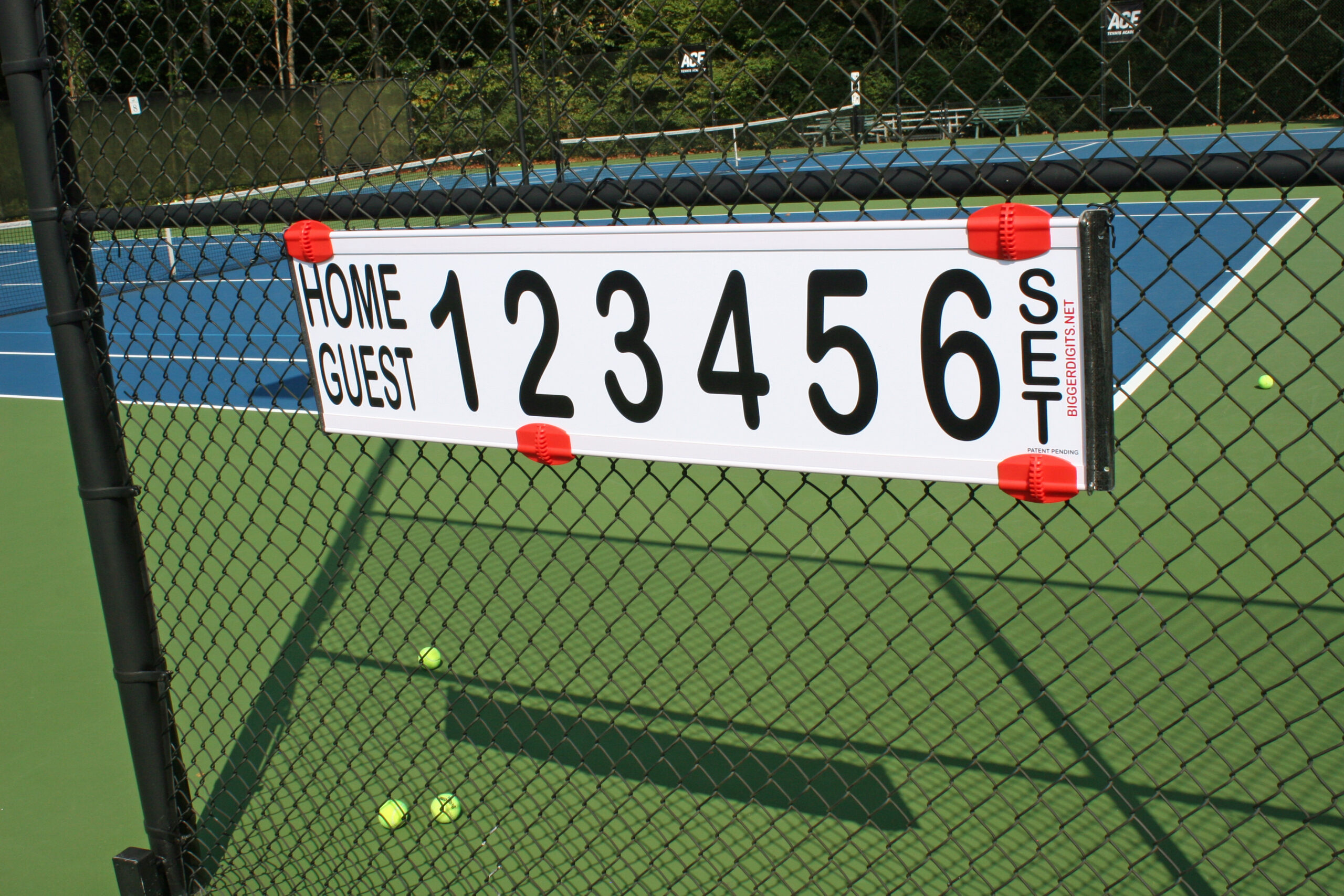
Player name plates occupy the far left, with one row for each player. Every column to the right belongs to one of those rows, which prevents a figure from being attributed to the wrong competitor. Each horizontal line represents that player’s complete match record.
Set columns sit in the centre, arranged from left to right in chronological order. Each column records the number of games won in that set: a display showing 6-4 in the first column and 2-3 in the second means the first player won the opening set 6-4, while the second set currently stands at 2-3 in favour of the second player. The live game score appears on the right, using standard tennis terms such as love, 15, 30, 40, deuce and advantage. It returns to love-love as soon as the game ends.
Finding the server and live score
A small dot or triangle beside one player’s name identifies the current server. It moves to the other player at the start of the next game because service alternates between players. A live display of 30-15 means the server has won two points and the receiver has won one. The same convention applies when reading a tennis score on television.
Reading scores on television
Television graphics compress the four-zone layout into a corner overlay, but the logic remains unchanged. Set scores appear as a sequence of numbers separated by commas, while the live game score sits alongside them. A serving indicator, usually a small ball icon or highlighted name, identifies who is currently serving, with the server’s score shown first in the live game column.
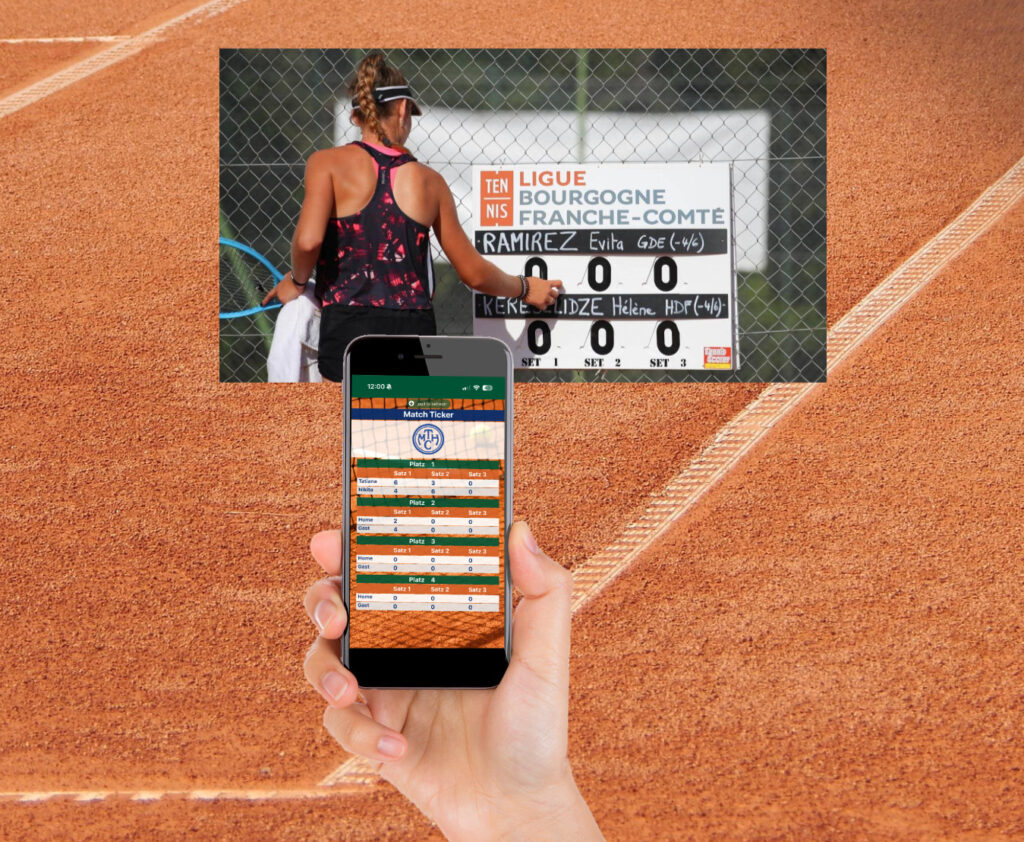
Full-panel boards with 10 cm numerals on a white background remain legible beyond 50 metres. That is why high-contrast design matters on court as well as in broadcast graphics. Once the zone structure is clear, the same reading method works for a courtside scoreboard, a television overlay or a match-tracking application.
Tennis scoring from point to game
The tennis scoring system follows a defined sequence of point values before a game is awarded. The convention is historical rather than mathematical, yet understanding it makes any live score display easier to read, from a club match to a Grand Slam final.
Love, 15, 30 and 40
The point system has four named stages before a game is won. Each stage has a fixed place in the sequence and a familiar display on the scoreboard.
- Love means zero points won. The player has not yet scored in the current game.
- 15 / 30 means one or two points won respectively. When both players have the same total, the score reads 15-all or 30-all.
- 40 means three points won. The next point usually wins the game, unless both players reach 40, creating deuce.
The server’s score is announced first and appears first on the scoreboard. A score of 30-15 therefore means the server has won two points and the receiver wins one in that game. The same order applies from the opening point of a match to its final game.
Deuce and advantage scoring
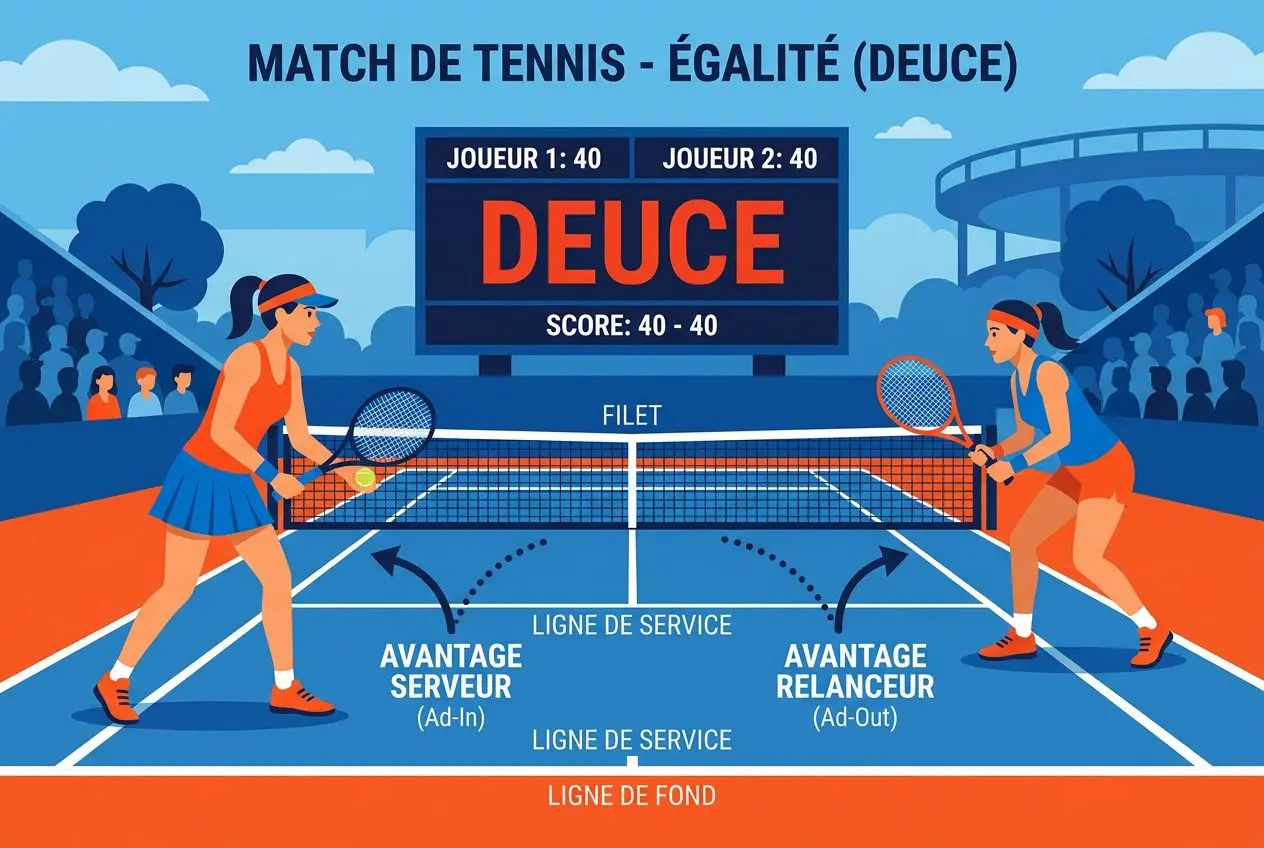
Deuce occurs at 40-40, after both players have won three points. From there, a player must win two consecutive points in order to win the game. The first gives advantage, not the game itself: advantage for the server is called Ad-in, while advantage for the receiver is Ad-out.
A player holding advantage wins the game by taking the next point. The sequence repeats: win the next point and the game is over, lose it and the score returns to 40-40. There is no limit to the number of deuce cycles, so one game can extend a set for several minutes before the set column changes.
Winning a set and match
A set goes to the first player to reach six games with a lead of at least two. Typical final scores include 6-3, 6-4 and 7-5. A score of 6-5 cannot end the set: the trailing player can level at 6-6 and force a tiebreak, or the leader can take the next game to win 7-5.
At Grand Slam events, men’s singles matches are best of five sets, so a player must win three sets in order to win the match. Women’s singles and most other competitive matches are best of three, requiring two sets won.
Tiebreak numbers and scoreboard notation
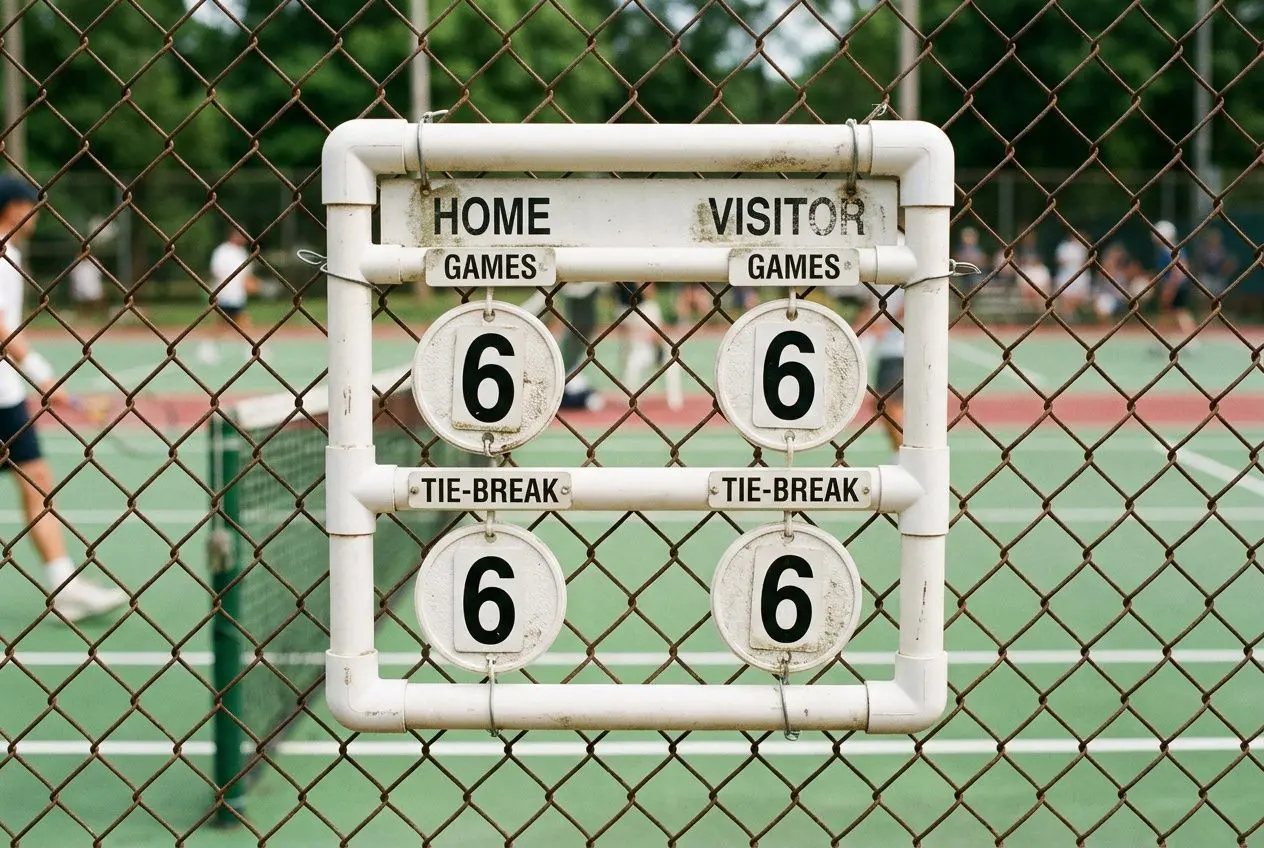
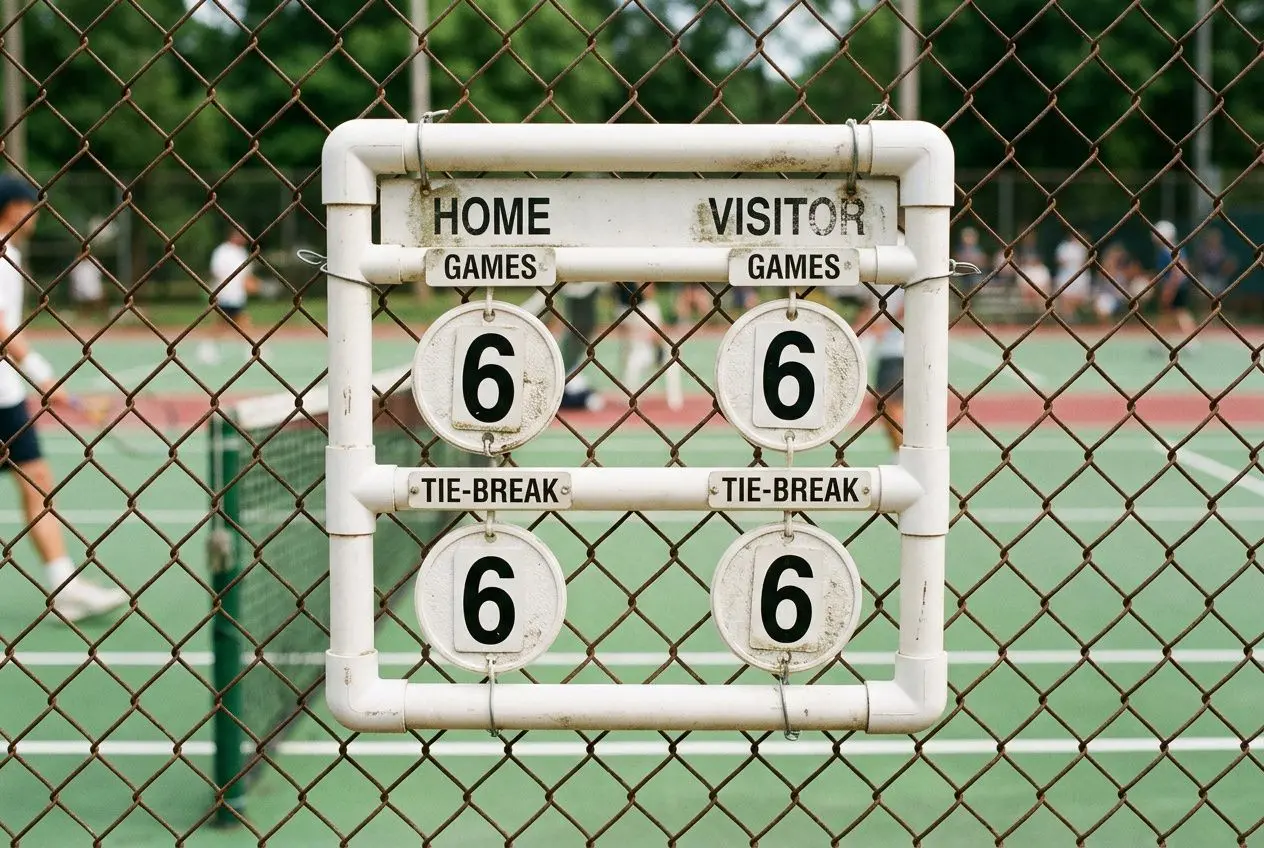
When a set reaches 6-6, ordinary game scoring gives way to a tiebreak, and the board switches to a numerical point-by-point count. The bracketed figures beside a 7-6 set score are a specific notation, not an extra game total. Understanding them completes the picture of how a tennis scoreboard is read.
How a tiebreak works
The tiebreaker replaces love-15-30-40 with a plain numerical count starting at zero. Standard tiebreak points prompt frequent questions on tennis forums, while explanations of how a tennis scoreboard works in Wimbledon Reddit threads continue to attract interest because bracketed notation confuses newcomers expecting the familiar game-score format. Service begins with one point from the first server, then alternates in blocks of two.
- Numerical scoring: points count sequentially from zero. There is no love, 15 or 30 terminology inside a tiebreak.
- Service rotation: the first server delivers one point, then the players alternate serving every two points for the remainder of the tiebreaker.
- Winning margin: the first player to reach seven points with a two-point lead wins the set 7-6. If both players reach six, play continues until one player leads by two.
The live point display resets, and the player who served first in the tiebreak becomes the receiver for the opening game of the next set, preserving the serving pattern across sets.
What bracketed numbers mean
The bracketed figure beside a 7-6 set score records the losing player’s tiebreak total, not the winner’s. A score written as 7-6(4) means that the loser reached four points before the tiebreak ended, so the tiebreak finished 7-4. Some displays write the full result as 7-6 (7-4), making both totals explicit for quick scanning.
Since 2022, all four Grand Slam tournaments have used a 10-point match tiebreak when the final deciding set reaches 6-6. This replaced the advantage-set format that produced the famous Wimbledon 70-68 final set in 2010. The winner of this match tiebreaker must reach at least ten points and lead by two. Because the winning total can exceed ten, both totals appear in brackets: 6-7(8-10) records each figure, and no further sets played follow because the match ends immediately.
Manual scoreboard formats
Two main categories of manual scoreboard serve club and tournament courts: compact rotating-disc models and full-panel PVC designs. Rotating discs record games from 0 to 7 per set and cumulative set totals up to 99, with tiebreak results shown in brackets, for example 7-6 (7-4), clearly distinguished from ordinary game scores. Tennis Scorer builds both formats from UV-resistant, rot-proof PVC that is designed for year-round outdoor exposure without deterioration.
In practice, full-panel boards fix to fencing through a no-drill cable-tie system using four supplied serflex ties, while disc models attach with brass eyelets and anti-rust metal hooks at every fixing point. No specialist tools are required for either format. Tennis Scorer documents 20 to 30 years of service life for manual scoreboards, with replacement digits available separately so a fault in one component never forces a full-unit replacement.
Frequently asked questions
What do the bracketed numbers on a tennis score mean?
The small number in brackets beside a 7-6 set score records the losing player’s point total in the tiebreak, not the winner’s. A result written as 7-6(4) means that the tiebreak ended 7-4: the winner reached seven points and the opponent won four. Some displays show the full tiebreak score as 7-6 (7-4), making both totals clear. In the 10-point Grand Slam match tiebreaker used since 2022, both figures appear in brackets because the winning total is not fixed in advance. A score such as 6-7(8-10) therefore shows both numbers.
How many sets does a player need to win a tennis match?
The required number of sets depends on the match format. At Grand Slam events, men’s singles is best of five sets, so a player must win three sets to claim the match. Women’s singles at Grand Slams, along with virtually all other competitive matches for men and women, uses a best-of-three format and requires two sets won. In doubles and mixed doubles, a match tiebreaker—first to ten points with a two-point lead—frequently replaces a full third set, so the match ends without additional sets played beyond the second.
What is a 6-0, 6-0 tennis score called?
A 6-0, 6-0 result is commonly called a double bagel. The term comes from the bagel metaphor for a 6-0 set, with the zero resembling the shape of the bread. A double bagel means that one player won every game across both sets in a best-of-three match, while the losing player failed to win a single game. It is the most complete winning margin possible in a two-set match: the scoreboard shows two 6-0 entries in the set columns, with no further sets played.