

Table of Contents
Finding the right tennis scorekeeper for a court, whether a physical board, a pocket device or a digital app, helps keep points, games and sets accurate throughout a match. The options below explain tennis scoring and show which tool suits each court.
Choosing a tennis scorekeeper for every match
Every solution for tracking a tennis score belongs to one of three categories: a fixed court scoreboard, a portable physical device, or a digital tool on a phone, tablet or laptop. The duties of a tennis scorekeeper include validating disputed line calls and reporting match statistics to the referee.
How tennis scoring works
Any reliable tennis score keeper must reflect three layers: live points within the current game, game totals within the active set, and completed sets across the match. A tennis point tracker that confuses these layers will fail at deuce or during a tiebreak. The four standard point values provide the foundation of tennis scoring:
- Love Zero points scored. It is the starting value for both players in each game and returns after the game ends.
- 15, 30, 40 Sequential point values. At 40-all, or deuce, the leading player must win two consecutive points under advantage scoring.
- Advantage The stage after deuce: Ad-In when the server leads and Ad-Out when the receiver leads. Losing the next point returns the score to deuce.
- Game Awarded when a player wins the required points with the necessary margin. The set counter rises by one and the point score resets to love-love.
A standard set is won at six games with a two-game lead. Valid scores include 6–0 through 6–4, followed by 7–5 or 7–6. At 6–6, a tiebreak replaces the love/15/30/40 format with numeric counting: a player must reach seven points with a two-point margin.
A tennis score keeper app
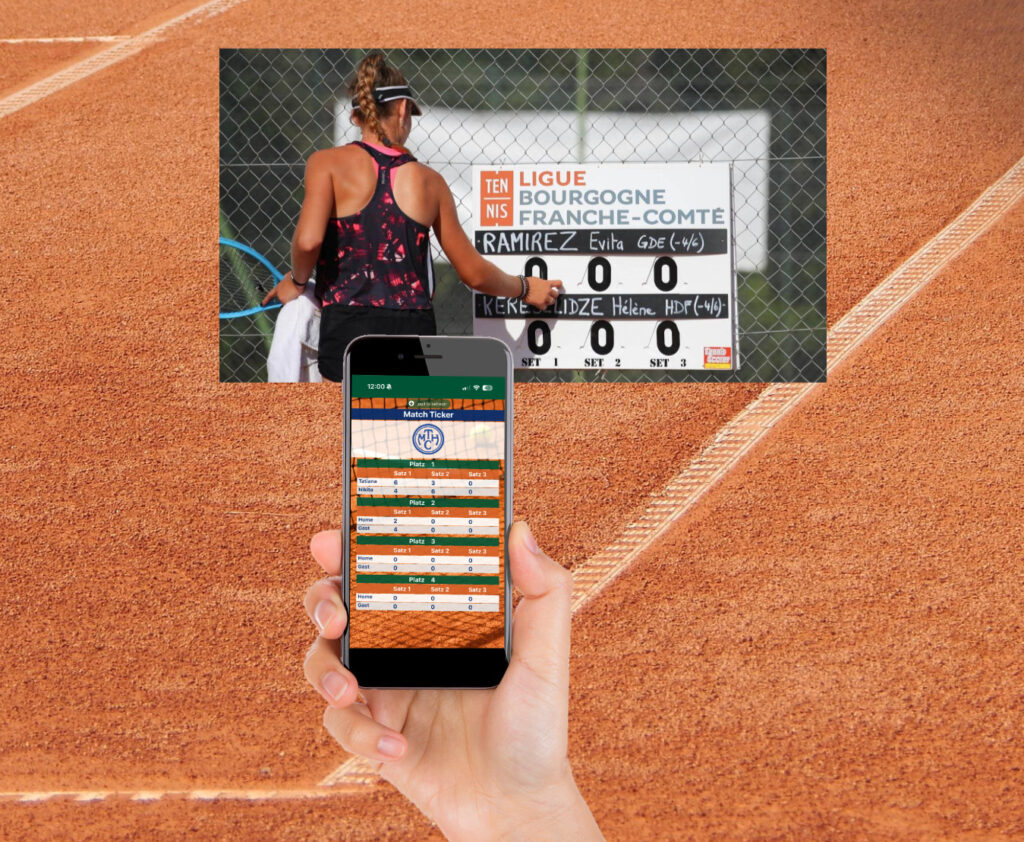
A tennis scorekeeper app on a phone or tablet automates deuce detection, advantage assignment, game completion, set totals and serve rotation. Tap controls advance either player’s score, while an undo or long-press function reverses an incorrect tap before it affects later points. Responsive design lets the app run courtside on a phone or on a laptop at the scorer’s table, while offline operation stores match data locally when reception is unreliable.
For doubles, the right app accepts team names and supports the selected format, including a deciding 10-point match tiebreak where applicable. Guidance on displaying and reading scores appears in how to use a tennis scoreboard.
Online tennis score tracking
A free online scoreboard needs no installation: open a browser, enter the player names and begin tracking without an account. Automatic tiebreak scoring follows ITF rules at 6–6, alternating serves with the first player to seven points winning by two. Before the match, users can select advantage scoring or no-ad scoring, in which one sudden-death point at deuce decides the game.
Unlike installed apps, browser-based scoreboards depend on a live connection. On a court with an unreliable signal, a locally installed app is safer; where Wi-Fi or mobile data is stable, an online board suits club matches, coaching sessions and recreational play.
Tennis scorekeeper choices compared
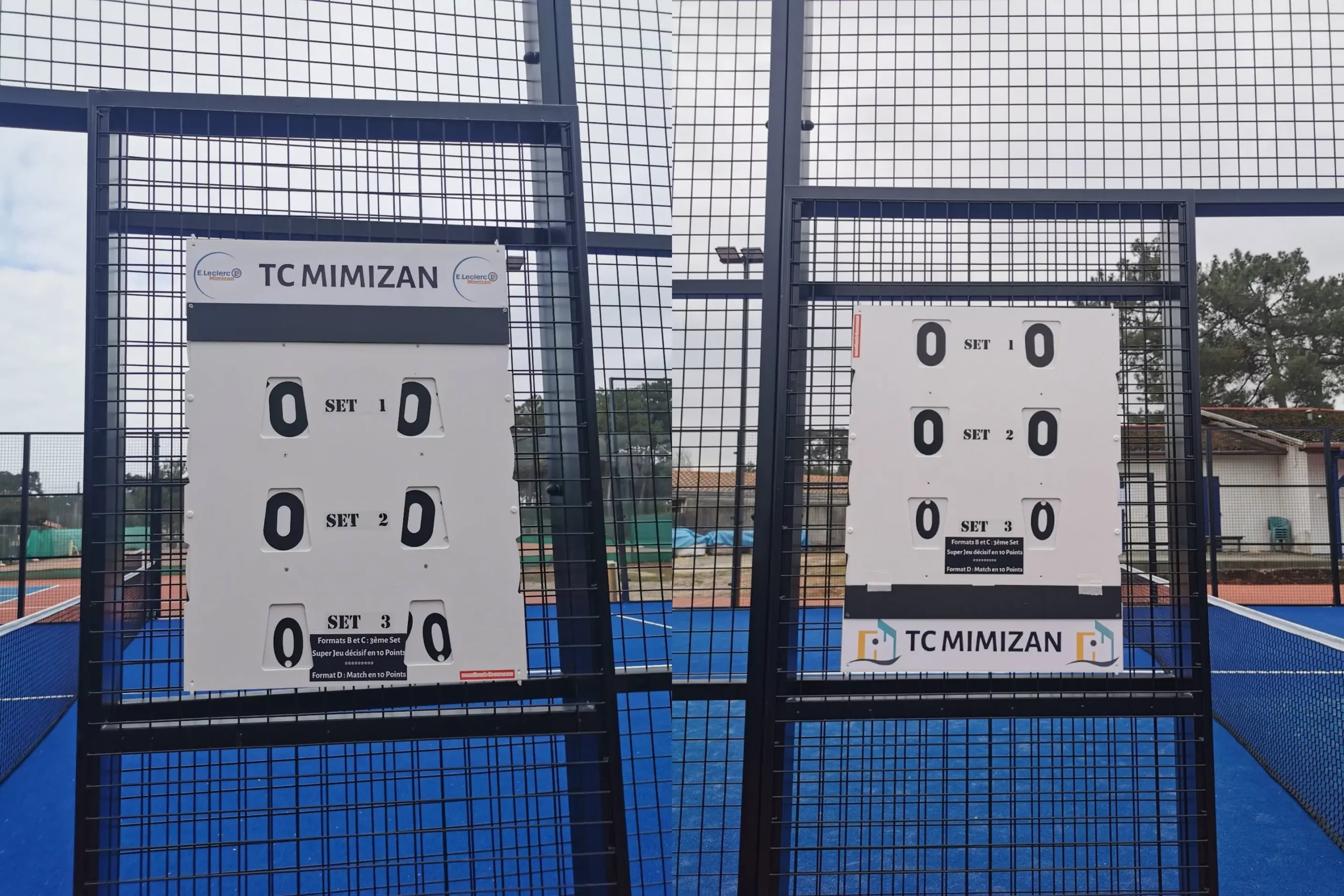
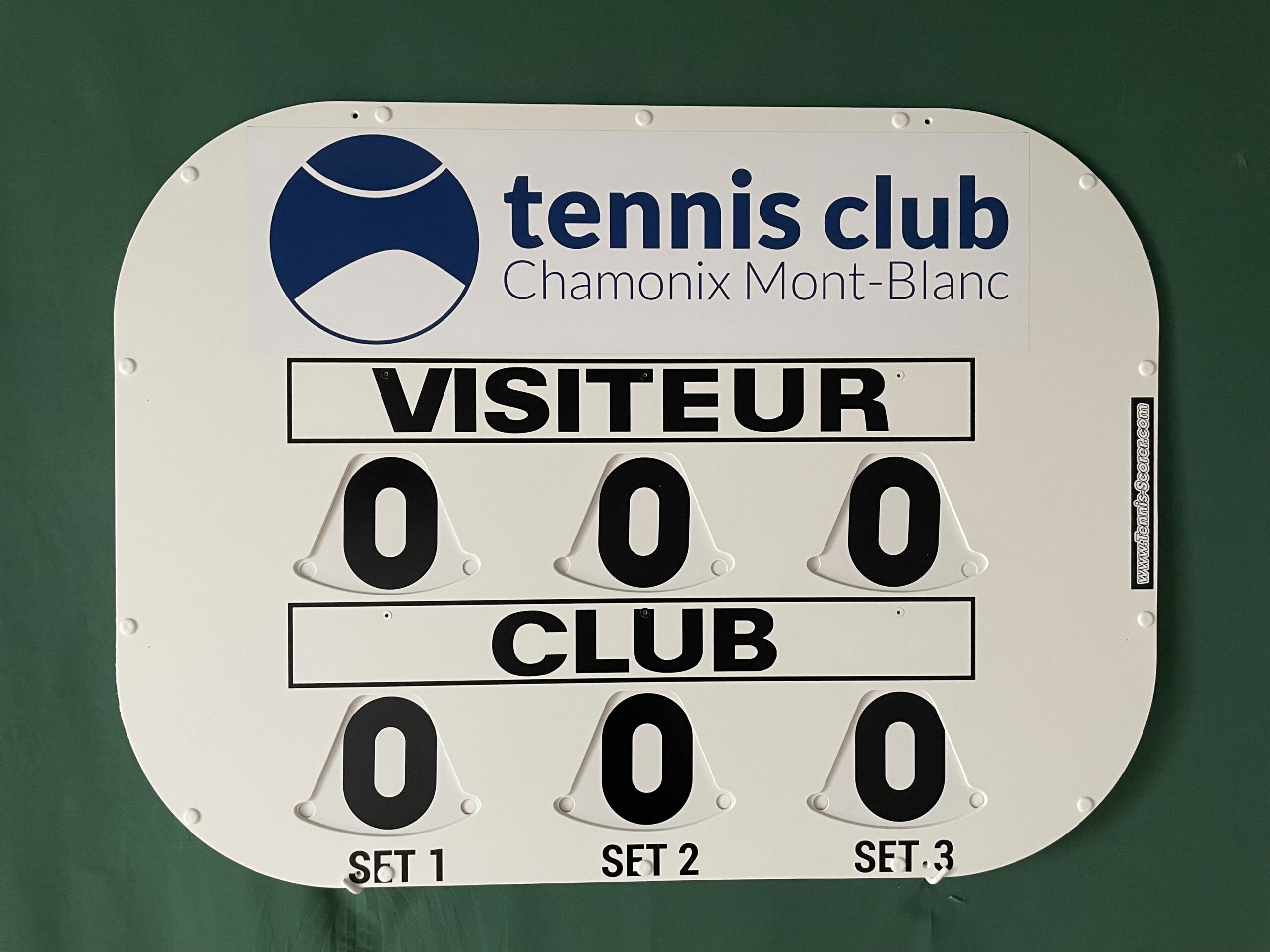
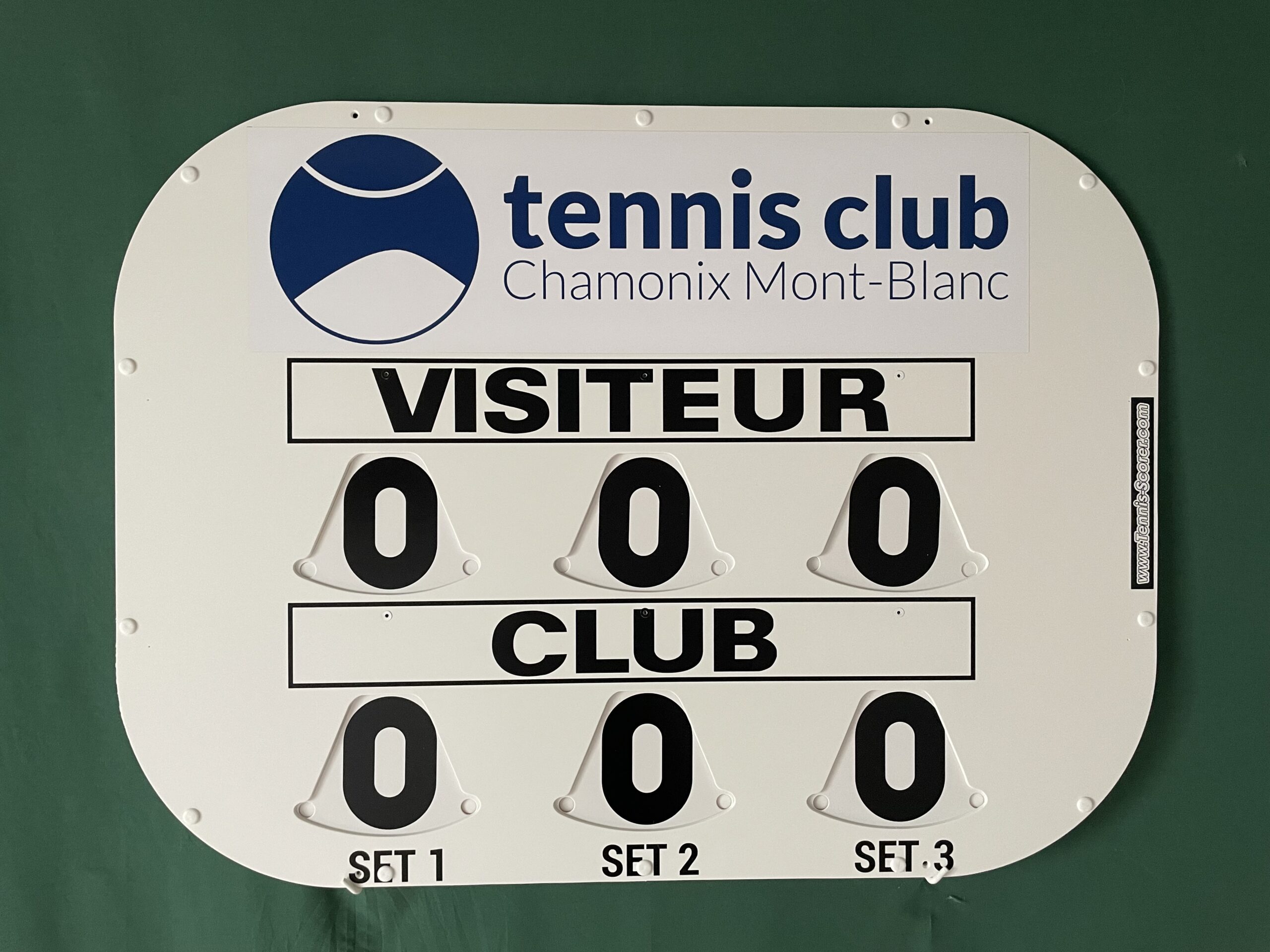
Physical scoreboards provide visibility from both baselines without requiring anyone to hold a screen. Tennis Scorer has manufactured manual PVC boards in France since 2002, supplying nearly 3,000 clubs and 16,000 courts across Europe and the United States. A compact disc model at net height suits a private court, while a full-panel board measuring 56×80 cm is durable in tournament conditions and remains legible beyond 50 metres without electrical power.
Racket-mounted and net-post devices offer greater portability. A holder clipped to the racket frame or placed over the net post keeps the score visible to both players without a third person operating the board. Specifications and format comparisons for permanent installations appear in the tennis scoreboards buyer’s guide.
The right scoring choice depends on the setting. A portable tennis score keeper with a mechanical dial suits solo training, while a fixed PVC scoreboard works for a shared court where several players need an immediate view. A wristband counter can support personal tracking; a digital tennis scorekeeper app is better when statistics or doubles formats matter. Tennis Scorer offers the right portable tennis solution for clubs, competitive venues and recreational players alike.
| Type | Visibility | Power needed | Auto scoring | Best for |
| Fixed PVC scoreboard | 50 m+ | None | No | Clubs, tournaments |
| Portable tennis score keeper (flip/disc) | Short range | None | No | Private courts, travel |
| Scorecard / wristband counter | Personal | None | No | Solo tracking, training |
| Tennis scorekeeper app | Screen only | Battery | Yes | Matches with stats, doubles |
| Free online scoreboard | Screen only | Wi-Fi/data | Yes | Club matches, casual play |
Frequently asked questions
What makes a tennis scorekeeper app worth using over a physical board?
A tennis scorekeeper app manages deuce, advantage, set totals, tiebreak serve rotation and match data automatically. It also saves a complete match history and set-by-set statistics for later review, which a physical board cannot provide.
A physical board remains practical on shared courts, where several players need to view the score quickly without holding a device. Correction tools such as undo and redo prevent one misplaced tap from affecting every later score during rapid serve exchanges.
How does a portable tennis score keeper attach to a net or racket?
Net-post models slide over the net post and remain outside the court lines, keeping the scorecard visible to both players without modifying the court. Over-net flip models hang from the net header using attachment points. Their heavy-duty PVC cards resist water, making them easy to use in changing conditions.
Racket-mounted models clip to the frame. Some use an adjustable wrist strap instead of adhesive, while certain designs combine score tracking with vibration dampening in a single holder. Multi-packs allow each player to carry a personal counter, which is useful for training matches without a dedicated scorekeeper on court.
Can a free online tennis scoreboard handle tiebreaks correctly?
A well-built free online tennis scoreboard follows ITF tiebreak rules automatically at 6–6 in any set. It changes from the standard love/15/30/40 format to numerical point counting, alternates the serve correctly, and requires a two-point lead from seven points onwards to win: one player serves the opening point, then each player serves two consecutive points in turn.
Players change ends every six points. The losing player’s total appears in brackets beside the set score, for example 7–6 (4), so the tiebreak margin remains clear at a glance. Some platforms also support the 10-point match tiebreak used as a deciding set in doubles and, since 2022, at Grand Slam events.