
Table of Contents
This guide explains exactly how to use a tennis scoreboard, covering every layer of tennis scoring from single point results to the full match outcome, so any player, coach, or spectator can read and operate the display with confidence. For a deeper reference, the tennis scoreboard guide from Tennis Scorer breaks down each part in full.
How to read a tennis scoreboard at a glance
A tennis scoreboard shows several levels of the score at the same time: the current point within the game, the game count in the live set, and the set totals already completed by each player. For extra match examples, the guide on how to read tennis scoreboard notation helps readers practise the tennis scoring system in context.
What does a tennis scoreboard look like
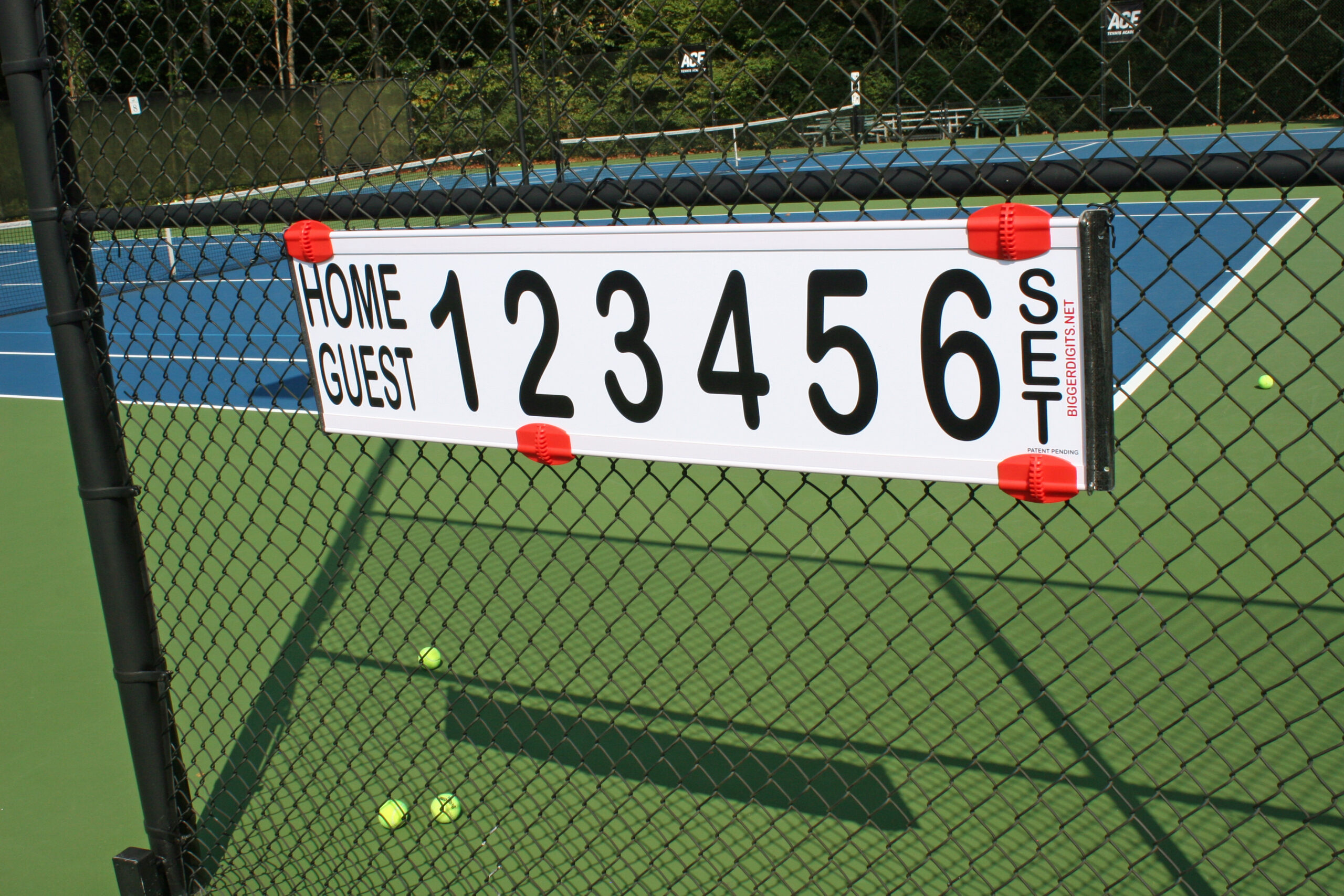
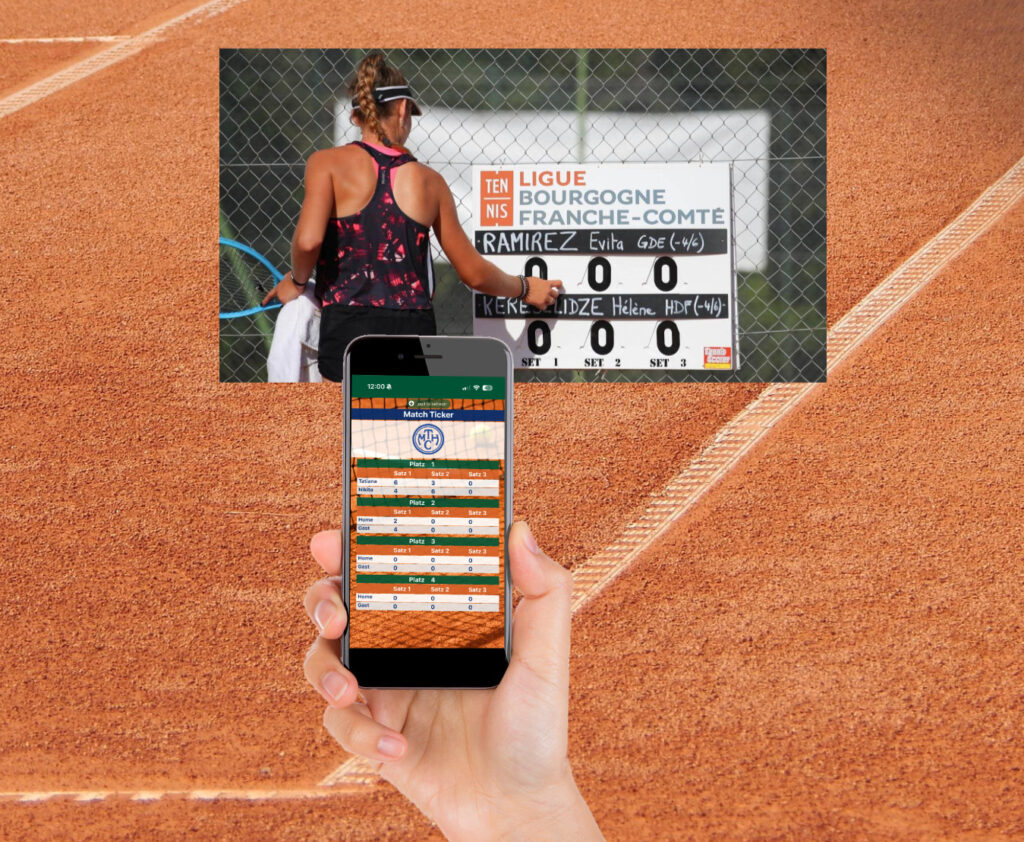
A typical tennis scoreboard is a rectangular board with one row per player, a section for names, central set columns, and a right-hand area for the live tennis score display. A marker such as a dot or triangle identifies the server, so the serving side can be read at a glance. The tennis scoreboard guide from Tennis Scorer shows how each section maps to the scoring system used on court.
Once installed, the board also needs to stay readable. Tennis Scorer manual models use digits measuring 10–12 cm: large enough to read from more than 50 metres on outdoor courts. White rot-proof PVC keeps the unit on court throughout the year, and in practice that matters when clubs need a display that keeps working regardless of weather or power cuts.
Understanding each point score displayed
From that point, the right-hand panel is the part most people check first. At game level, the points system follows the standard tennis scoring rules: love for zero, 15 for one point, 30 for two points, 40 for three points, then game. The server’s score is always shown first, so a tennis score such as 15-love means the server won the opening point on serve.
By contrast, if both players are tied on one or two points, the count is read as 15-all or 30-all; once both reach 40, the score becomes deuce. Because the display mirrors official tennis scoring rules exactly, the count on screen and the count called aloud are always identical.
Why tennis scoring uses 15, 30, and 40
The tennis scoring system is commonly linked to medieval French clock-face quarter hours: 15, 30, and originally 45. The word love for zero is often associated with the French l’œuf, or egg, reflecting the shape of a zero, while 40 replaced 45 for simpler calling and had been standardised at Wimbledon by 1877.
From that history, the difference comes down to convention: officials, players, and spectators read the score through inherited language that remains central to the scoring system. Recognising these terms is essential to follow deuce situations and read any live display with confidence.
How a single game is scored and displayed
A single game is the scoring unit updated most often during a tennis match. Each rally produces a point, and that point moves a player through the standard tennis score sequence: love, 15, 30, 40, then game. On a tennis scoreboard, the point display changes after each rally, while the game count in the set section changes only once the game is won.
Scoring a game from love to game point
Keeping the point display and the game count separate at all times is the first discipline a scoreboard operator must establish. If the score is 40-love, 40-15, or 40-30, the player in front wins the game by taking the next point.
Once the game is complete, the tennis scoreboard should display one more game for the winner and reset the point score to love-love. From that point, the server changes because players alternate serving by game. In practice, checking that both players agree before play resumes helps prevent errors over the score.
Deuce rules and advantage on the scoreboard
Once both players reach 40-40, the score reaches deuce. Under the rules, a player must then win two consecutive points to take the game. The next point creates advantage: Ad-In if the server wins it, Ad-Out if the receiver wins it.
At that stage, the numeric tennis score no longer applies on the display, and the advantage label takes its place for that game. If the player with advantage loses the next point, the score returns to deuce at once. A double fault during the advantage point immediately returns the score to deuce, resetting the sequence entirely.
Tennis scoreboard layout and physical design explained
The physical design of a tennis scoreboard determines how easily a player, an official, or a spectator can track the match. A clear board separates sets, the current game, and the live point display without overlap.
Reading set columns and the live point section
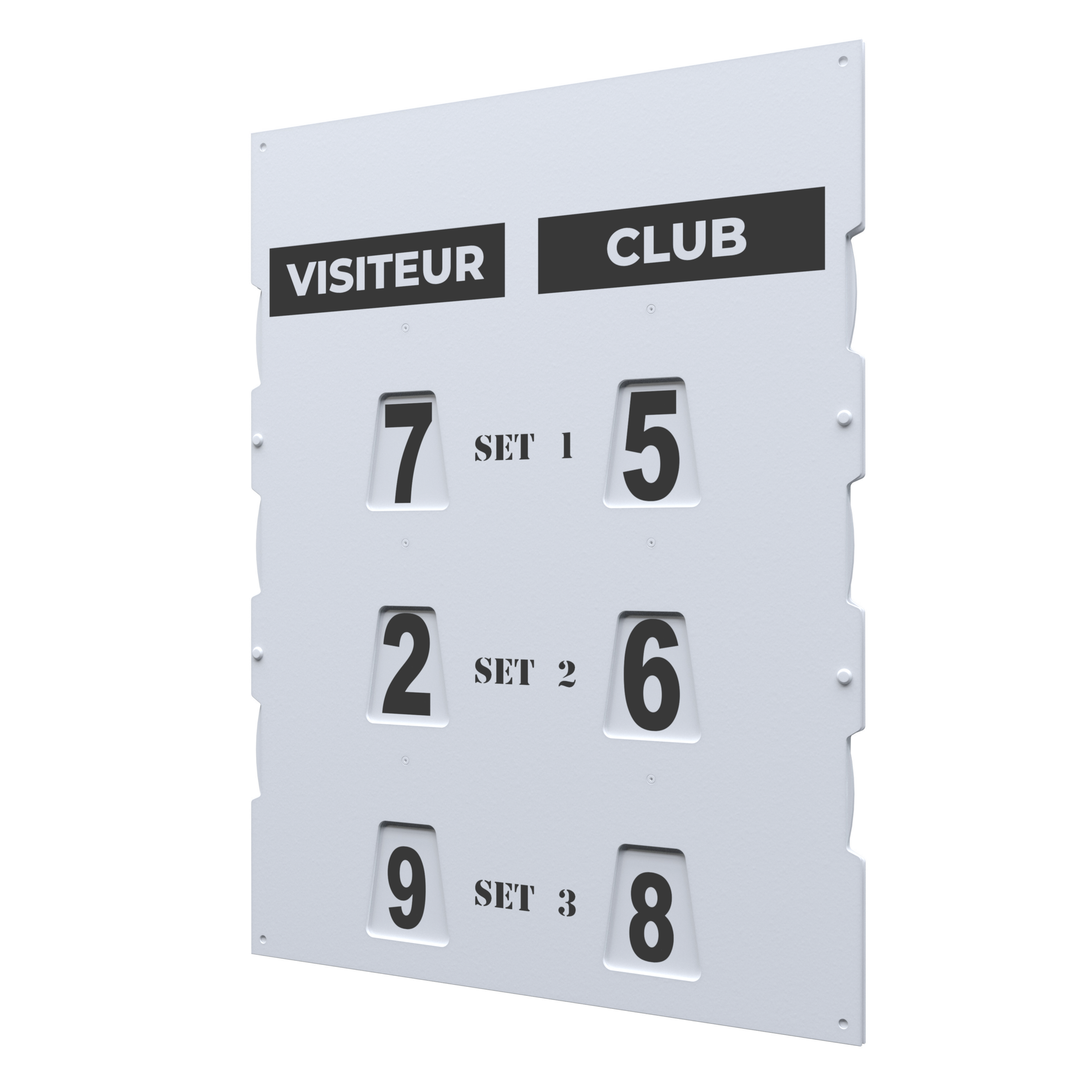
That clarity starts with the layout itself. For anyone asking what does a tennis scoreboard look like, the answer is straightforward: name plates sit on the left, set columns run through the centre, and the right-hand section shows the tennis score within the current game using standard tennis terms such as love, 15, 30, 40, deuce, and advantage.
- Player names: Displayed on slate name plates at the far left, one row per player, so each line of the display stays easy to read throughout the match.
- Set columns: The central columns show how many games each player has won in each set; once a set is complete, that column stays fixed and the next one becomes active.
- Live point display: The rightmost section shows the point score for the current game, updated after every rally.
- Serving indicator: A dot or triangle beside the name or score row marks the server. It should move at the start of each new game.
As a result, each area of the board corresponds to one level of scoring. The table below shows which part to update, when to update it, and how the score appears on the display.
| Scoreboard zone | Scoring level | Updated when | Display format |
| Left panel, name plates | Player identity | Before match begins | Player surnames or initials |
| Central columns, sets | Games within each set | After each game is won | Integer (0–7) |
| Right section, points | Points within current game | After every rally | Love / 15 / 30 / 40 / Deuce / Ad |
| Serving indicator | Current server | Start of each new game | Dot or triangle symbol |
From that structure, set columns run from left to right in order, so the first completed column is the opening set, the next is the second, and so on: if one player won the first set 6–3 and leads the second 4–2, that row shows 6 and 4, while the other shows 3 and 2. The live point section therefore refers only to the current game, regardless of the wider set totals.
Manual vs digital scoreboards for club courts
The same principle applies when comparing board types. Useful tennis scoreboard setup tips vary between manual and digital models, but the scoring structure does not change: the operator still updates the point after each rally, the game total after each completed game, and the serving marker when serving changes.
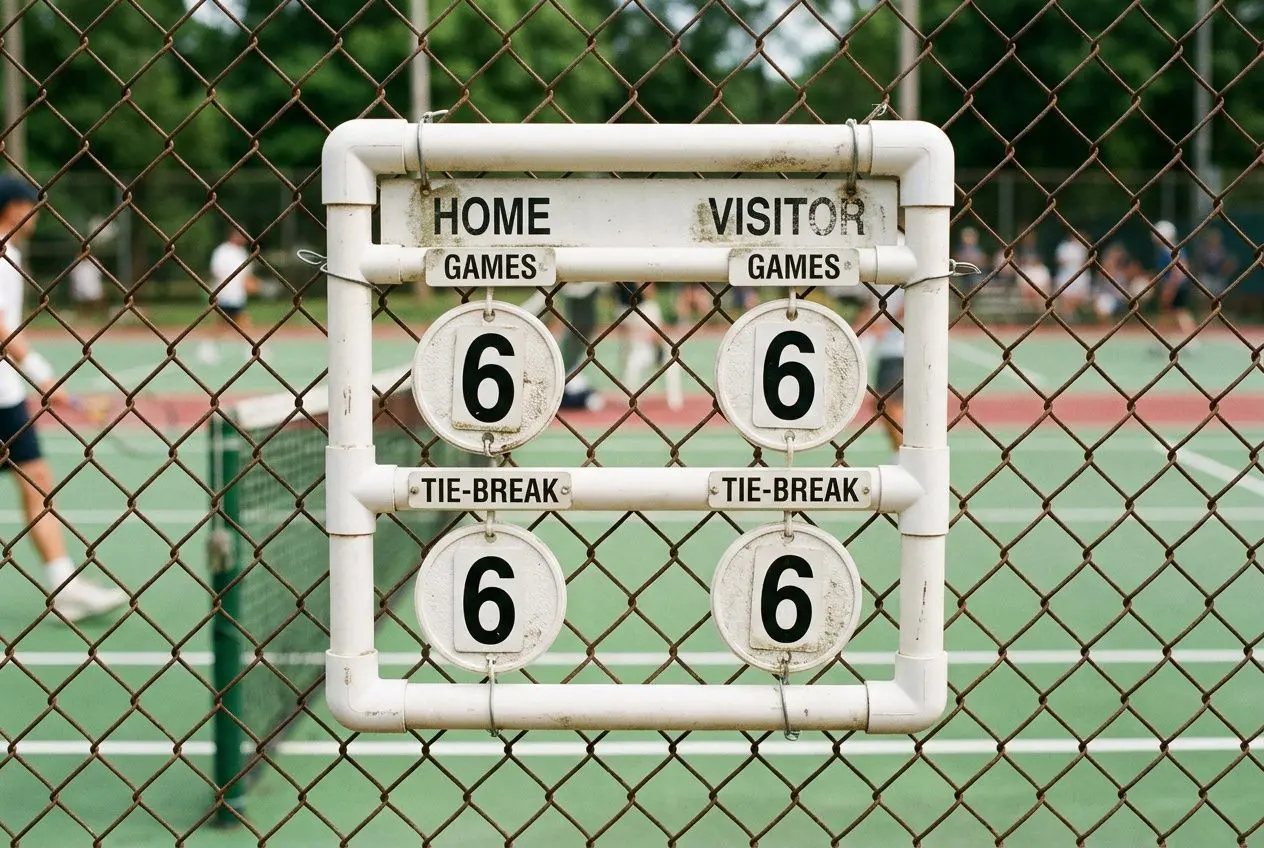
The update mechanism is what separates the two types. On a manual tennis scoreboard, rotating discs or sliding tiles are moved by hand; on a digital unit, a remote control or button panel sends the new score to the display. Digital systems can reduce operator error, but they rely on power and, in some cases, cabling or a stable wireless connection.
By contrast, Tennis Scorer produces manual boards in rot-proof white PVC for outdoor club use. High-contrast discs stay easy to read from the baseline and from spectator areas, with no electrical infrastructure required. For clubs where reliability is the priority, the simpler system is consistently the sounder option.
Once installed, a manual board from Tennis Scorer needs little beyond occasional cleaning. It continues to display clearly in bright sun, rain, and cold, conditions that can render screen-based displays unreadable within a single match.
Set rules, tiebreak scores, and small scoreboard numbers
Set scoring follows the same two-point margin as a standard game, but applied to the game count. A player does not win a set at 6–5; the score must show a lead of two, so the valid outcomes are 6–0, 6–1, 6–2, 6–3, 6–4, 7–5, or 7–6.
Once the set is complete, that result stays in its column on the tennis scoreboard and the next set starts from zero–zero.
How sets are won and displayed on the board
That completed set score is shown using each player’s final game total. If the set reaches 5–5, one player must win two consecutive games to take it 7–5, unless both players reach 6–6 and a tie-break is played.
- Standard set win: First player to six games with a two-game lead; the display then freezes that set at the final count for both players.
- 7–5 set win: Reached from 5–5 when one player wins the next two games and keeps the required margin under the rules.
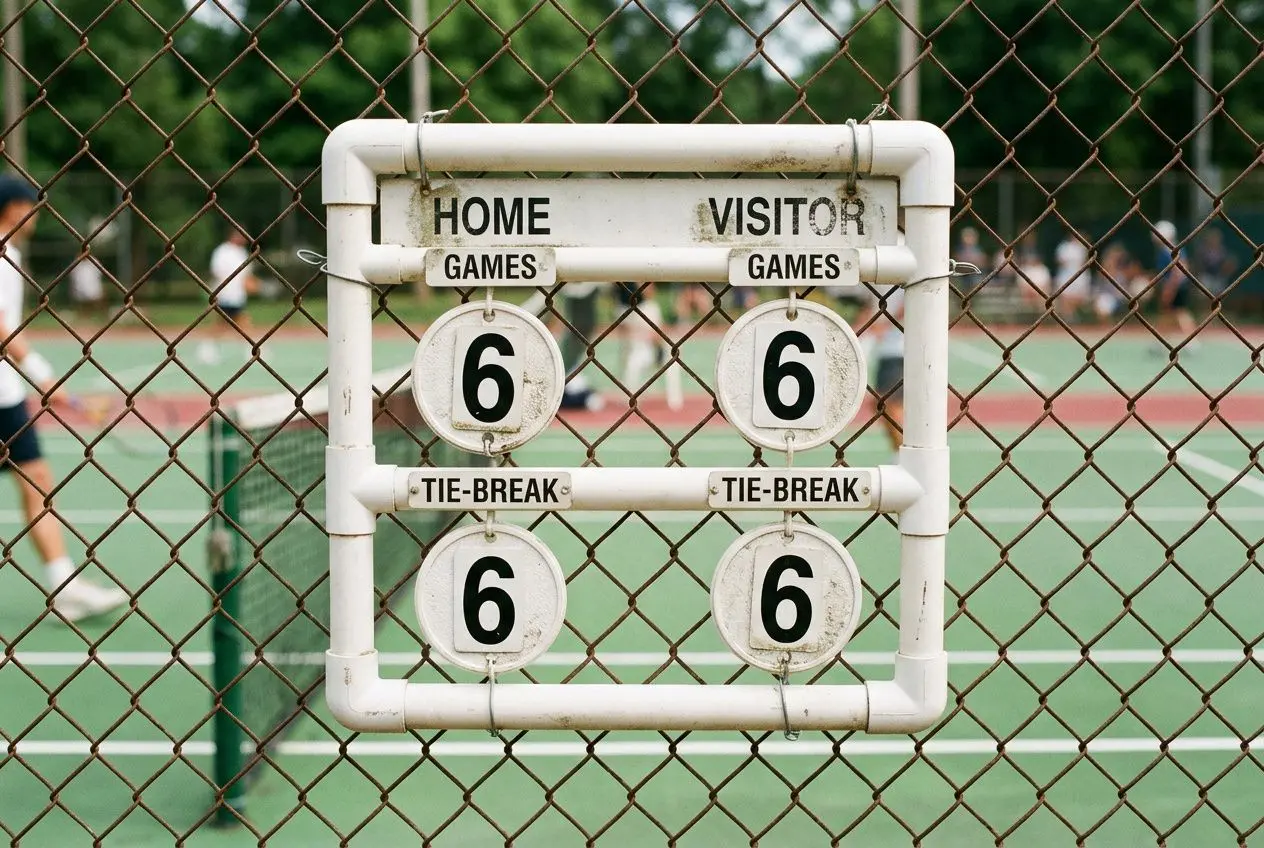
- Tiebreak set: Triggered at 6–6; the set ends 7–6, with the loser’s tie-break point total shown in brackets beside the set score.
During a tiebreak game, the point count changes format: 1, 2, 3, and so on, instead of love, 15, 30, and 40. Serving changes as well, with one player opening the tiebreak on the first serve, then each player serving two points in turn; players also change ends every six points.
What the small numbers in brackets mean
Those small numbers record the loser’s total in the tie-break, not the winner’s: a score of 7–6 (4) means the losing player reached four points before the set closed.
That notation only appears when the set is decided by a tiebreak game. By contrast, regular game scoring still follows deuce and advantage, whereas a tie-break continues until one player leads by two points, such as 8–6 or 9–7, with no deuce call under standard scoring rules.
A score of 7–6 (6) signals a far tighter finish than 7–6 (1): Tennis Scorer treats that distinction as essential to clear scoreboard reading.
Super tiebreak and Grand Slam final set rules
The same principle carries into the deciding-set format used in some events: a match tiebreak, also called a super tie-break or championship tiebreak. Here the first player to 10 points, with a two-point lead, wins the match; since 2022, Grand Slam events have used this format at 6–6 in the deciding set.
Where this format is adopted, the distinction lies in notation. A match tiebreak display shows both players’ full totals in brackets, for example 6–7 (8–10), rather than listing only the losing player’s points, which makes the final tennis score immediately legible.
Match formats, alternative rules, and scoreboard operation
The format of a tennis match decides how many set columns a tennis scoreboard must display and when a winner can be confirmed. Before play starts, the operator needs the exact format: standard structures and alternative scoring rules both affect what must be shown, from set totals to the way deuce is handled.
Best-of-three vs best-of-five set formats
The match format determines how many set columns the board must carry from the opening game. In a best-of-three tennis match, the board must track up to three set scores; in a best-of-five, it must track up to five. The tennis scoring system itself does not change, only the number of sets a player must win.
- Best-of-three: the first player to win two sets wins the match; this format is used for all women’s singles and all doubles at professional and club level.
- Best-of-five: the first player to win three sets wins the match; this is used only for men’s singles at Grand Slam tournaments.
- Super tiebreak final set: some events replace the third or fifth set with a 10-point match tiebreak, especially in doubles, to shorten the tennis match.
- Advantage final set: a small number of historic events continued the final set without a tie-break until one player led by two games; that format is now largely discontinued.
Because the number of possible sets is fixed in advance, the scoreboard layout must match that format before the first names are inserted. Confirm the format with the referee before the name plates go in.
No-Ad and FAST4 scoring on a scoreboard
The same match-format check also matters when non-standard scoring is used: No-Ad and FAST4 both alter what the board must display during a game, starting with the deuce sequence. No-Ad removes the advantage stage from the scoring system at deuce: at 40–40, one deciding point settles the game. The player set to receive chooses the side for the return, and the board moves straight to Game with no advantage display required.
By contrast, FAST4 changes the structure more broadly. Sets go to four games, a tiebreak starts at 3–3, and a sudden-death point replaces the usual deuce sequence. In practice, the point display still follows the same tennis scoring logic, but the operator must recognise the 3–3 tiebreak trigger rather than the standard 6–6.
Common scoreboard operation mistakes to avoid
Once installed, the main errors come from sequence rather than hardware. One common problem is failing to switch the serving indicator after a tiebreak game. Under the rules, the player who served first in the tie-break will receive in the opening game of the next set, so the operator must count the games carefully to keep serving correct and avoid disputes.
From that point, the next risk is a stale point display. If the board is not reset to love before the next game begins, players can start serving with the wrong tennis score still visible. Reset the points only after the completed game has been entered in the set column.
That same sequencing matters in the tie-break bracket. On a tennis scoreboard, the number beside 7–6 records the losing player’s point total in that tie-break, not the winner’s seven.
Frequently asked questions
How do you read a tennis scoreboard for beginners?
Begin with the player names on the left so each row is tied to the correct competitor. From there, read the set columns through the middle from left to right: they show the game count in chronological order and make the tennis score easy to track as the match develops.
Once that is clear, move to the point display on the right for the current game. In tennis scoring, that panel uses terms such as love, 15, 30, 40, deuce, and advantage, while the serving marker, often a dot or triangle, shows which player is serving.
From that point, the serving marker and point terms remain consistent across all scoreboard formats, so the display reads the same whether it is a club match or a Grand Slam.
What do the small numbers in brackets on a tennis scoreboard mean?
Those bracketed figures relate to a tiebreak game. They show the losing player’s point total in the tiebreak that settled the set, so a set listed as 7–6 (4) means the winner took the set 7–6 and the opponent scored four in the breaker.
The same principle applies when a final set is decided by a match tiebreak, sometimes shown as a super tiebreak. In that case, both totals may appear in brackets, as in 6–7 (8–10), because a single number no longer gives a clear enough display of the result.
Why is tennis scoring 15, 30, and 40 instead of 1, 2, 3?
The tennis scoring system is generally traced to medieval France, where quarter-hour markings helped track each point: 15, 30, and 45. The term love for zero is commonly linked to the French l’œuf, or egg, because its shape resembles 0.
From that point, usage shifted. The sequence 15–30–45 became 15–30–40, largely because 40 was quicker to call, and by 1877 Wimbledon had fixed that form in the rules.
History, not logic, explains the terminology, which is why the language still looks unusual at first read.