

Table of Contents
New to tennis and unsure how the scoring works, or which scoreboard makes a match easier to follow? This guide explains the tennis scoring system from the first point of a game through the tiebreak, sets and matches, then shows which scoreboard features help a beginner track the score clearly. For hardware decisions, this tennis scoreboard buying guide and the fence mounted tennis scoreboard guide cover format, size, weather resistance and installation in full.
Understanding the tennis scoring system from points to games
Tennis scoring follows a fixed sequence that can look unusual at first. Points within a game are not counted as one, two, three and four; they have their own names.
Why points go from love to 40
The tennis points system uses four named stages instead of a straightforward numerical count. The essentials are straightforward: only four points separate the start of a game from a standard win, and the names remain fixed. Love means zero. The term may come from the French l’oeuf, meaning egg and suggesting a zero shape, or from the Dutch and Flemish lof, meaning honour. Either way, every game begins at love.
- Love: zero points scored; both players begin each new game at love, shown as 0–0 on the scoreboard.
- 15: the first point won moves a player’s score to 15. This is a scoring convention, not a time unit.
- 30: the second point advances the score to 30. At 30–30, both players are two points from winning the game.
- 40: the third point reaches 40. The next point normally wins the game, provided the player has a two-point lead.
A player at 40–15, 40–30 or 40–love wins the game by taking the next point. The 15–30–40 shorthand is accepted through the sport’s history, so beginners do not need to calculate why 45 is absent.
When a player wins a game
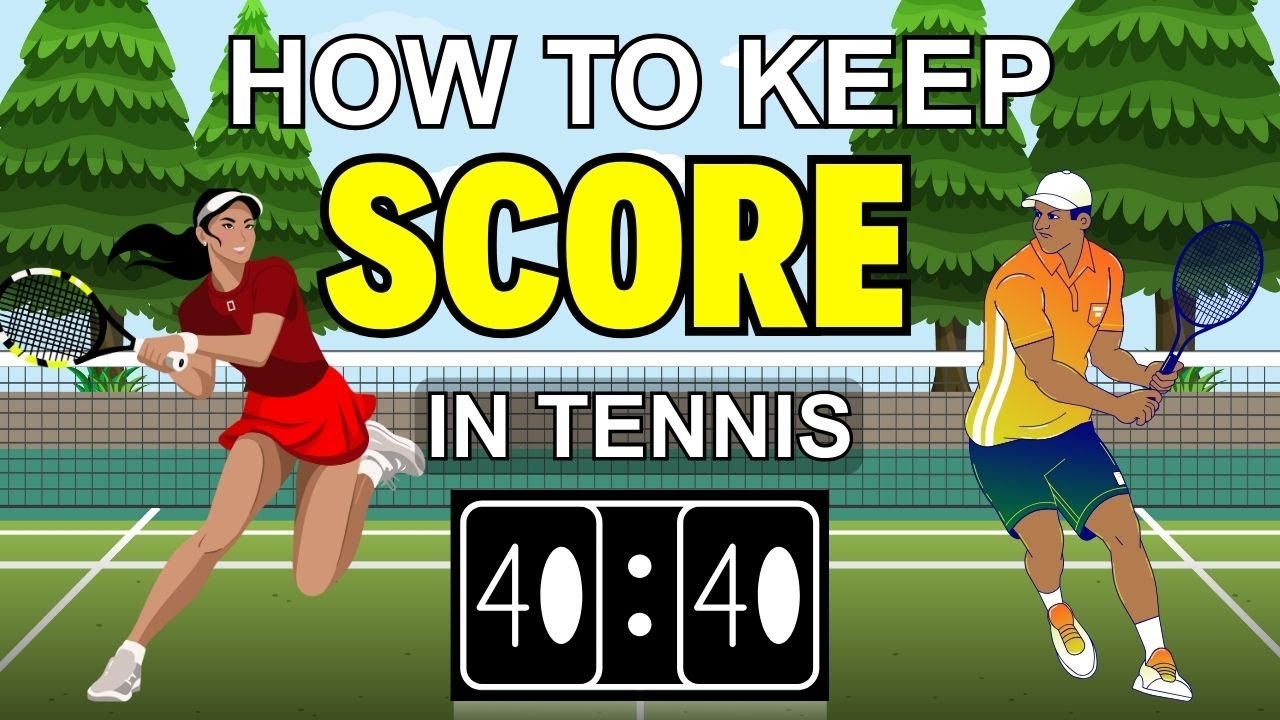
To win four points is the basic requirement for winning a game, but a two-point lead is also necessary. If both players have won three points and the score is 40–40, the game moves to deuce rather than ending on the next point. From deuce, one player must win the following point to gain advantage, then win another to close the game.
A common beginner question is how many games in a set of tennis are needed. The answer is six, provided the winner leads by at least two games. Games build the middle layer of the tennis scoring system: points form games, games form sets, and sets form matches. A tiebreak may decide a set when the score reaches 6–6, according to the competition rules.
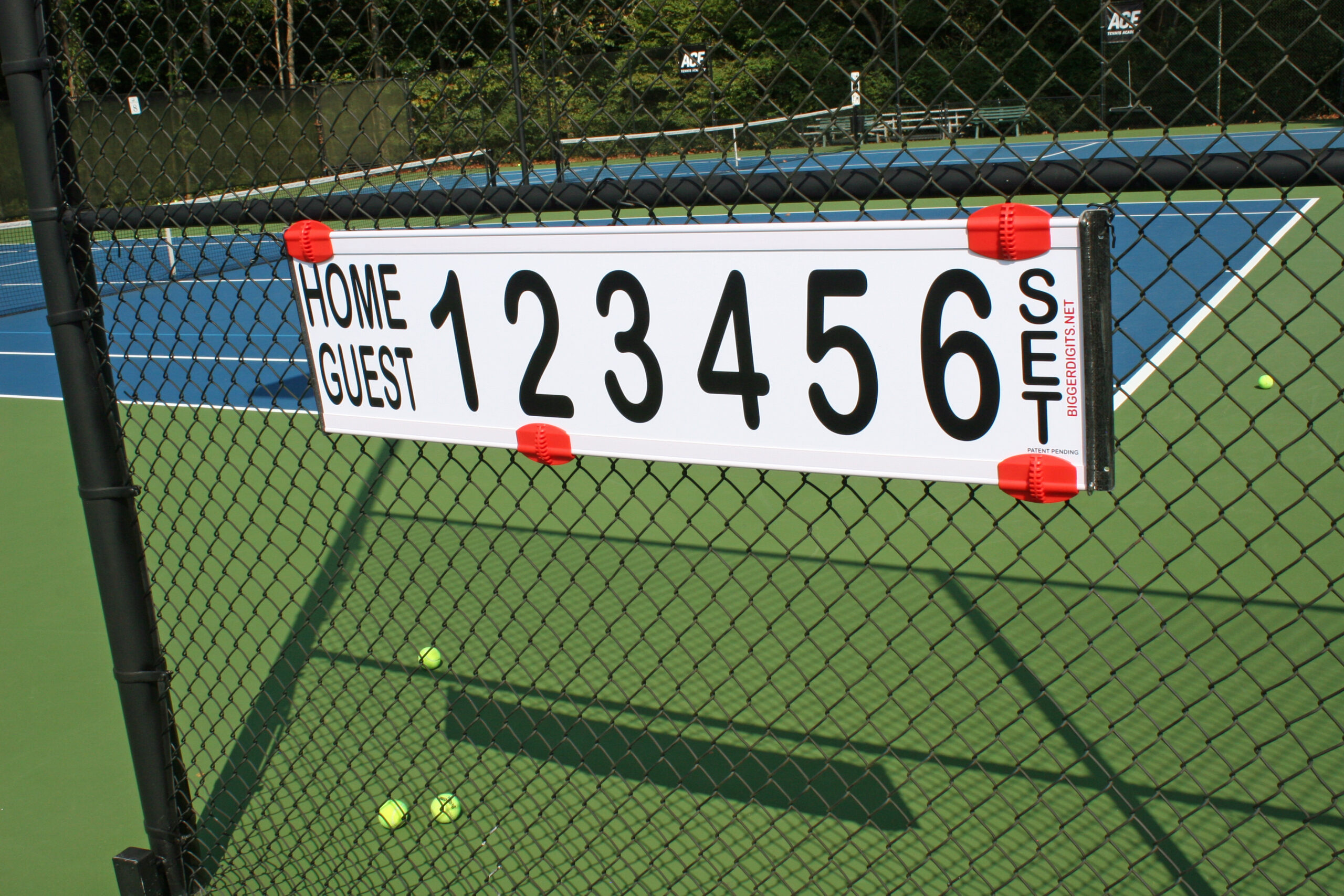
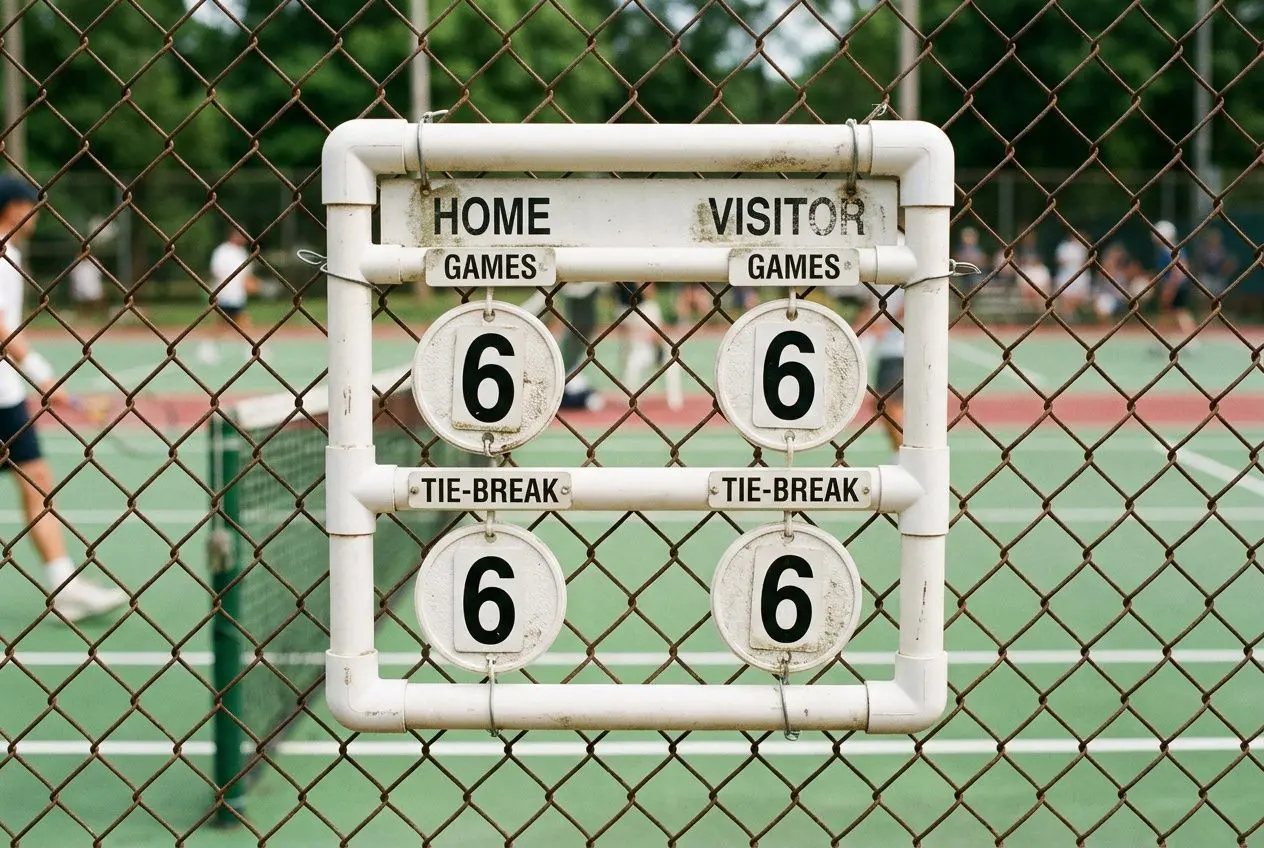
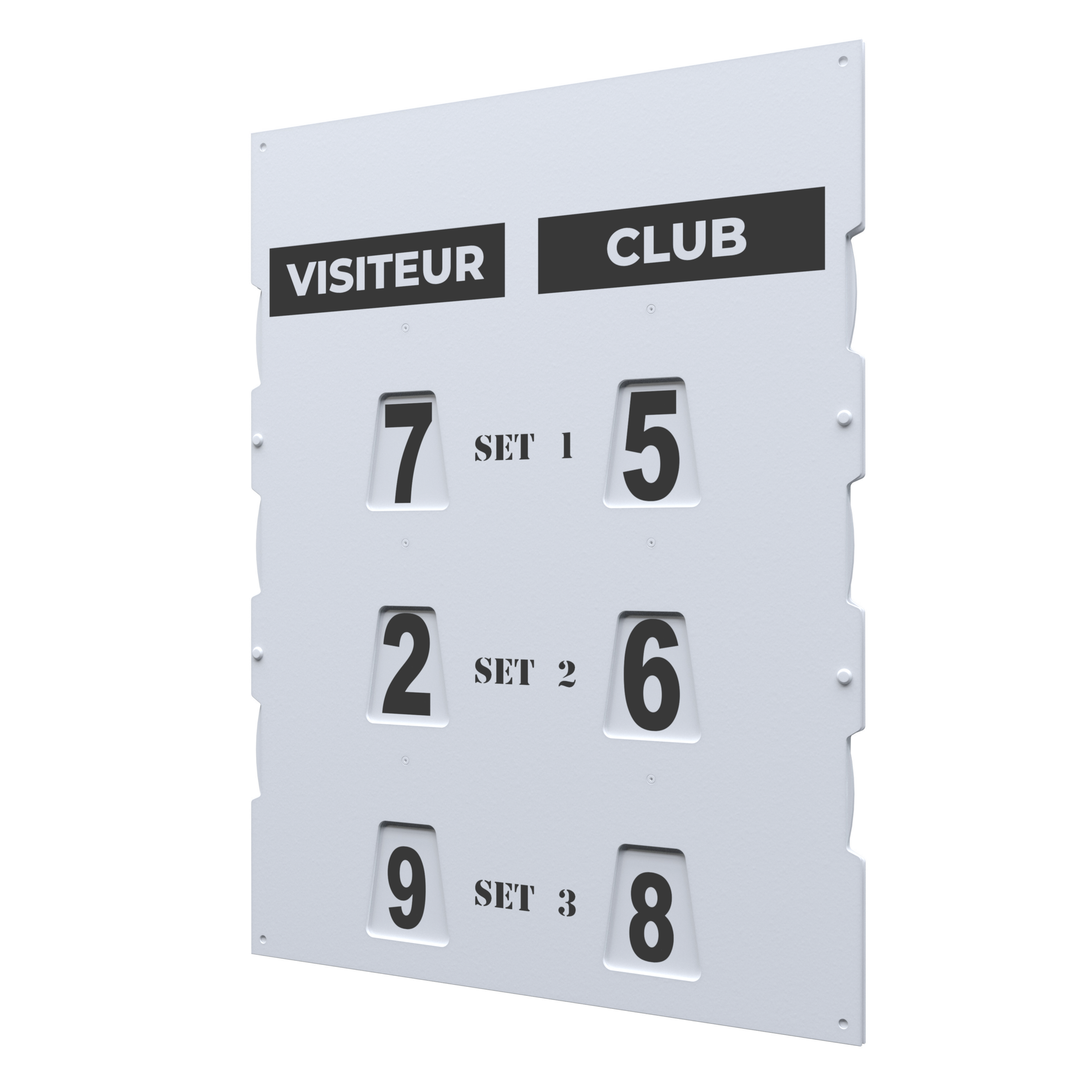
Manual scoreboards show this layered structure through dedicated columns: one for current points in the ongoing game and separate columns for the running game total in each set. Tennis Scorer designs rotating-disc boards with that layout, allowing players and spectators to read the current game score and wider set position at a glance.
Deuce, advantage and winning a set
Deuce is the point at which a game refuses to end neatly. Both players have reached 40–40, so neither can win on the next point alone. The game continues until one player takes two consecutive points, a requirement that can extend a single game through several minutes of high-quality play.
How deuce and advantage work
Once the score reaches deuce, the next point creates advantage rather than winning the game immediately. If the server wins the point after deuce, the score becomes ad-in; if the receiver wins it, the score becomes ad-out. The terms show which player is one point from taking the game.
From advantage, the outcome is binary. A player who wins the next point claims the game; a player who loses it returns the score to deuce.
- Deuce: both players are at 40–40, and neither player wins the game on the next single point alone.
- Ad-in: the server wins the point after deuce and holds advantage; one further point wins the game for the server.
- Ad-out: the receiver wins the point after deuce and holds advantage; one further point wins the game for the receiver.
- No-ad scoring: a format used in many doubles competitions where the point after deuce decides the game immediately, with the receiver choosing the side for that serve.
No-ad scoring removes the advantage stage, which shortens matches and simplifies scorekeeping. Many doubles matches and recreational leagues use this format, so a beginner entering a club competition should confirm the rules beforehand. On a manual scoreboard, the same game-score column records both formats; only the interpretation of 40–40 changes.
How many sets decide a match
A set is won by reaching six games with a lead of at least two games. At 6–5, the leading player can take the set 7–5 by winning the next game. If neither player establishes that two-game margin and the set reaches 6–6, a tiebreak replaces the extended set in most standard formats, helping keep match duration predictable.
The number of sets needed to win a match depends on the format. Most recreational and women’s professional matches are best of three sets: the first player to win two sets takes the match. Men’s Grand Slam matches are best of five sets and require three set victories. A rotating-disc scoreboard with cumulative set-total columns up to 99 across three sets handles both formats without a hardware change: the same equipment serves best-of-three and best-of-five play.
Tiebreak scoring and scoreboard features
When a set reaches 6–6, the tiebreak replaces the conventional game-scoring sequence. Points are no longer called love, 15, 30 and 40; they are counted numerically from zero upwards. That change can unsettle a beginner, while a scoreboard with a clearly distinct tiebreak display removes uncertainty during the changeover.
Reading a tiebreak correctly
A readable tiebreak display uses bracket notation, a separate numerical count beside the standard game column, and a serving indicator showing which player is serving after each two-point rotation. Together, these details keep players and officials aligned with the score.
- Standard tiebreak: first to seven points with a two-point lead. It is used when a set reaches 6–6 in most formats, with players changing ends every six points.
- Match tiebreak: first to ten points with a two-point lead. It replaces a full third set in many doubles and mixed doubles matches.
- Grand Slam final-set tiebreak: since 2022, a ten-point tiebreak with a two-point margin has been used when a final set reaches 6–6 in Grand Slam tournaments.
Serve rotation follows a fixed pattern: one player serves the opening point, then each player serves two points alternately. After several rotations, identifying the next server becomes difficult. A dot or triangle beside the relevant player’s row makes that information immediate.
| Tiebreak format | Points to win | Two-point margin required | Typical use |
| Standard tiebreak | 7 | Yes | Set reaches 6–6 in singles and doubles |
| Match tiebreak (super tiebreak) | 10 | Yes | Replaces third set in doubles and mixed doubles |
| Grand Slam final-set tiebreak | 10 | Yes | Final set at 6–6 in Grand Slam events (from 2022) |
Features beginners need to see
A well-designed manual board separates three information layers: the current points in the live game, the running game totals for each set, and the tiebreak score in brackets, such as 7–6 (7–4).
- Serving indicator: a dot or triangle beside the server’s row identifies the current server for players, officials and spectators without electronic components.
- Bracket tiebreak display: tiebreak scores appear in parentheses beside the set score, preventing confusion between ordinary game totals and tiebreak points.
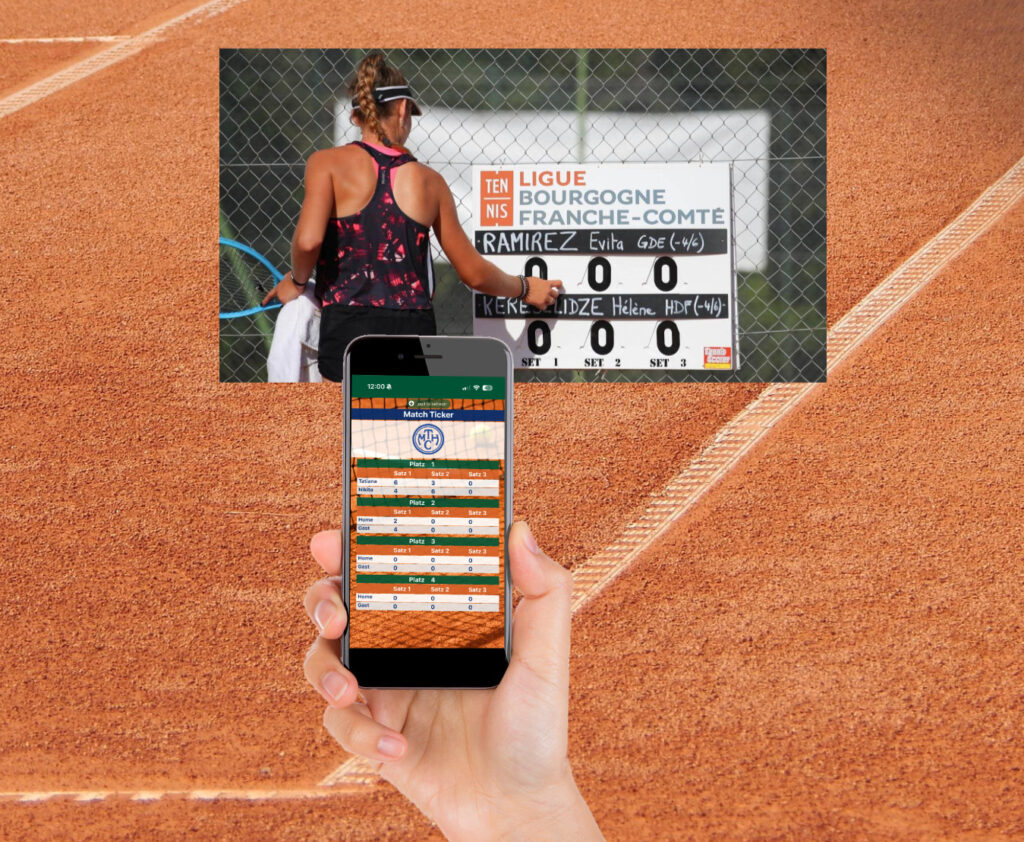
- Removable name plates: slate or equivalent plates display player or team names at the top of the board, showing which row belongs to each competitor.
Tennis Scorer builds these conventions into every rotating-disc model: game scores run from 0 to 7 per set, cumulative set totals reach up to 99 across three sets, and bracket notation for tiebreak results is supported as standard. As a result, players and officials can update the board after every changeover in under a minute.
Choose the right scoreboard size
The correct scoreboard size depends primarily on viewing distance. A board that is clear from the net on a private court may be unreadable from the far baseline of a competition court with spectators.
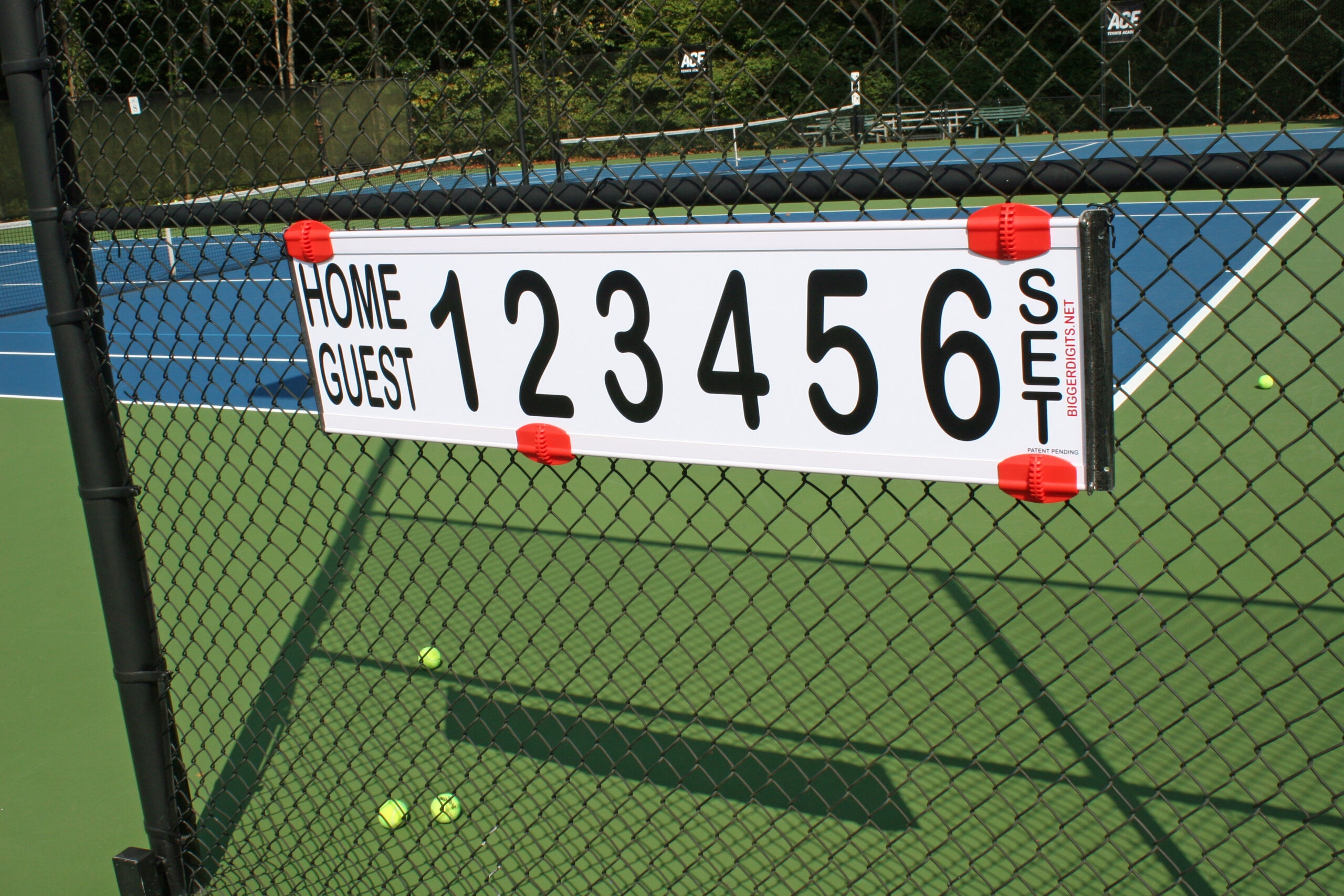
Match size to viewing distance
For a beginner learning how to choose a tennis scoreboard, viewing distance takes priority over the type of court, whether private, club-based or used for tournaments. The difference comes down to digit height: numerals should be at least 10 cm high on a white PVC background for dependable reading from both baselines and courtside positions beyond 50 metres.
- Small format (35 × 50 cm), suited to net-side positioning on private or compact courts with short sightlines.
- Medium format (46 × 65 cm), the standard club size, readable from both baselines and compatible with most mesh-fence installations.
- Large format (56 × 80 cm), designed for tournament courts, spectator areas and sightlines extending beyond 50 metres. It is the right choice when visibility must serve a wider audience reliably.
Full-panel PVC boards of approximately 60 × 60 cm use 10 cm numerals on a white background and stay legible beyond 50 metres. Compact rotating-disc and full-panel models install without specialist tools and need no ongoing servicing once fitted. Mounting hardware is supplied with every model, while cable-tie installation requires no drilling.
Compare rotating discs and full panels
Rotating-disc models show game scoring from 0 to 7 per set, cumulative set totals across three sets and a dedicated current-points column beside the set columns. Players or officials adjust the discs manually during changeovers, while the serving indicator, shown as a dot or triangle, identifies the current server without requiring power. The system therefore remains self-contained for outdoor use in all conditions.
Full-panel PVC boards take a different approach: large-format numerals on a plain white background, optimised for long-distance readability rather than the layered structure of a rotating-disc score display. Both formats use weatherproof construction and include a branding zone measuring 56 × 17 cm. Sponsor logos or club identity can be added with free personalised adhesive stickers in green, blue or black.
Weatherproof scoreboards and long-term value
A scoreboard installed on an outdoor tennis court faces ultraviolet exposure, frost, driving rain and seasonal temperature swings over decades of use. Material quality and construction detail determine whether it remains operational after twenty years or starts to fail within the first five.
Materials that withstand outdoor courts
Durable construction begins with UV-stabilised, rot-proof PVC integrated throughout the board body rather than applied as a surface coating. Counter-glued, watertight edges limit moisture ingress and frost damage during year-round use, which is especially important in climates with sustained winter freezing. Corrosion-resistant brass eyelets and anti-rust hooks protect fixing points on disc models from seasonal weathering, while full-panel boards attach with four supplied cable ties, requiring no drilling.
Tennis Scorer documents a 20-to-30-year service life for correctly installed boards, supported by evidence from nearly 16,000 courts across Europe and the USA that remain in active use after installation in the early 1990s.
Manual and electronic running costs
The cost difference between manual and electronic scoreboards extends well beyond the initial purchase price. A manual PVC board needs no power supply, software subscription or maintenance contract during its working life. Electronic systems, by contrast, typically include manufacturer warranty cover in year one for parts, LED digits, labour and callouts; from year two onwards, labour, callout fees and non-LED components generally fall outside that cover unless a paid annual service plan is added.
- Manual boards, zero ongoing costs: no electricity, servicing contract or electronics maintenance is required. Once installed, the board operates without external input.
- Electronic systems, year-one warranty: parts, LED digits, labour and callouts are covered in year one. Buyers should verify certifications such as ETL listing to UL 48, CSA testing and CE labelling before purchase.
- Electronic systems, year-two-plus costs: annual service plans typically include telephone support, on-site repairs, annual inspection and priority callout, creating recurring expenditure over a 20-to-30-year horizon.
- Manual replacement parts: individual score digits, discs and name plates are sold separately. Club members can usually fit replacements in minutes without a specialist callout.
Over a 20-to-30-year lifespan, the cumulative cost gap between a manual board and an electronic system with annual service plans can become significant for a club working within a fixed facilities budget. Manual boards avoid that compounding expenditure: replacement components are the likely outlay, and they can be purchased separately instead of replacing the complete unit. That approach suits committees managing court equipment from one year to the next.
Tennis Scorer describes its Premium Match Pointer as 100% weatherproof and maintenance-free under normal conditions. Sealed score discs are engineered to prevent water cohesion and operate smoothly during heavy rain without silicone lubricant. In practice, players can update the score during changeovers without using a board that has become stiff, waterlogged or difficult to read. That practical advantage carries across every match played through a British winter season.
Frequently asked questions
How does tennis scoring work for a complete beginner?
The tennis scoring rules have three layers: points within a game, games within a set, and sets within a match. Points move from love (zero) to 15, 30 and 40. A player wins a game by reaching at least four points with a two-point lead.
Six games win a set, provided the margin is at least two games. At 6–6, a tiebreak decides the set. Most matches are best of three sets, so the first player to win two sets wins the tennis match. If both players reach 40–40, the score is deuce; from there, two consecutive points are needed to win the game.
Why is tennis scoring 15, 30 and 40 rather than 1, 2 and 3?
The 15–30–40 sequence is one of the sport’s oldest conventions, and no single definitive explanation accounts for its origin. One widely cited theory links each increment to the quarter-hours of a clock face: 15, 30 and 45. The final value was later shortened to 40, supposedly to allow the two-syllable call of “advantage” after deuce without confusion.
Another theory points to historical French monetary values used in early forms of the game. Every tennis game score in tennis follows the same progression, regardless of playing level, and a manual scoreboard’s current-points column displays it directly.
What scoreboard features help most when learning to score a match?
For a beginner developing an understanding of the scoring system, three scoreboard features are particularly useful. A dedicated current-points column shows love, 15, 30, 40 or tiebreak numerals separately from the game totals, so the two layers remain visually distinct.
A serving indicator, such as a dot or triangle, removes doubt about serving order during the tennis serve rotation. This is especially helpful in a tiebreak, when the serving sequence changes every two points. Bracket notation for tiebreak scores, such as 7–6 (7–4), also keeps the tiebreak result separate from the ordinary set score across all three sets.