

Table of Contents
A tennis score is built in layers: points make games, games make sets, and sets decide the match. Learning how to read tennis scoreboards means taking those layers one at a time, from love and deuce to set columns, tie-break brackets and match status. Tennis Scorer’s manual and connected boards follow the same logic, so club players can match each figure to what happened on court.
Where to look on a tennis scoreboard
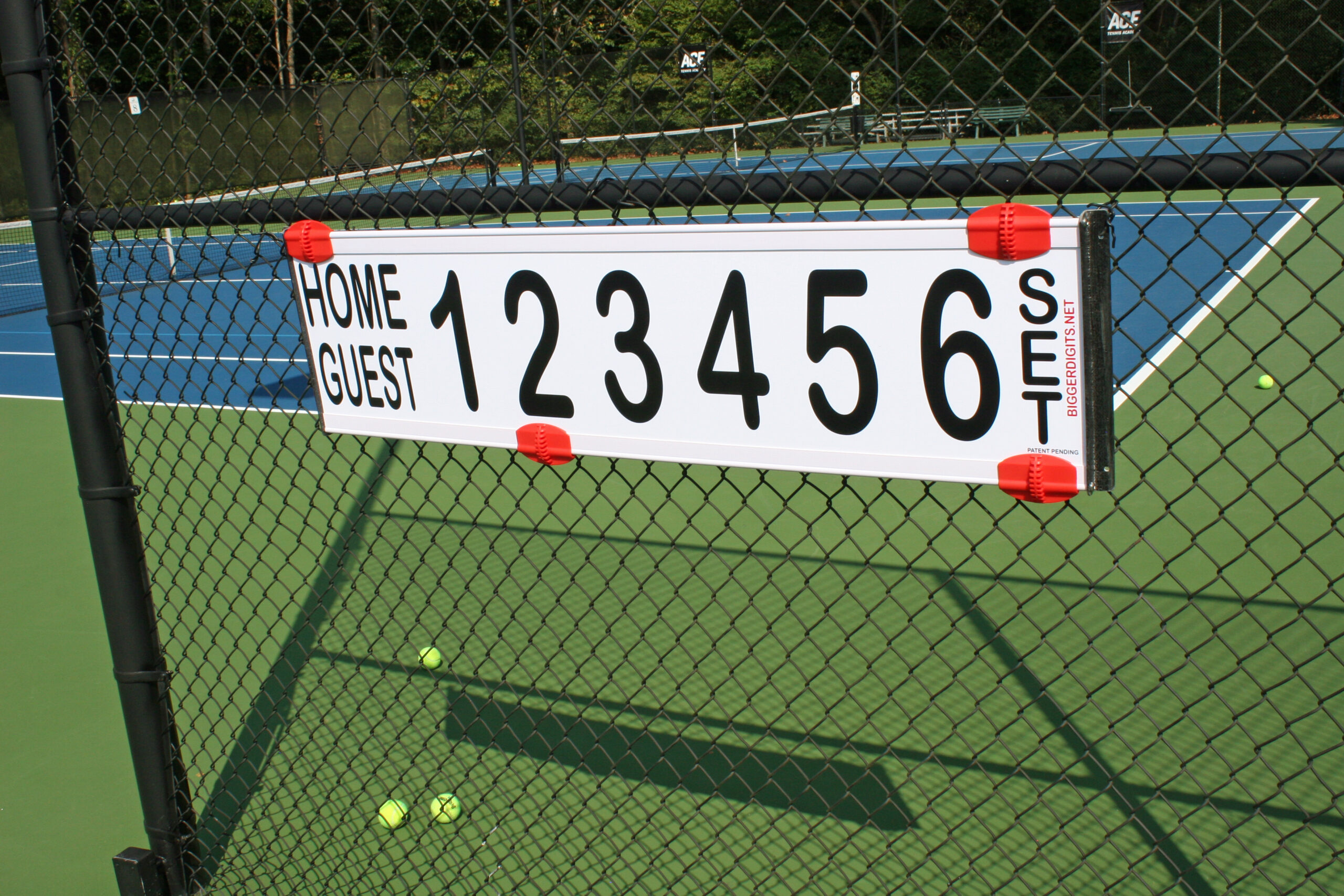
Every tennis scoreboard follows the same logic, even when layouts differ. Each player or pair has a row. The columns along that row hold the score, from finished sets to the game in progress.
Read the rows and columns
Reading tennis scores starts with the row. Each figure belongs to the player or pair named on that row, so numbers on different rows never combine into one player’s score. Then read the completed-set columns in the order they were played, followed by the games in the current set and, where shown, the current game’s points.
A number in a set column counts the games won in that set. It is not the points won in the current game. As a result, the current-set total moves only when a game finishes, never after every rally.
Find the service marker
Once the rows are clear, the next detail is service. A marker beside one row identifies the server, meaning the player who serves the next point. Its shape depends on the board, so the board’s key matters:
- Dot: a small filled circle beside the server’s name or row.
- Triangle: often pointing towards the server’s row.
- Arrow: points at the player due to serve.
- Top row: on a fixed-row board this is not necessarily the server’s row, whatever its position.
The marker says nothing about who leads. Take a board where Evans has 6 games to Khan’s 3 in the first column, then 4–2 in the next. Evans won the first set 6–3 and leads the current set 4–2, whichever row carries the marker.
Recognise what a display omits
Not every display shows every layer. A compact television graphic may drop the detail of earlier sets while still showing the live score. By contrast, a club board may show set and game totals with no panel for the current game’s points.
From there, the rule is to read only what the display actually carries. A partial display cannot show every step that led to the present score. In practice, a missing points panel means the game in progress is followed on court, not on the board.
How to read the current game’s points
Within a game, tennis scoring uses its own vocabulary rather than plain counting. Once each label is clear, the spoken score and any points panel become easy to follow.

Translate love, 15, 30 and 40
An ordinary game starts at love–love, or 0–0. “Love” simply means zero points. From there, each point won moves a player one step along a fixed sequence.
The steps are labels, not totals. On court, that means 40 marks three points won, never four:
- 15: first point won.
- 30: second point won.
- 40: third point won; the next point can win the game.
Reaching 40 is not enough on its own. Under ordinary tennis scoring rules, a player needs at least four points and a two-point lead to win the game.
Say the point score aloud
The point score is always spoken with the server’s figure first. “30–15” means the server has won two points in the game and the receiver one.
The same convention covers every early score. At 15–love, the server has won one point and the receiver none. “All” marks a level score: 15-all means one point each, 30-all two each.
On a fixed-row board, this means finding the service marker before reading aloud. Suppose Evans shows 15 and Draper 30, with a service triangle beside Draper. Draper is about to serve, so the spoken score is 30–15, not 15–30.
Recognise deuce and advantage
When the score reaches 40–40, both players have won three points in the game: this is deuce. Under advantage scoring, the next point gives its winner advantage, not the game. Winning the following point takes the game; losing it sends the score back to deuce, which can repeat many times.
A compact “A” or “Ad” on a points display means advantage, not an extra game, and naming its holder is clearer than saying “ad-in” or “ad-out”. A game point is any point that would win the game: at 40–30, the server’s next point is one. When that point belongs to the receiver, it becomes a break point, a chance to break serve.
How to read sets and tie-break numbers
Once a game ends, the game score in the current set changes by one. Those game totals then decide when a set is complete, and at 6–6 they open a tie-break with its own counting method.
Decide whether a set is complete
A standard set needs at least six games won and a two-game lead. Any set score from 6–0 to 6–4 is therefore final, as is 7–5. By contrast, 6–5 is not: at 5–5, a player must win the next two games to take the set 7–5.
Game and point layers can meet on a single rally. At 5–4 in games and 40–15 in the current game, the leader’s next point is both a game point and a set point. Winning it produces a 6–4 set.
Decode a tie-break score
At 6–6 games in a tie-break set, a standard tie-break begins. Points are counted from zero in plain numbers: 1, 2, 3, not 15, 30, 40. The first player to reach at least seven points with a two-point lead wins the tie-break and the set 7–6.
The tie-break score usually appears as one small bracketed number giving the loser’s points: 7–6(4) means a 7–4 tie-break, while 7–6(6) means 8–6. Some displays print both figures instead, as in 7–6 (7–4). Without punctuation, row labels or headings, “7 6 3” stays ambiguous: it could mean 7–6(3), or figures in separate set columns.
Follow service during a tie-break
Service in a tie-break moves faster than in ordinary games. The player due to serve takes the first point, the opponent serves the next two, and service then alternates every two points. As a result, the service marker can move several times within one tie-break.
Players change ends after every six tie-break points, with no ordinary changeover rest. The player who served the tie-break’s first point receives in the first game of the next set. Outside tie-breaks, service normally changes after each game, not at changes of ends; in doubles, the scoring layers stay the same while service follows an order within each pair.
How to tell whether the match is over
The match score counts the sets each player has won across the set columns. Reading it correctly depends on two things: how many sets the match requires, and which format the competition uses for a deciding set.
Count sets won and check status
In a best-of-three tennis match, the first player to win two sets wins. In best of five, three sets are needed.
Set columns read in playing order. In a 6–4, 4–6, 7–6(5) scoreline, the first-named player won the first and third sets and lost the second.
The same logic separates finished matches from live ones. In best of three, 6–3, 4–6, 7–6(8) is a completed win, while 6–3, 4–6, 6–6 is still in progress if a final-set tie-break remains. Labels such as “live”, “final” or “suspended” describe match status, not another scoring unit.
Identify the deciding format
A scoreline such as 6–4, 4–6, [10–7] uses a 10-point match tie-break in place of a third set. The difference comes down to timing: a 10-point tie-break can also be played inside a final set once it reaches 6–6 games. Both forms need a two-point lead, so 10–9 never ends one.
The four Grand Slam events adopted the 10-point tie-break at 6–6 in the final set in 2022, and the 2026 Grand Slam Rule Book keeps it. The 2026 ITF Rules of Tennis also allow other deciding-set formats: an advantage set, a tie-break set or an approved match tie-break. In an advantage set, play continues beyond 6–6 until one side leads by two games.
Allow for shorter scoring formats
Club and junior events often shorten matches further. Under no-ad scoring, the point played at 40–40 decides the game, with no advantage stage. The LTA scoring guide describes FAST4 as combining four-game sets, a tie-break at 3–3, no-ad scoring and a 10-point match tie-break at one set all.
Because formats vary this widely, the competition’s stated format settles what a deciding score means. It shows whether the figures represent continuing games, a tie-break within a set or a replacement match tie-break.
How to read a Tennis Scorer board
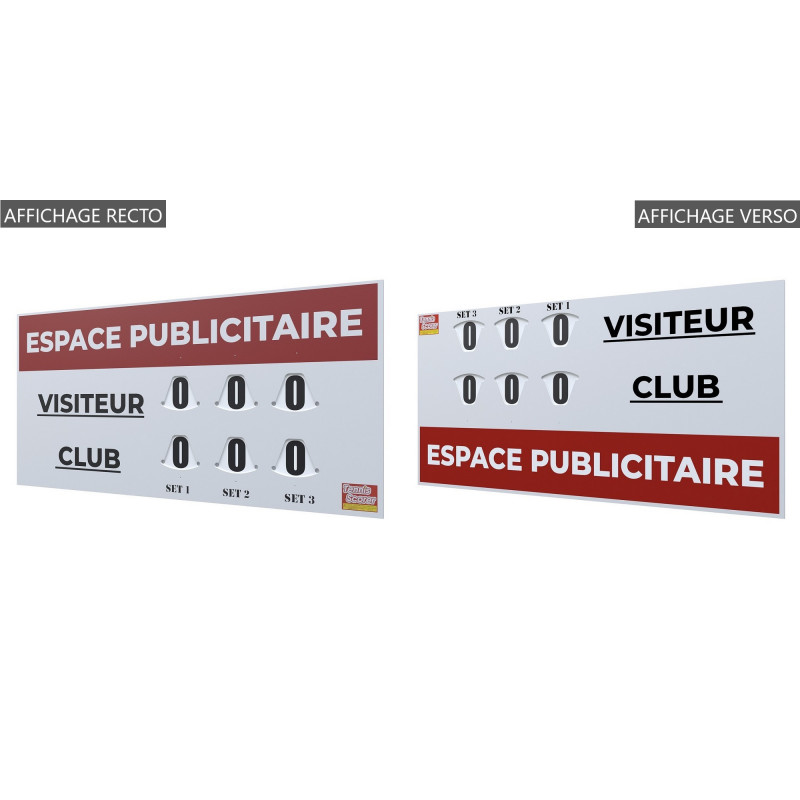
Tennis Scorer’s manual boards apply the layers described above to a fence-mounted panel that players update themselves. Each board covers a specific part of the score, which explains what it shows and what it leaves to the players.
Read the manual set displays
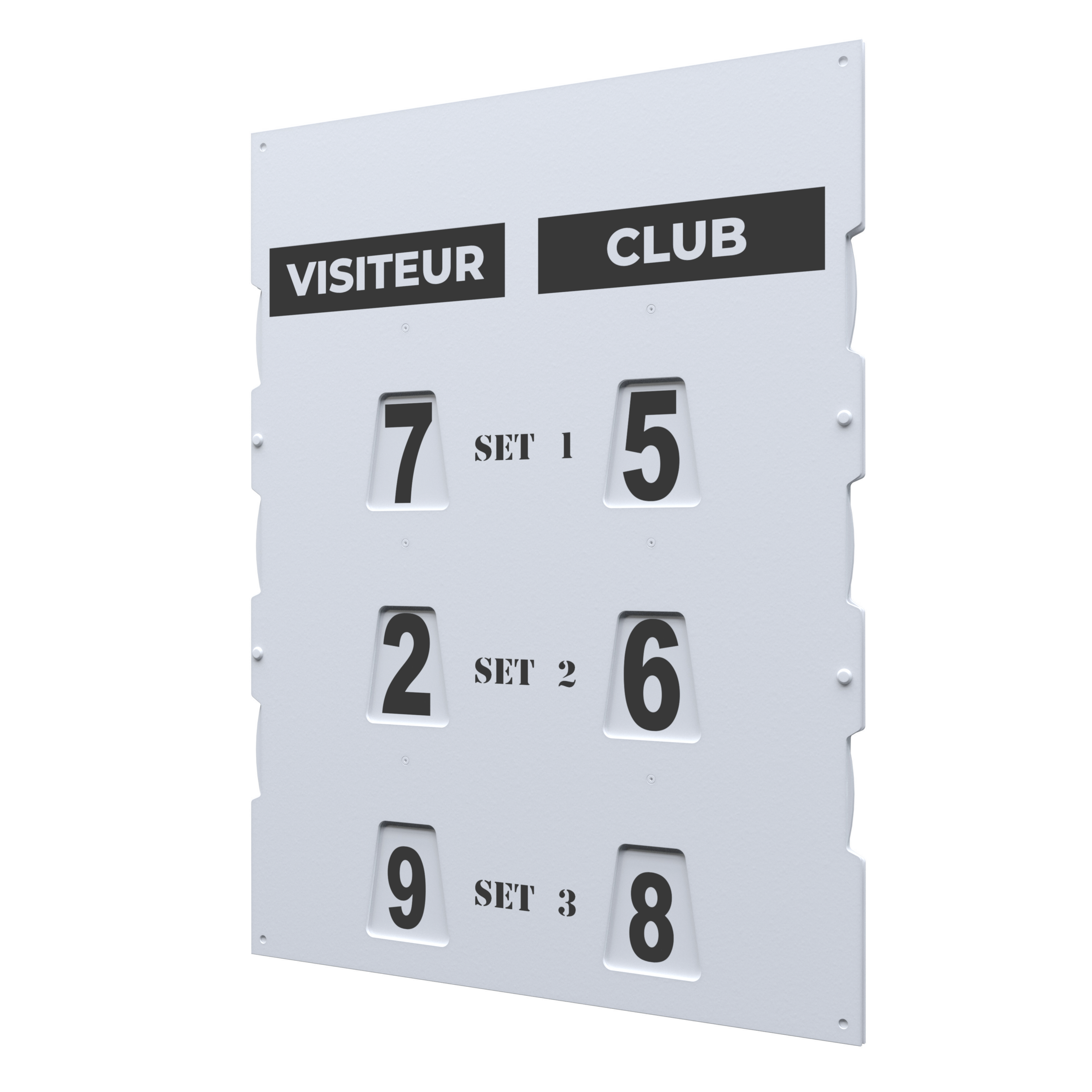
Tennis Scorer’s set boards display games, not points. Their rotating discs show 0 to 7 in each of three set columns, with set numbers marked:
- Large Model: 120 × 60 × 1 cm and 4 kg, with one plate for players’ names and rankings.
- Double Sided Compact Model: 80 × 60 × 1 cm and 3 kg, with two name-and-ranking plates; its padel version displays 0 to 9.
- Figures: 12 cm high and 2.5 cm wide, framed automatically, readable from more than 50 metres.
Reading the large fence-mounted tennis scoreboard follows the row-and-column method: each name plate anchors a row of game totals. The same applies to the compact double-sided tennis scoreboard, readable from both sides of the fence. On both, the 0–7 discs alone never show love, 15, 30, 40, deuce or advantage.
Read decisive-game points separately
A tie-break needs a separate points display. Tennis Scorer’s Special ‘Decisive Game’ board shows each player’s or team’s points from 00 to 99 on rotating discs. Its two slate boards identify players in individual tournaments or clubs in team matches.
The decisive-game tie-break scoreboard handles seven-point tie-breaks and 10-point super tie-breaks in tennis, padel and beach tennis. Ordinary 0–7 discs cannot show a 10-point tie-break’s full total. The board measures 60 × 60 × 1 cm and weighs 2 kg. Its figures, 10 cm high and 2 cm wide, are visible from beyond 50 metres.
Check updates against play
Players update Tennis Scorer’s manual boards as they change ends, a task taking two seconds every two games. Ends change after the first, third and every later odd-numbered game of a set.
Each change of ends follows the same routine: agree the last game result, update the game total, change the set total if a set has ended, then check that names still match the rows. Under the 2026 ITF Rules of Tennis, an ordinary changeover allows up to 90 seconds, with no rest after a set’s first game.
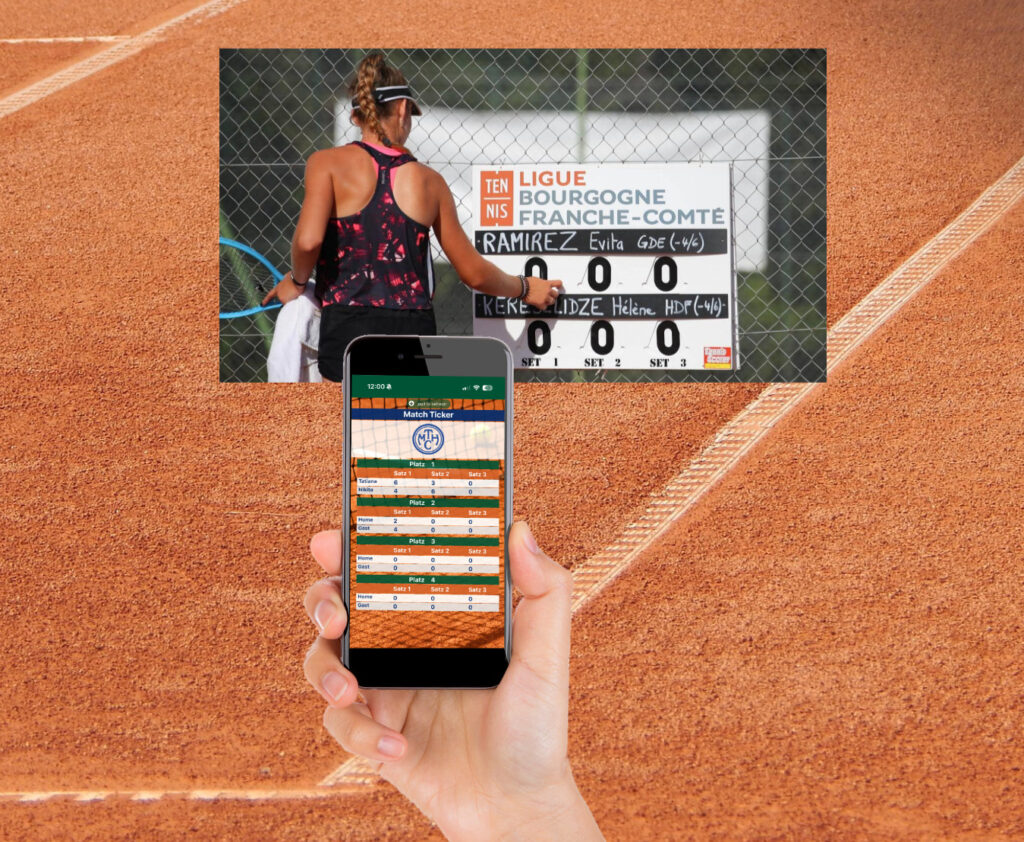
The connected Tennis Scorer board works like the manual one but also shows scores in an app. Its view displays live points and the server only when players enter and update them. If either view looks stale, compare it with the score agreed on court and the latest board update.
Frequently Asked Questions
Why does a manual scoreboard not show a score such as 30–15?
A manual board without a separate points panel only counts games and sets, so no 30–15 display is normal. Tennis Scorer’s 0–7 set discs, with figures 12 cm high and 2.5 cm wide, do not show love, 15, 30, 40, deuce or advantage. The current game’s points are followed on court.
How does a double fault change the score at advantage?
It depends on who holds advantage. If the server has advantage and double-faults, the score returns to deuce. If the receiver has advantage, the double fault gives the receiver the game.