
Table of Contents
This article covers the official tennis net height in inches, centimetres and feet. It explains why the net dips at the centre and how to check and maintain the correct height, drawing on the basic rules, including tennis net height, alongside equipment standards recognised across court surfaces and competition levels.
Official tennis net measurements
Every regulation tennis court uses the same net dimensions, whether the surface is grass, clay or hard court.
Height in inches and feet
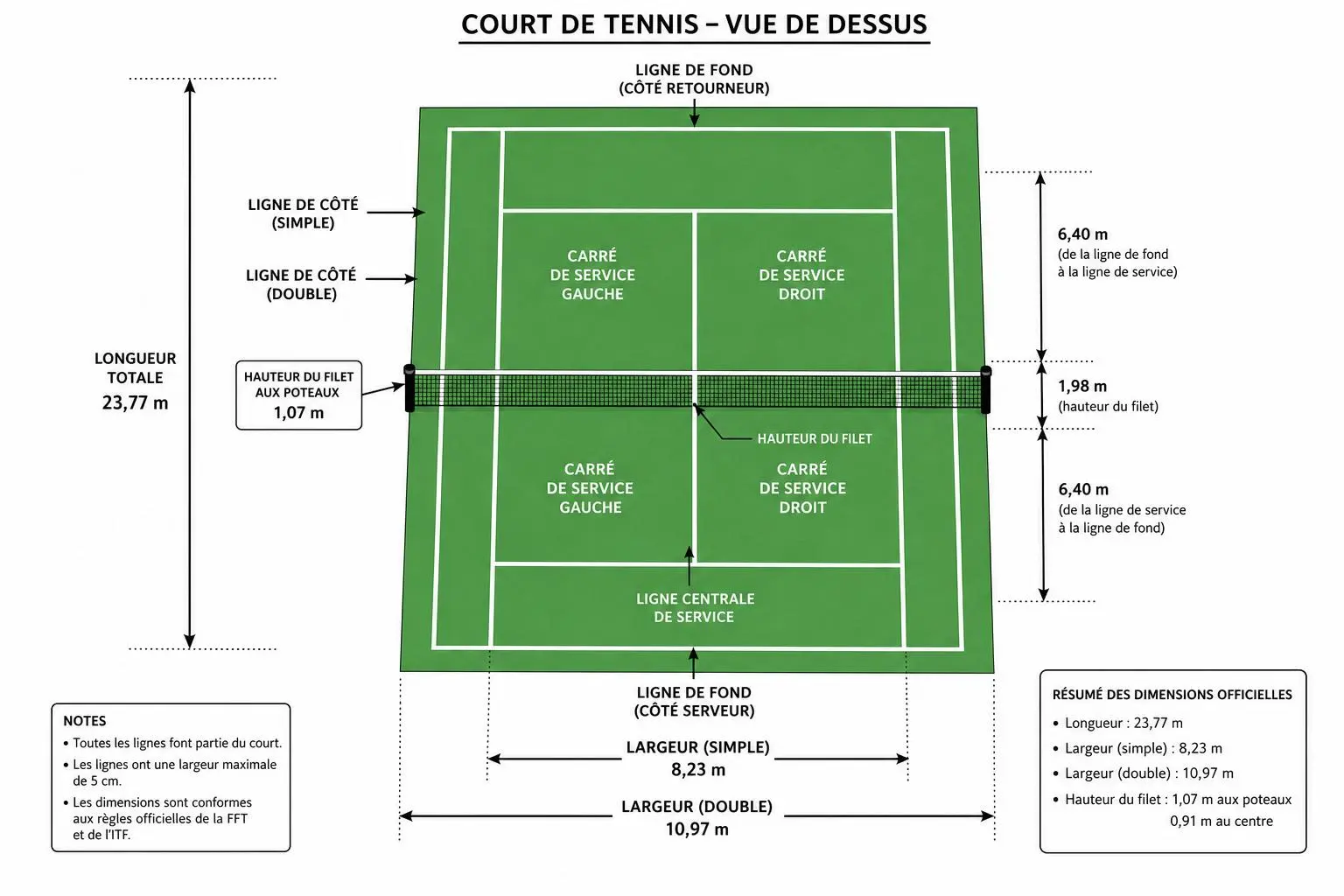
The ITF sets the tennis net height in inches at 36 inches at the centre and 42 inches at the poles. Those figures equal 3 feet and 3.5 feet respectively. The 6-inch difference is part of the standard specification, not a fault in the net assembly. Competitions on clay, grass and hard courts therefore rely on the same reference points from the warm-up to the last point.
Net position across the court
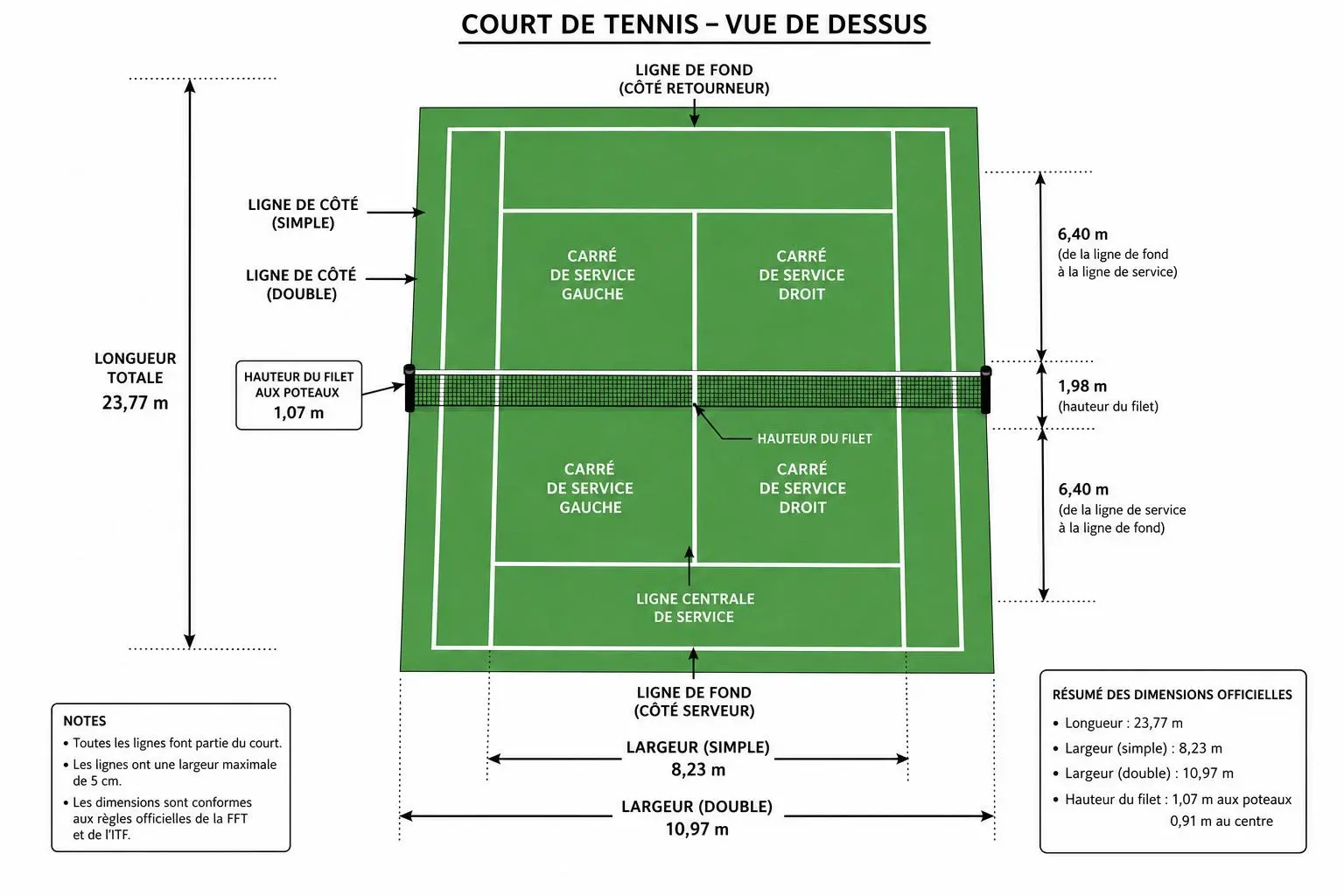
The tennis net height in feet establishes two fixed reference points: 3 feet at the centre strap and 3.5 feet at each post. A standard net spans 42 feet (12.8 m) in total length, extending beyond the doubles court width of 36 feet to provide complete coverage at the sidelines.
- Centre height 36 inches (3 feet / 0.914 m / 91.4 cm), held by the centre strap.
- Post height 42 inches tall (3.5 feet / 1.07 m), the required elevation at each net post on either side of the court.
- Net length 42 feet (12.8 m), extending 3 feet beyond each doubles sideline for consistent full-width coverage.
- Surface compatibility The net height remains identical on grass, clay, hard court and carpet, so no adjustment is required when changing surfaces.
For a doubles tennis net setup, the centres of the poles sit 3 feet outside each doubles sideline. For a singles tennis net on a doubles court, singles sticks placed just outside the singles sidelines maintain the correct 42-inch elevation at the sides. The tennis net accessories guide specifies how the centre anchor and post hinges keep those 42 inches stable across a full season.
Why the tennis net dips centrally
Gravity acts across the net cord’s full 42-foot span, pulling the middle lower than the posts. The rules accommodate that force: a white centre strap anchors the net to the ground at a precisely defined height.
The centre strap controls height
The tennis net height in cm at the centre is exactly 91.4 cm, regulated by that white strap. For match play, the strap must be completely white and no more than 5 cm wide. By contrast, the net cord at the posts sits at 106.7 cm, creating the characteristic curve that players learn to exploit when choosing between a middle shot and a wide one.
- Center strap specification: Completely white, a maximum of 5 cm wide, and mandatory for regulated match play and inspections.
- Strategic margin: A shot through the middle clears a lower net, providing a higher margin than one aimed near the higher posts.
- Top band: A white band, 5 to 6.35 cm wide, is folded over the net cord or cable along the full upper edge.
The mesh itself must be sufficiently fine to prevent a tennis ball from passing through. Worn or stretched centre-strap webbing should be replaced promptly.
Posts and singles sticks
Posts must not extend more than 2.5 cm above the net cord and may be no more than 15.25 cm square or in diameter. Singles sticks, 42 inches high and no more than 3 inches wide, must not project more than 1 inch above the net. These precise tolerances keep the net at the required elevation without obstructing play near the sidelines.
Checking tennis net height correctly
A net set even slightly too high or too low alters ball trajectory on low shots and can affect referee decisions at competitive level. Tennis Scorer recommends adding a brief verification routine to every pre-match preparation, using proper measuring tools rather than improvised guides that may introduce error.
How to measure and adjust
Measuring the net at three points—the two posts and the centre—provides a complete accuracy check. By contrast, the pickleball net height is 34 inches at the centre and 36 inches at the posts, while a tennis net follows a different standard. A dedicated net-height gauge or measuring tape is therefore required to confirm the correct 36-inch centre measurement without ambiguity.
- Aluminium net gauge A portable aluminium net-height gauge provides precise, repeatable readings before competitive play without disturbing the net assembly.
- Centre strap buckle Pull the strap tighter to lower the middle; feed more strap through the buckle to raise it when the net is sitting too high.
- Post winder or reel Use the reel on the tennis posts to adjust net cord tension across the full width, producing a consistent result on both sides.
- Measuring tape A standard measuring tape applied at the centre strap and at each post confirms the 36-inch and 42-inch reference points quickly.
Daily checks should confirm that the centre remains exactly 36 inches, because even slight sag changes the path of lower shots. A two-minute pre-match measure at the centre and posts is sufficient to catch drift before it affects gameplay or prompts a rules challenge.
Tennis and pickleball net heights
Differences in net heights across racket and paddle sport disciplines reflect each sport’s rules and court dimensions. Tennis sits in the middle of the range: lower than a badminton net, which reaches 1.524 m at the centre and 1.55 m at the posts, but higher than both pickleball and table tennis, where the net is just 6 inches tall.
The right choice when setting up a multi-sport facility is to install dedicated net systems for each sport rather than adjusting one net repeatedly. Repeated adjustment accelerates strap and webbing wear, compromising the precision required for regulated play and adjacent sport standards.
Routine inspection essentials
Weekly inspections should cover every component involved in maintaining net height: posts, the winder mechanism, the centre anchor and all fixings. Tennis Scorer recommends replacing the centre strap and ground anchor together, rather than one at a time, because mismatched components can create uneven tension along the lower edge of the net, which is harder to detect visually than simple centre sag.
- Weekly post check Inspect the post, winder and all fixings; confirm structural integrity before any higher court load or tournament period.
- Centre anchor replacement Replace the centre strap and ground anchor together; mismatched wear between the two creates uneven lower-edge tension.
- Strap and webbing condition Worn or stretched webbing loses holding strength; replace it immediately rather than waiting for a visible height deviation.
- Netting integrity Repair any rip or tear in the netting immediately; deterioration spreads quickly once the mesh structure is compromised.
Kept courtside, an aluminium net-height gauge makes it straightforward to verify the 36-inch centre figure before every session. This practical tool removes guesswork from the inspection routine and keeps official measurements within the required tolerance.
Frequently asked questions
Why is a tennis net lower in the middle than at the posts?
Gravity pulls the net cord down across its 42-foot span, so keeping it perfectly straight from post to post would require impractical tension. The rules account for this instead: a white centre strap anchored to the ground holds the middle at exactly 36 inches, while the posts remain at 42 inches.
What are the standard tennis net dimensions for singles and doubles play?
The standard net height remains identical in both formats: 36 inches at the centre and 42 inches at the posts. A singles court is 27 feet wide, while a doubles court is 36 feet wide, so the net span changes but its vertical measurements do not. When singles matches are played on a doubles court, singles sticks at the singles sidelines maintain the required 42-inch elevation at those points and preserve the correct net profile.
Is the net the same height for tennis as for pickleball?
No. The two sports use different net heights. A regulation tennis net stands 36 inches at the centre and 42 inches at the posts, whereas a pickleball net is 34 inches at the centre and 36 inches at the posts.