

Table of Contents
This guide breaks down the tennis scoring system from the first point to the final set, including deuce, tiebreak rules, and how scoring works on a physical scoreboard.
How tennis scoring works from points to match
Tennis is built on four clear layers. Understanding how tennis scoring works starts with the smallest unit and moves upwards: points form a game, games form a set, and sets win the match.
Each layer has its own rules, then resets once the next one is decided. For live play, a read tennis scoreboard guide shows exactly where to look on a tennis scoreboard at any moment.
The four levels of a tennis score explained
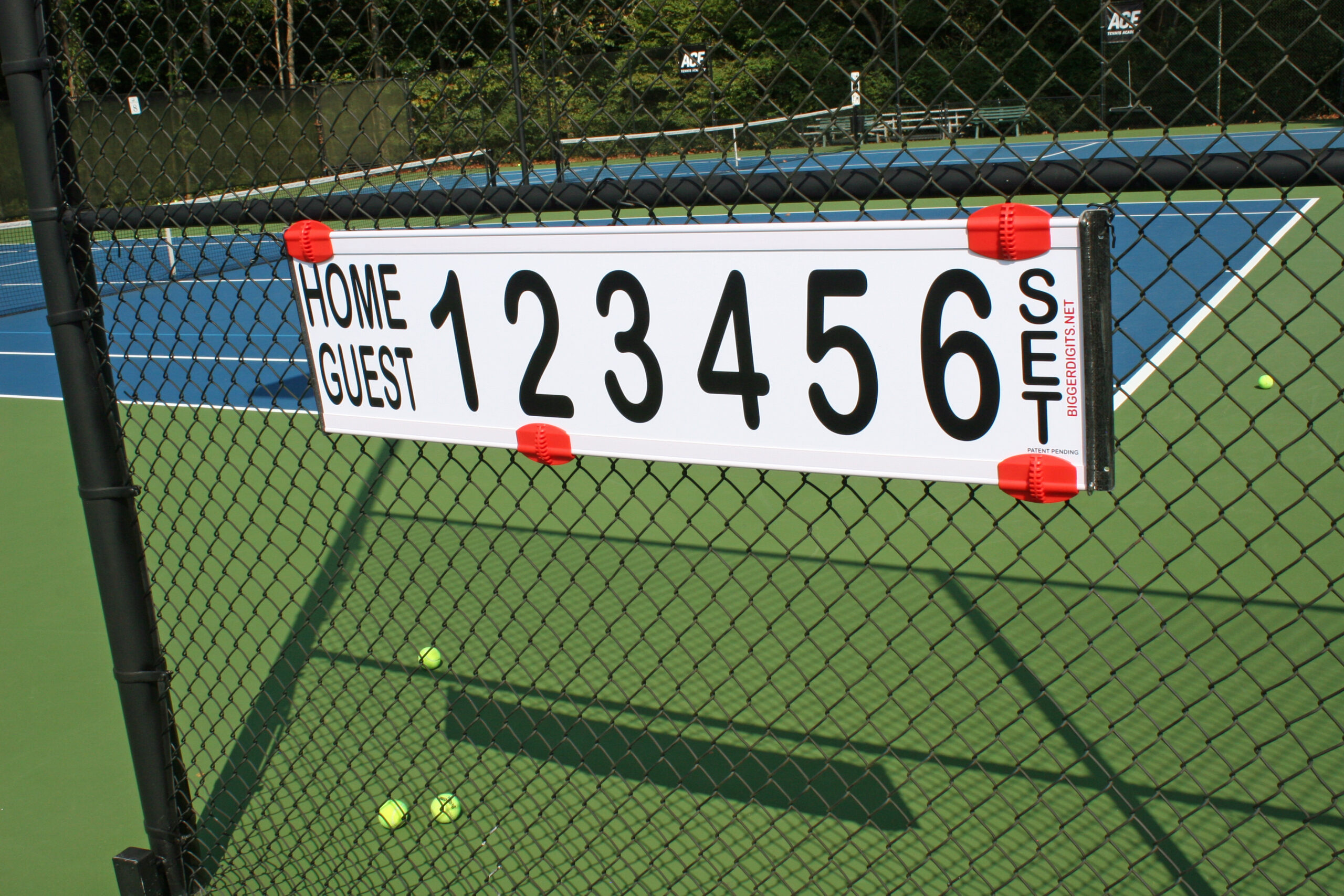
A manual tennis scoreboard makes the hierarchy easy to follow: separate spaces usually show the current game count and the completed set totals.
- Points: love, 15, 30, 40, then game, with the serving player’s score called first.
- Games: won by the first player to take four points with a two-point margin.
- Sets: won by the first player to reach six games with a two-game margin; at 6–6, a tiebreak is played.
- Match: decided by sets, with most events using best of three and men’s singles at Grand Slams using best of five.
Serving matters when calls are announced. A score of 30–15 means the server leads by two points to one, and that convention applies throughout every game.
From that point, reading a scoreboard becomes simpler. A player may lead the set but trail in the current game: checking both the game score and the set column together is the only way to read the full situation.
Why the game uses love, 15, 30 and 40
The points system is generally traced to medieval France. The sequence 15, 30 and originally 45 reflected quarter-hour divisions on a clock face, before 45 was shortened to 40 because “quarante-cinq” was awkward to call during play.
That shorter call was formalised at the first Wimbledon in 1877. Those looking for the background behind these terms can consult the tennis scoring origins article.
Love means zero. The term likely comes from the French “l’œuf”, or egg, because its shape resembles a zero, and that term appears on every scoreboard and broadcast display, making it one of the first to recognise.
How to read a set and match score
A set score is written as two numbers separated by a dash: 6–4 means one player won six games and the other won four. Completed set scores can be 6–0, 6–1, 6–3, 6–4 or 7–5, while 6–5 is not a finished set because the two-game margin has not been met.
Once the score reaches 6–6, a tiebreak decides the set. The set is then recorded as 7–6, with the tiebreak score in brackets: 7–6 (7–4), for example.
A match score lists the sets in the order they were played. So 6–4, 3–6, 7–6 (7–4) shows a three-set match in which the same player won the first and final set, while the opponent took the middle set.
At 40–40 the game reaches deuce. A player must then win two consecutive points to take the game: first advantage, then game point converted.
How to read a tennis scoreboard at a glance
A standard tennis scoreboard shows three layers of information at once: the current player score, the game count in the current set, and the completed set totals. Once that column order is understood, the full match score can be read in a single glance.
What each column on the scoreboard means
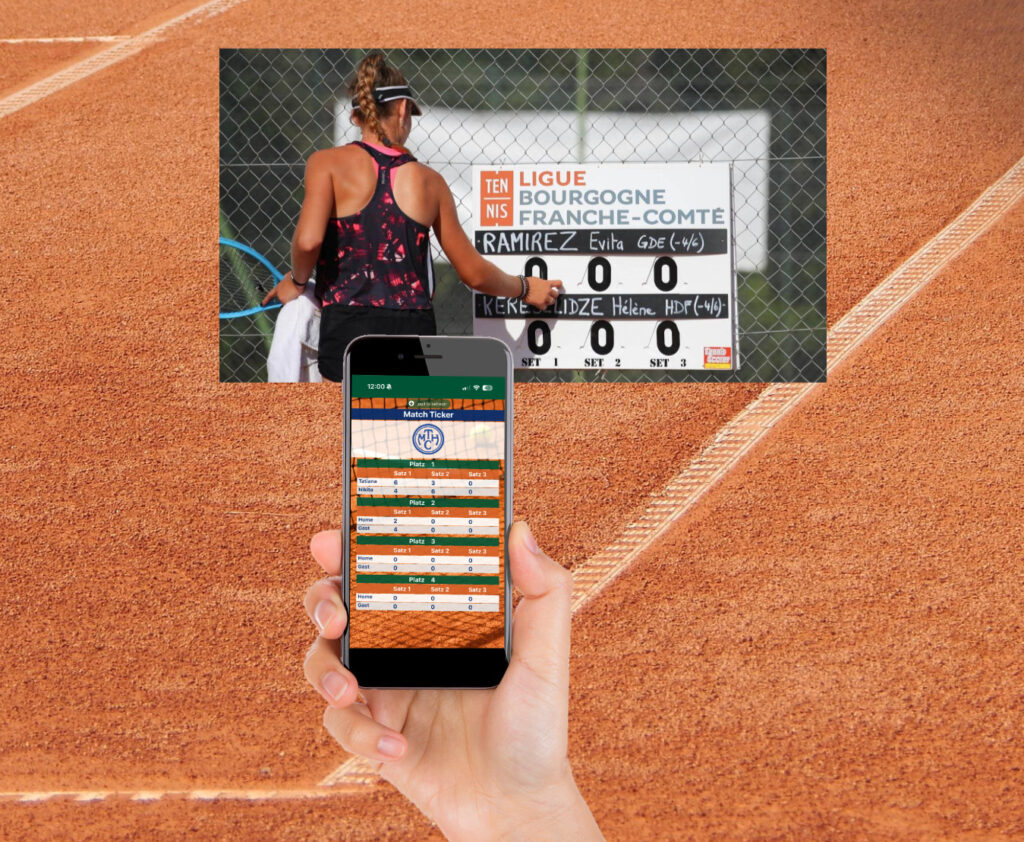
That layout starts with identification. The left-hand section lists the players on slate name plates, the starting point for orienting everything that follows.
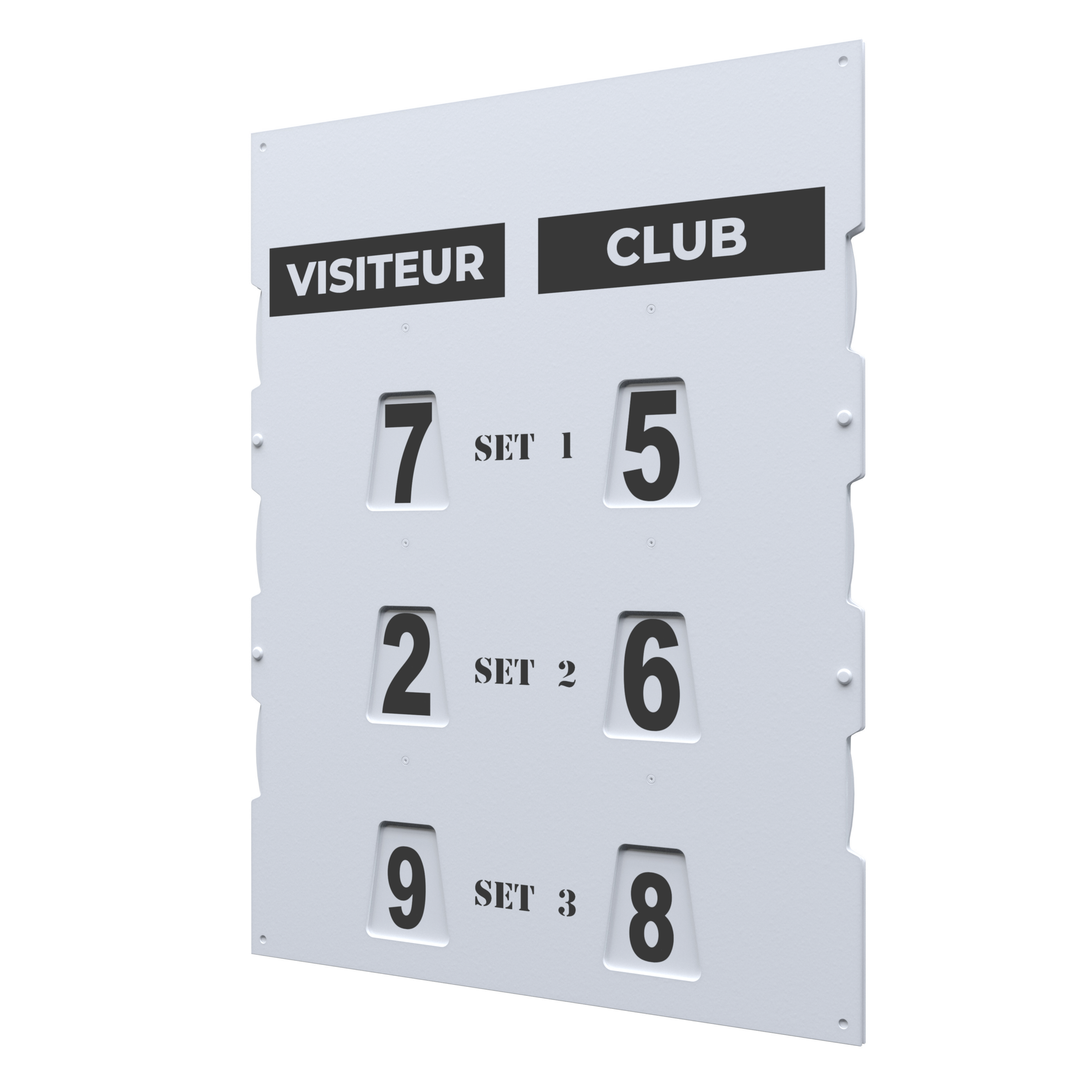
From there, the central columns track each set: one numerical column per set, showing how many games each player has won. On the right, the live point score follows the familiar system of love, 15, 30 and 40, then deuce or advantage when needed. A dot or triangle marks who is serving.
- Player names column: identifies both competitors; on Tennis Scorer boards, slate plates allow quick updates between matches.
- Set score columns: one column per set played, recording games won by each player in order from left to right.
- Game score display: shows the live point score within the current game, including love, 15, 30, 40, deuce and advantage.
Once installed, a manual Tennis Scorer board remains easy to read from distance: it displays scores from 00 to 99 across three sets, with digits 10 cm high and 2 cm wide, visible from more than 50 metres. The white PVC construction is built to last through year-round outdoor use.
| Scoreboard section | What it shows | Format used |
| Player names | Identity of both competitors | Text (chalk or chalk pen) |
| Set columns | Games won per completed or current set | Numerical (0–7) |
| Game score | Current point score within active game | Love / 15 / 30 / 40 / Deuce / Adv |
| Serving indicator | Which player is currently serving | Dot or triangle symbol |
| Tiebreak score | Points within an active tiebreak | Numerical (0–10+), shown in brackets on board |
How tiebreak scores appear on the board
That same logic applies in a tiebreak. In practice, the set column shows 7 for the winner and 6 for the loser, with the tiebreak total placed in brackets beside it: 7–6 (4) means the losing player’s score in the tiebreak was 4. The bracket records the loser’s point score, not the winner’s.
From that point, reading the tennis score stays straightforward whether the match uses a standard tiebreak to 7 points or a super tiebreak to 10. Tennis Scorer manual boards use the same rotating-disc system for both formats, updating each point in under three seconds without interrupting play.
Deuce and advantage rules in a tennis game
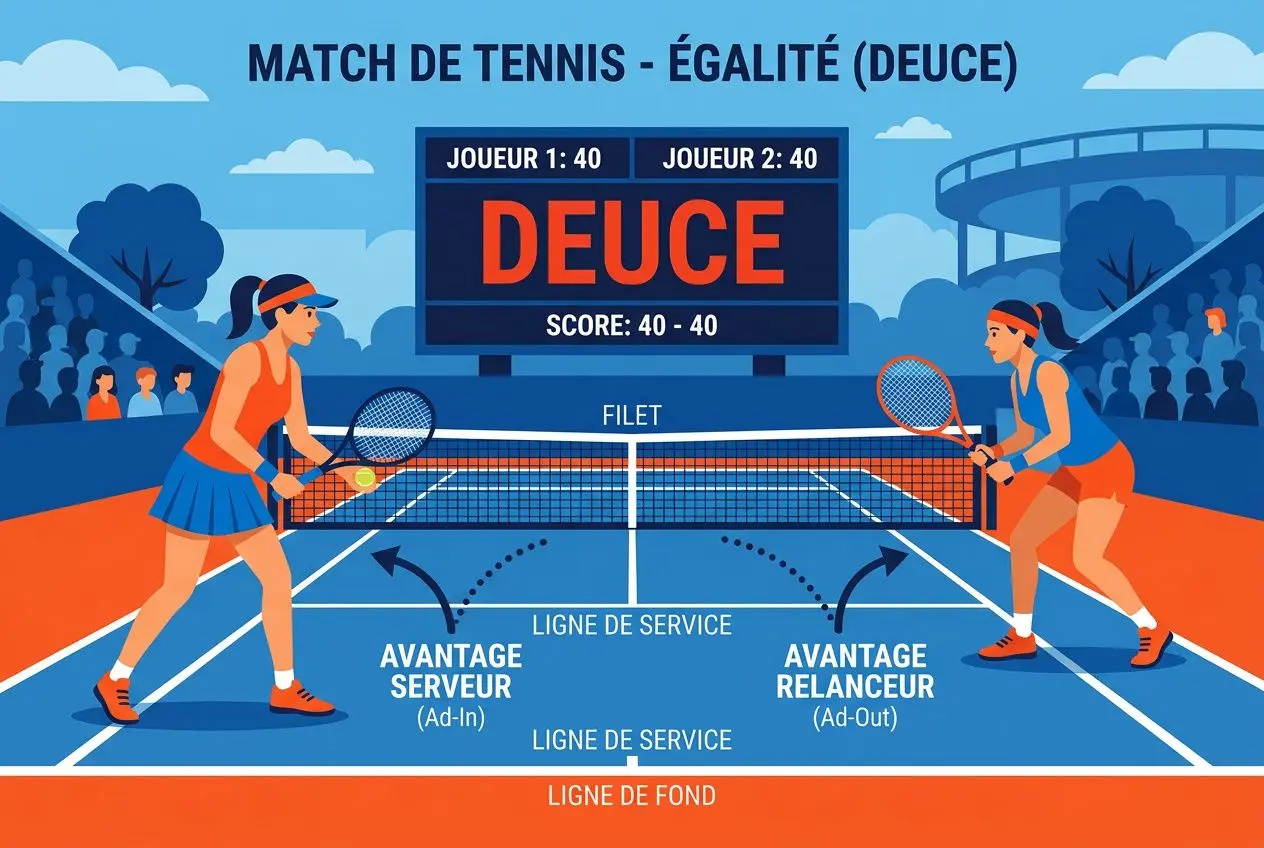
Once both players reach 40 in a single game, the usual sequence stops. From that point, the tennis scoring system follows different tennis scoring rules: a player must take two consecutive points to close the game.
What deuce means and when it occurs
This tied score is called deuce. In the tennis score, it appears when each player has won three points, or 40–40, and that term matters for anyone learning how to read tennis scores against official commentary and a scoreboard.
It marks the point in the system where the rules require a two-point gap, so the game can continue through several returns to deuce under standard tennis rules.
How advantage scoring decides the game
Once deuce is established, the next point decides who holds the upper hand: the server winning earns Ad-In; the receiver winning earns Ad-Out.
A player who holds advantage must then take the next rally as well: if the same player wins the point again, that game point wins the game; if not, the score returns to deuce.
At this stage, the scoreboard no longer displays a numeric score between the two players.
No-Ad scoring and when the rules differ
By contrast, No-Ad scoring changes the scoring rules at 40–40. There is no advantage phase in that format, and whichever player wins the point at deuce wins the game immediately.
This version appears in doubles, NCAA tennis, and many recreational leagues. In practice, it alters how to read tennis scores because the receiver may choose the side for the next return at deuce, a feature that does not apply under the standard tennis scoring system and its usual rules.
Tiebreak rules and how a set is decided
When a set reaches 6–6 in games, the tiebreak decides it. The score no longer follows the usual love–15–30–40 pattern of a regular game.
How a standard tiebreak game is scored
For anyone learning how to read tennis scores, whether on a courtside board or a betting market display, tiebreak points are shown as simple numbers: 0, 1, 2, 3 and so on.
The rules are straightforward. The first player to reach seven points with a two-point advantage wins the tiebreak and the set, and the set score is recorded as 7–6 on the tennis scoreboard.
- Numerical scoring: points rise from zero in whole numbers, with no love, 15, 30, or 40 used in this system.
- Serving rotation: the player due to start begins by serving one point, then each player serves two points in turn.
- End changes: players change ends every six points, for example at 3–3 or 6–6, under rules specific to the tiebreak.
From that point, the notation on the tennis scoreboard follows a fixed convention. A set shown as 7–6 (4) means the winner took the set 7–6 and the player who lost the tiebreak scored four points.
Super tiebreak and final set rules at Grand Slams
The same principle extends to the super tiebreak, also known as the match tiebreak. Here, the target is 10 points rather than seven, while the two-point advantage still applies, so a tennis score such as 12–10 remains valid.
This format is often used to decide a final set in doubles and some mixed doubles events. Since 2022, Grand Slam tournaments have also used it at 6–6 in the deciding set, replacing the older advantage system that allowed the final set to continue without limit.
The scoreboard uses the same bracket style for the tiebreak total, although the figures in a final set or match tiebreak may reach double digits.
Tennis Scorer manual boards support both the seven-point and 10-point formats on the same rotating-disc mechanism. As a result, officials can track every point won cleanly, from the first set to the closing point of a final-set decider, and spectators can read tennis scores without ambiguity at any stage of the match.
Frequently asked questions
Why is tennis scored 15, 30 and 40?
The tennis scoring system is generally traced to medieval France, where the score was marked in quarter-hour steps on a clock face: 15, 30 and originally 45. From that point, the shift to 40 appears practical rather than symbolic, because “quarante-cinq” was awkward to call quickly during a game. “Quarante” became the shorter form in use and was later formalised at the first Wimbledon in 1877.
The older French clock logic pointed towards 50 and then 60, figures that have since disappeared from the scoreboard but whose structure survives in the advantage rule and the final step to game.
How do you know if a tennis match is best of 3 or best of 5 sets?
That format is determined by the event. Most professional matches use a best-of-three-set system, including all women’s singles and ATP Tour matches outside the Grand Slams: two sets win the match.
By contrast, men’s singles at the Australian Open, the French Open, Wimbledon and the US Open are played over best of five sets, so three sets win the match. Doubles and mixed doubles usually return to best of three, although some events use a super tiebreak in place of the final set.
What is a 6–0, 6–0 tennis score called?
A set won 6–0 is commonly called a “bagel”. As a result, a 6–0, 6–0 tennis score is known as a “double bagel”.
The term is informal, but the score itself sits squarely within standard tennis rules.