

Table of Contents
This guide covers everything needed to understand how to keep score in tennis, from the basic point terms through to tiebreaks and match formats. For a fuller breakdown of the tennis scoring guide, Tennis Scorer expands each layer of the system in detail. Those interested in the background can also read the dedicated tennis scoring origins article, while clubs that need a practical on-court tool can explore the manual tennis scoreboard range from Tennis Scorer, built to last through years of outdoor use.
How does tennis point scoring work for beginners
Tennis uses a layered scoring system. Points become games, games become a set, and sets decide the match.
The four-tier scoring structure explained
That structure works in clear stages. A player wins a game by taking enough points and finishing at least two clear of the opponent. Once enough games are won, the player takes the set. From that point, the match goes to the side that reaches the required number of sets first: two in best-of-three formats, three in best-of-five.
As a result, a player can win more points overall and still lose, because the scoring work is done at game and set level rather than by raw accumulation alone. The difference comes down to when each point is won.
What do love, 15, 30 and 40 mean
Anyone learning how to keep score in tennis for beginners or how to keep tennis score for beginners needs the standard calls first: love for zero, 15 for one point, 30 for two, and 40 for three. The server’s score is called first, so 30-15 means the server leads.
When both players are level, the call uses “all”: 15-all and 30-all are the usual examples. By contrast, once both players reach 40, the score is no longer called 40-all but deuce.
Why is tennis scoring 15, 30 and 40
The sequence is generally linked to medieval France and the quarter-hour markings of a clock face: 15, 30, then 45. Over time, 45 became 40 because it was quicker to call aloud. A poem by Charles d’Orléans in 1435 records the earlier 15-30-45 pattern, and Wimbledon had standardised 40 by 1877.
From that point, the language of the score also explains later situations in a game and set. It helps explain why a game can reach deuce, why a break matters, and how a tiebreak fits into the wider scoring system when players are level late in a set.
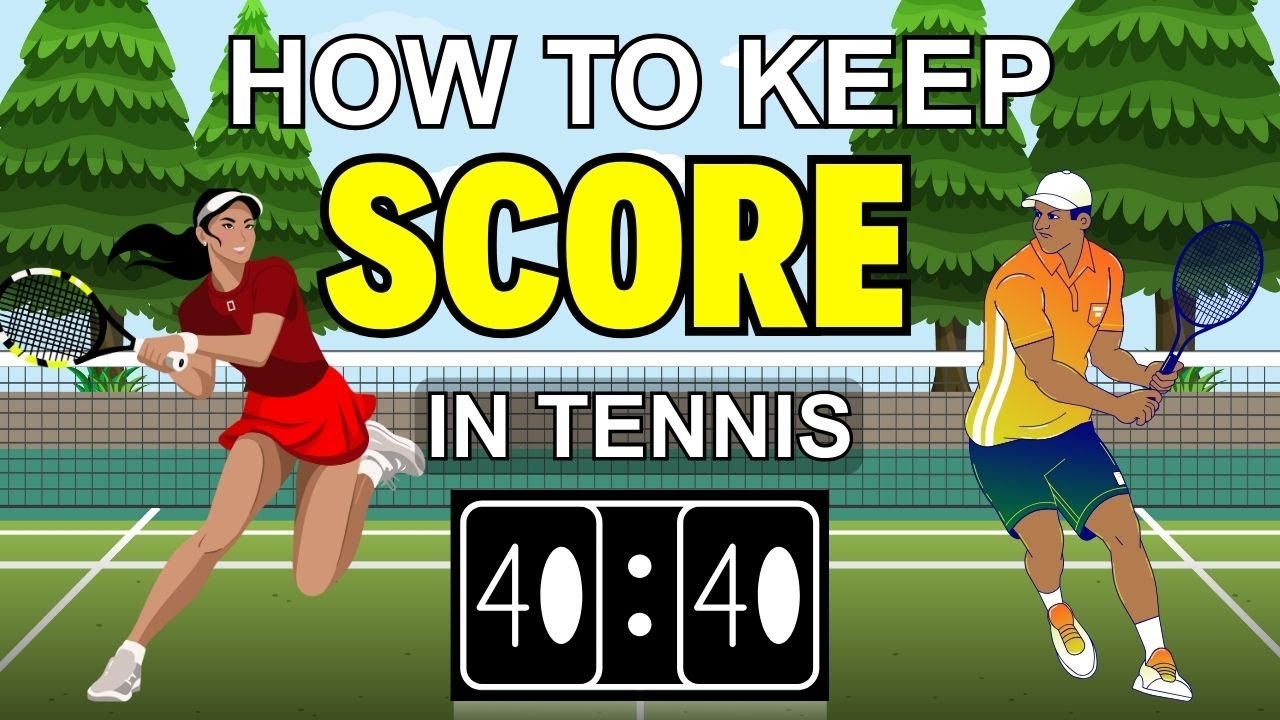
Understanding deuce, advantage and tennis scoring at 40-40
When both players reach 40, the usual sequence stops. From that point, game scoring follows a separate rule: the game can only be won with a two-point lead, and that rule shapes the closing phase of many a set and match.
What happens at deuce in tennis
For anyone learning how to keep track of points in tennis, 40-40 is the key moment to understand. The score is called deuce, a term linked to the French “deux”, meaning two, because neither player can take the game on a single point.
- Deuce: both players are tied at three points each, shown as 40-40, so one point alone does not end the game
- Ad-In: the server wins the next point and takes advantage; one more point wins the game
- Ad-Out: the receiver wins the next point and holds advantage by the same rule
- Back to deuce: the player without advantage wins the following point, so the score resets immediately
That cycle can continue without limit. Control under pressure decides the outcome: a player must win two consecutive points from deuce to close the game.
The same principle applies on a double fault. A double fault transfers the point to the opponent, which can push the score from advantage back to deuce just as any other lost rally would.
Ad-in, ad-out and returning to deuce
Once deuce has been reached, the language becomes exact. Advantage always belongs to one player, never to the score in general, so if that player loses the next rally the game returns straight to deuce with no intermediate score call.
By contrast, if the player with advantage wins the following point, the game ends at once. On court, that means the most advanced position in the game is also the most fragile, because a single lost point removes it completely.
No-ad scoring as an alternative format
From that standard system, some competitions move to no-ad scoring. At 40-40, one deciding point is played, and the opponent acting as receiver chooses the return side; whoever takes that point wins the game.
As a result, matches are shorter and easier to schedule. This format is common in professional doubles, NCAA college tennis and many recreational leagues, particularly when predictable timings matter across more than one court.
How to win a set and when a tiebreak is played
Once game-by-game scoring is understood, the next layer is the set. A player does not take a set simply by reaching six games: the lead must also be two clear games over the opponent.
The six-game set rule and two-game margin
For any tennis score-keeping task, this rule governs every set result. A player must win six games and finish two ahead, so 6-3, 6-4 and 7-5 all complete the set, while 6-5 does not.
As a result, the number of games to win a set can be six or seven. If the score reaches 6-5, play continues to 7-5 or moves to a tiebreak at 6-6; on court, that means the set always ends with either a two-game gap or a formal decider.
| Set score | Set complete? | Two-game margin met? |
| 6-3 | Yes | Yes (3-game margin) |
| 6-4 | Yes | Yes (2-game margin) |
| 7-5 | Yes | Yes (2-game margin) |
| 6-5 | No | No, play continues |
| 7-6 | Yes (via tiebreak) | Resolved by tiebreak |
How tiebreak scoring works at 6-6
When the set reaches 6-6, a tiebreak game decides it. The score then shifts from traditional tennis terms such as love to straight numbers: 0, 1, 2, 3 and so on.
Here the scoring logic shifts. The first player to reach seven points with a two-point margin takes the set 7-6, but if the breaker reaches 6-6, play continues until one side leads by two.
From that point, players change ends after every sixth point. The recorded set score also shows the losing tiebreak total in brackets, so 7-6 (4) means the winner took the set and the loser made four points in the tiebreak.
Grand Slam final-set tiebreak rules since 2022
Since 2022, all four Grand Slams use the same deciding system at 6-6 in the final set: a 10-point match tiebreak rather than an open-ended advantage set.
The first to 10 points wins the final set and the match; unlike the standard tiebreak, no set score of 7-6 is recorded, the bracket shows the full point totals instead. By contrast with the previous advantage-set format, this caps the deciding set and prevents matches from extending beyond two hours in the fifth set.
Tennis Scorer records that finish exactly as it appears on the official sheet. A result such as 6-7 (8-10) shows the decider was settled by the 10-point format, while a full match record might read 6-4, 6-7 (5), 7-6 (8).
Match formats, scoreboards and reading the score
Best-of-three vs best-of-five match formats
Format confirmation comes first: the scorer must establish how many sets are required before a point is played. To know how to keep score in tennis, that distinction matters immediately: best-of-three ends when a player wins two sets, while best-of-five ends at three.
- Best-of-three: the standard format for all women’s singles at professional and club level
- Best-of-five: used only in men’s singles at the four Grand Slam tournaments: the Australian Open, French Open, Wimbledon and the US Open
- Doubles and mixed doubles: played as best-of-three at all professional tournaments, often with a match tiebreak in place of the third set
- Club and recreational tennis: usually best-of-three, though sometimes shortened to a single set or a match tiebreak when time is limited
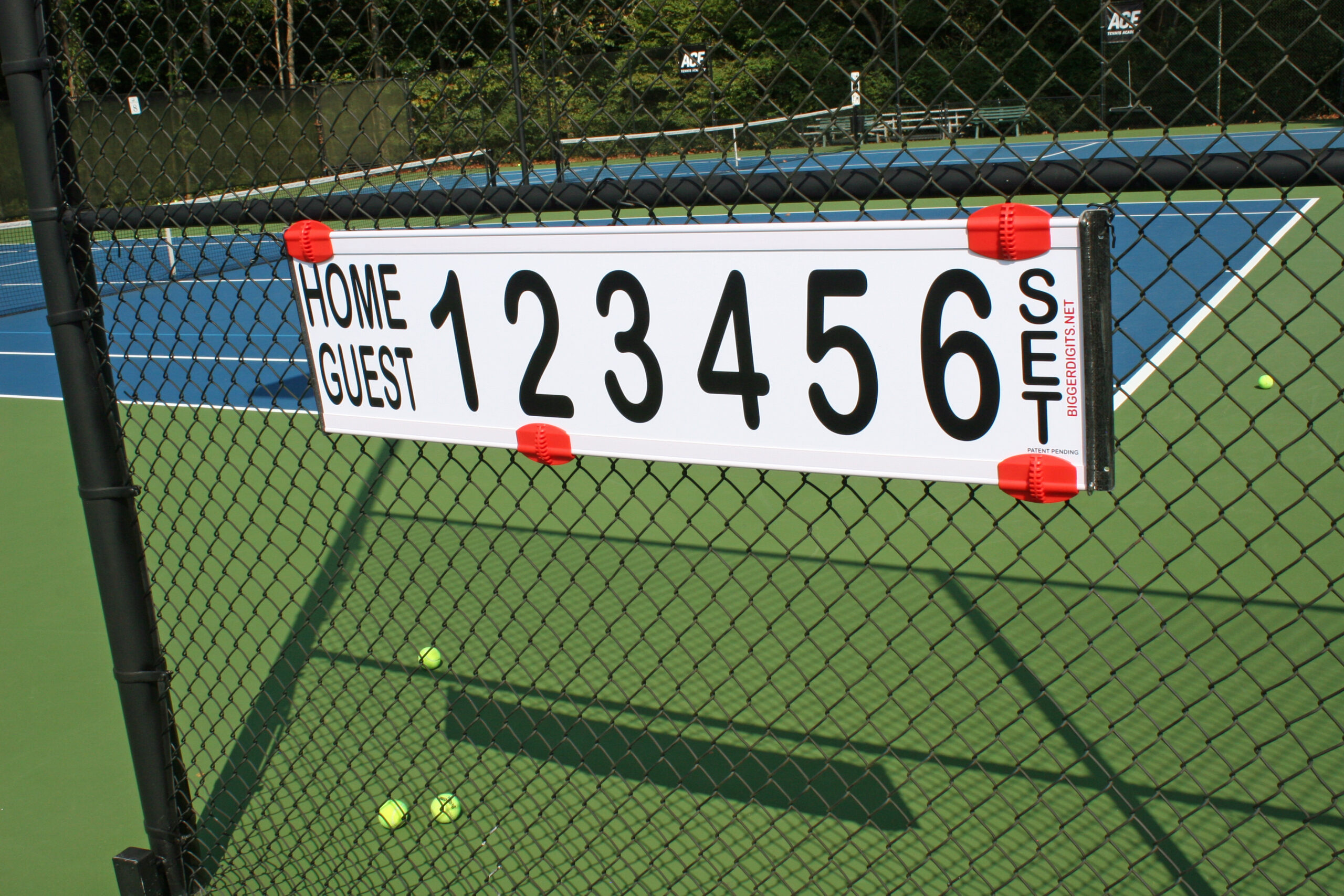
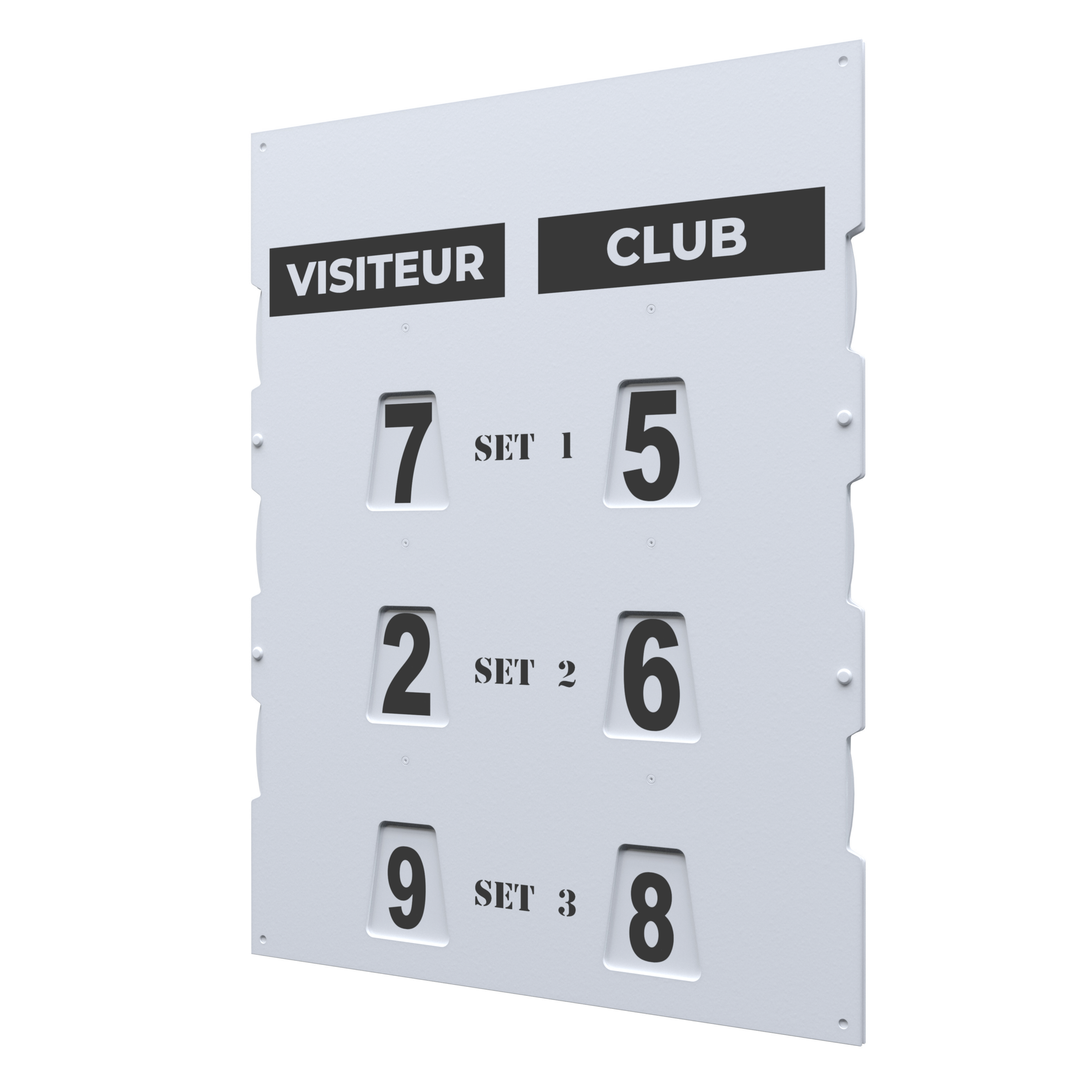
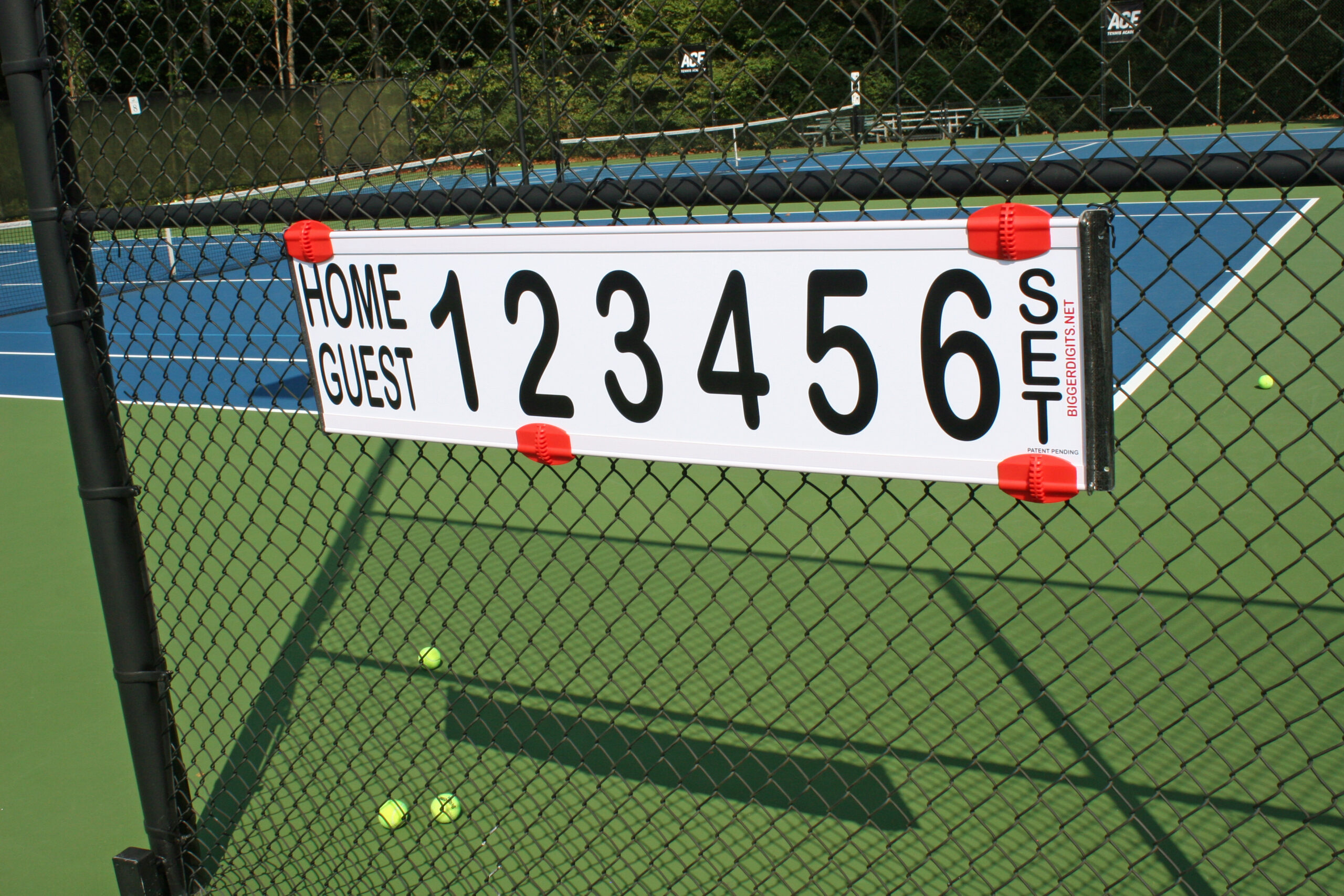
From that point, the scoreboard has to reflect the format in use. A best-of-five board needs five set columns; a best-of-three board needs three. Tennis Scorer manual scoreboards accommodate up to three sets as standard.
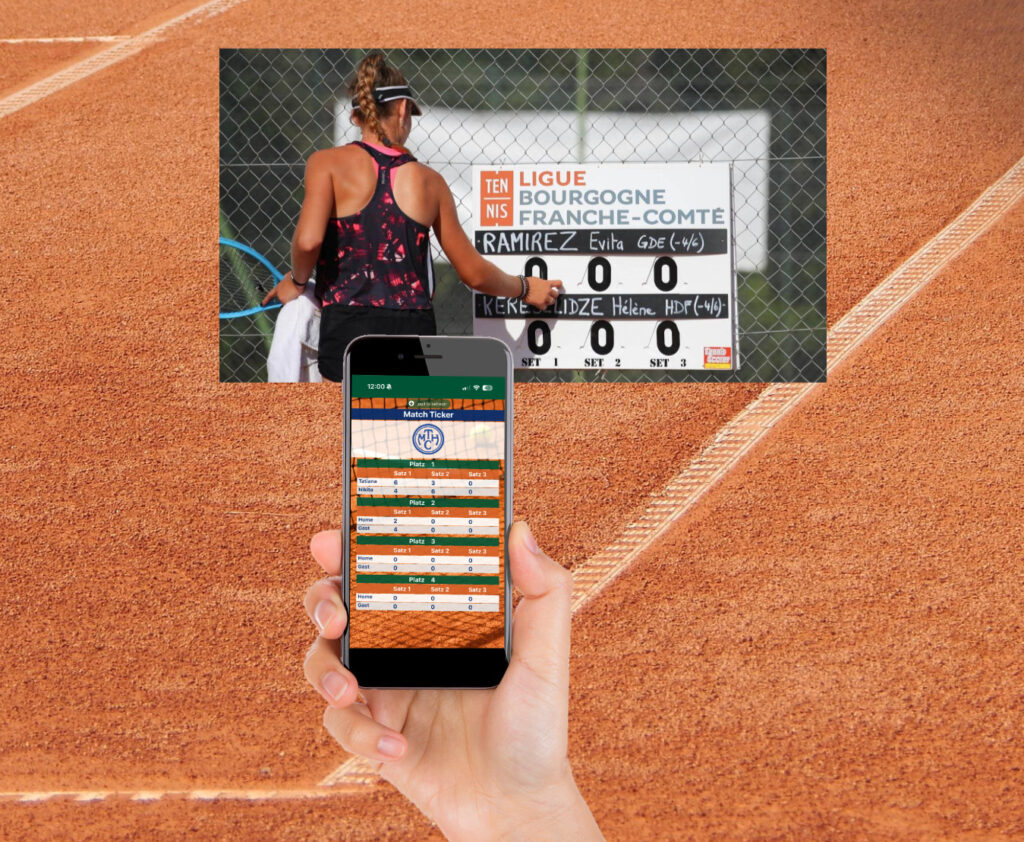
How to read a tennis score on a scoreboard
- Player names: shown on separate rows so each line of data matches the correct player
- Current point score: displayed as love, 15, 30, 40, deuce or advantage, with the serving player’s score read first
- Set columns: showing how many games each player has won in each set, updated whenever a player manages to win a game
- Serving indicator: usually a dot or arrow, marking the current server because the server’s score is always announced first
From that structure, the full tennis scoring sequence reads clearly across the board. Tiebreak scores are shown in brackets beside the relevant set column. Tennis Scorer uses rotating discs with numbers from 00 to 99 for each set, designed in high contrast for legibility beyond 50 metres on outdoor courts.
Alternative formats like FAST4 tennis
By contrast, FAST4 shortens the usual structure. Sets go to four games rather than six, a tiebreak starts at 3-3 instead of 6-6, and a sudden-death point replaces the usual deuce sequence. A game therefore ends at four points maximum, with no deuce extension.
That shorter format suits exhibition events, club sessions with limited court time and junior starter programmes. The same hierarchy used in the tennis scoring rules still applies, but each stage resolves more quickly. For anyone new to scorekeeping, FAST4 compresses the full hierarchy into fewer decisions: each stage resolves before complexity builds.
Frequently asked questions
How does the tennis scoring system work from love to match point?
The tennis scoring system follows a clear ladder: each point builds a game, each game contributes to a set, and sets decide the match. In standard tennis scoring, the call within a game runs from love to 15, 30 and 40. A player needs four points to win a game, but only with a lead of two.
From that point, the scoring system moves up a level. A player must win six games to take a set, again by two clear games, then reach the required number of sets to complete the match.
What is the difference between deuce and advantage in tennis?
That same principle explains deuce and advantage. At 40-40, neither player can win a game with a single point. The next point gives advantage: Ad-In for the server, Ad-Out for the opponent.
That advantage, however, is not permanent. If the player with advantage wins the next point, the game ends; if not, the score returns to deuce at once. In practice, this is how scoring works when a game extends beyond 40-40.
When is a tiebreak played, and how does tiebreak scoring work?
A tiebreak is triggered when a set reaches 6-6. Unlike standard scoring, points are counted simply as 0, 1, 2, 3 and onwards. The first player to reach seven points with a margin of two wins the set.
If the tiebreak reaches 6-6, play continues until that gap appears. Since 2022, Grand Slam events have used a 10-point match tiebreak in the deciding set: the first player to 10 by two takes the set and the match.