

Table of Contents
Tennis matches are decided by sets: the first player to reach the required number of set wins the match. In the standard format used in most events, a player must win two sets. In men’s singles at a Grand Slam, by contrast, a player must win three sets.
How many sets do you need to win in tennis
Tennis matches are decided by sets: the first player to reach the required number of set wins the match. In the standard format used in most events, a player must win two sets. In men’s singles at a Grand Slam, by contrast, a player must win three sets.
Best-of-three vs best-of-five: the two tennis formats
That basic rule leads straight to the two match formats used across tennis. The two formats differ only in how many sets are required to decide the contest.
- Best-of-three: the first player to win two sets wins the match. This is the standard format for most professional events, all WTA tournaments and most recreational tennis matches.
- Best-of-five: the first player to win three sets wins. This format is used in men’s singles at the four Grand Slam tournaments.
- Doubles format: doubles and mixed doubles usually use best-of-three, although some events replace the final set with a super tie-break.
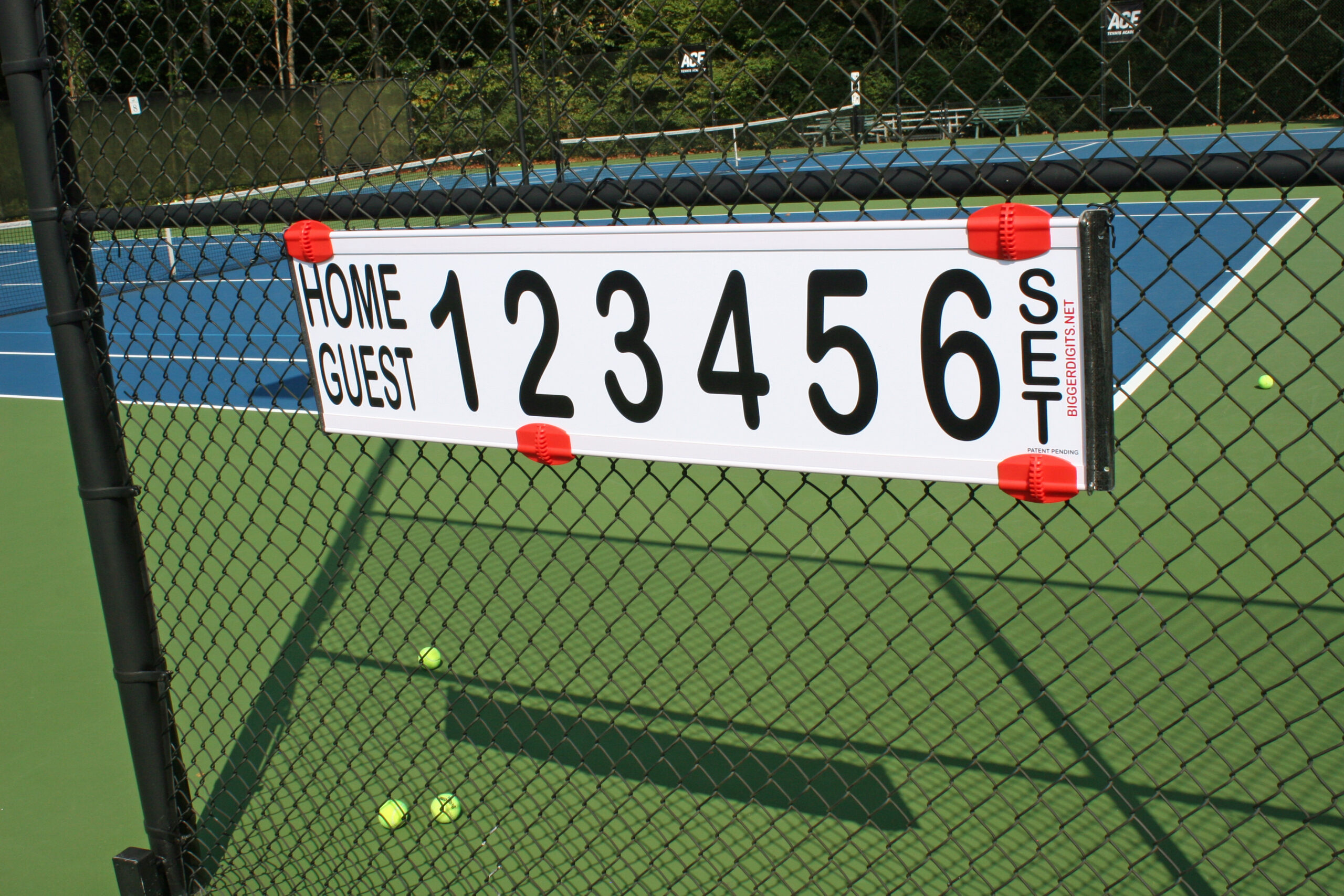
- Scoreboard columns: Tennis Scorer scoreboards show three columns for best-of-three and five for best-of-five. If the match ends early, the unused columns stay blank.
Once a player reaches the required total, the match stops there. In practice, the match ends as soon as the target is met: a player who leads 2–0 in a best-of-three has already won.
Why the number of sets varies by tournament
Once the format is clear, the reason for the variation becomes easier to follow. The number of sets in a tennis match reflects scheduling limits, physical demands and event tradition.
At club level, how many sets in a match usually means two because best-of-three fits ordinary booking windows. At the top end of the sport, men’s singles at a Grand Slam keeps the longer format, including the final, where players must win three sets to take the match.
As a result, best-of-five asks for more endurance and more tactical adjustment over time. The right choice when court time is limited is usually best-of-three, which keeps the same scoring logic explained in sets to win.
Is tennis 3 or 5 sets depending on the tournament
Whether a tennis match is played over 3 or 5 sets depends on the event. In standard professional and club tennis, the usual format is best-of-three, while best-of-five is reserved for a narrow part of the sport.
ATP and WTA tour set requirements explained
That distinction starts with the main tours. On the ATP and WTA circuits, the format is overwhelmingly best-of-three: the first player must win two sets to take the match in regular events.
- ATP Tour (outside Grand Slam events): best-of-three is the standard format.
- WTA Tour (all events): best-of-three applies throughout, including every Grand Slam tournament.
- Davis Cup: some ties historically used best-of-five, although many have shifted to best-of-three in recent years.
In both cases, winning two sets decides the match. If a player takes the opening two sets, the contest ends there.
When is best-of-five used in professional tennis
That same principle changes only at the highest level. In men’s singles at each Grand Slam, the format is best-of-five, while women continue to play best-of-three at the same tournaments.
The four events are fixed: the Australian Open, the French Open, Wimbledon, and the US Open. In that setting, a player must win three sets to advance, from the first round to the final.
The difference comes down to endurance. Best-of-five regularly produces matches exceeding four hours, a duration rarely approached in best-of-three.
Set formats for beginners and club tennis
That elite exception leaves the rest of the game straightforward. For beginners and local competition, best-of-three is the usual format, so two sets are required to win a match.
The set count is therefore simple to read: the moment one side reaches the target, the match is decided. Tennis Scorer is built around that standard approach to scoring, which is why it suits everyday matches as naturally as higher-level play.
How many sets to win the Wimbledon final and Grand Slams
Grand Slam finals ask more of a player than any other regular event in tennis. The number of sets required depends on the singles category, and since 2022 the deciding-set rule has been aligned across all four majors.
Men’s singles at Grand Slams: how many sets are required
For anyone asking how many sets to win the Wimbledon final, the answer in men’s singles is straightforward: a player must win three sets. The Wimbledon final uses the same best-of-five format as every other round in the men’s singles draw, so the requirement does not change on the last day.
That same principle applies across the four major tournaments. Every men’s singles Grand Slam match is played over up to five sets; every women’s singles match is played in a best-of-three format.
- Australian Open (men’s singles): best-of-five; three sets required to win, including the final.
- French Open (men’s singles): best-of-five; three sets required to win.
- Wimbledon (men’s singles): best-of-five; three sets required to win.
- US Open (men’s singles): best-of-five; three sets required to win.
By contrast, women’s singles at all four majors use best-of-three, so two sets are enough to progress or take the title.
| Tournament | Category | Format | Sets required to win |
| Australian Open | Men’s singles | Best-of-five | 3 |
| Australian Open | Women’s singles | Best-of-three | 2 |
| French Open | Men’s singles | Best-of-five | 3 |
| French Open | Women’s singles | Best-of-three | 2 |
| Wimbledon | Men’s singles | Best-of-five | 3 |
| Wimbledon | Women’s singles | Best-of-three | 2 |
| US Open | Men’s singles | Best-of-five | 3 |
| US Open | Women’s singles | Best-of-three | 2 |
The deciding-set tiebreaker rule at 6-6
Since 2022, all four majors have used the same deciding-set procedure: a 10-point tiebreaker at 6-6.
Before that change, Wimbledon used an advantage final set, which could continue without a tiebreak until one player led by two games. As a result, exceptionally long matches were possible, including the 2010 Isner–Mahut contest.
Under the current rule, if the deciding set reaches 6-6, the match moves into a 10-point tiebreaker. The first player to reach ten points with a two-point margin wins the set and the match. In men’s singles this applies in the fifth set; in women’s singles, in the third.
From that point, the answer to how many sets to win the Wimbledon final remains unchanged: men must still win three sets, even if the last one is settled by a tiebreaker. Tennis Scorer scoreboards designed for five-set matches include five set columns and room for the tiebreak score beside a 7-6 result: a practical way to record the full match clearly. For a fuller explanation, see tennis sets required.
How to win a set in tennis: rules and scoring
In tennis, a set is not won on game count alone: the set winning conditions require a margin of two games.
Reaching six games with a two-game margin
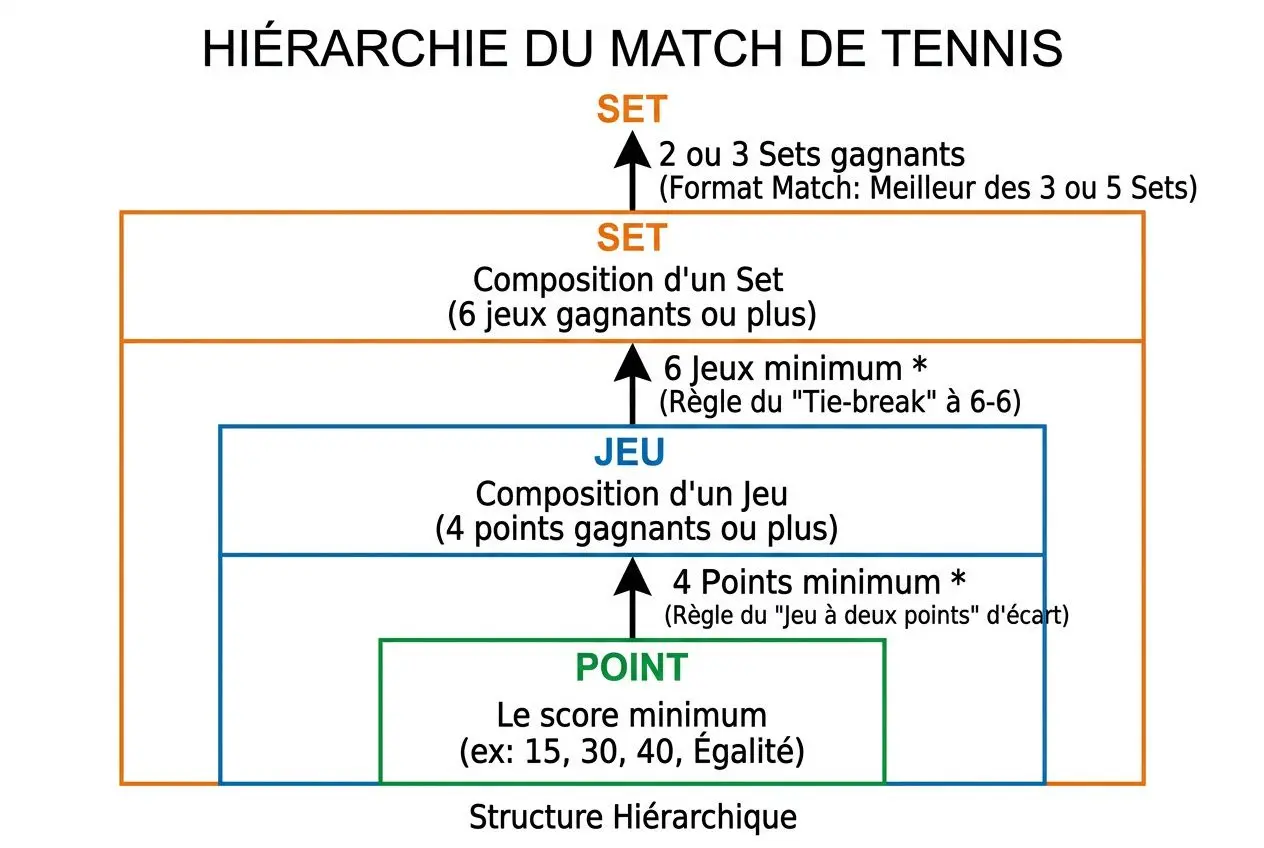
To understand tennis scoring, start with the standard rule: a player must win six games and lead by two. Completed set scores therefore include 6-0, 6-1, 6-2, 6-3, and 6-4.
That same logic explains why 6-5 does not decide the set: the score must reach 7-5 before the set closes.
What happens at 6-6: the tiebreak set scoring rule
Once both players reach six games, the standard format moves into a tiebreak set. Instead of extending the set until someone leads by two games, a tie-break is played to decide it, and the score is then recorded as 7-6.
The difference comes down to tiebreak scoring: the first player to reach seven points with a two-point lead wins, or, if the tiebreaker reaches 6-6, play continues until that margin is achieved, such as 8-6.
On the scoreboard, the tiebreaker score appears in brackets beside the set number: 7-6 (4) means the losing player scored four points in the tie-break (sets to win).
Tennis game scoring: from points to sets and matches
Sets and matches are built from games, and each game is built from points. The tennis point system follows a fixed sequence, with the same margin principle shaping the whole scoring system: a player must win by two points in a game, by two games in a set, and by the required number of sets to win a match.
How points progress: love, 15, 30, 40 and deuce
The answer to how many points to win a game in tennis is usually four, moving through love, 15, 30 and 40, provided the player finishes two points clear.
- Love: zero points, the starting score in every tennis game scoring system.
- 15: one point won; the server’s score is called first, so “15-love” means the server leads.
- 30: two points won; “30-15” shows a one-point advantage to the server.
- 40: three points won; one more point can decide the game unless both players reach deuce.
Once both players reach 40-40, the score becomes deuce. From that point, the next point is advantage: Ad-In for the server, Ad-Out for the receiver. Win the following point and the game is over; lose it and the scoring returns to deuce.
At deuce and beyond, the same call order holds: Ad-In or Ad-Out is announced from the server’s perspective, a convention maintained through every game point.
How games build into sets and match victory
From that point, the wider structure becomes clear. In standard scoring, a player must win six games to take a set, with a margin of two.
If the set reaches 6-5, one more game is not always enough: the lead must extend to 7-5 unless a tiebreaker is used at 6-6. The number of sets required to win a match depends on the format, including Grand Slam events.
Tiebreak scoring versus standard game scoring
Once a set reaches 6-6, tiebreak scoring may be used to decide it. By contrast with standard game scoring, the tiebreaker uses simple numerical scoring rather than love, 15, 30 and 40.
- Numerical counting: points run 0, 1, 2, 3 and upward, with no traditional game calls.
- Winning target: the standard tiebreaker is first to seven points with a two-point lead; a super tiebreaker is first to ten.
- Service rotation: the first server delivers one point, then each player serves two points in turn.
- End changes: players change ends every six points, at 3-3, 6-6 and so on.
In Grand Slam deciding sets, the super tiebreaker follows the same number-based format with a target of ten points.
Frequently Asked Questions
Is tennis 3 or 5 sets?
In standard tennis, most matches use a best-of-three format. That means the first player to win two sets wins the match.
By contrast, the five-set format is reserved for men’s singles at each Grand Slam: the Australian Open, French Open, Wimbledon and US Open. In those matches, a player must win three sets, so the answer depends on the event and its format.
Women’s singles, ATP Tour events beyond the majors, and most club matches follow best-of-three, meaning the five-set format applies only to that single bracket at each Grand Slam.
Are tennis sets to 6 or 7?
Sets are primarily played to six games. To take a set, a player must win six games with a margin of at least two.
Once the score reaches 6-5, the set remains live: the leader can close it out at 7-5, or the trailing player can level at 6-6. From that point, a tiebreak is usually used to decide the set, producing a 7-6 scoreline.
As a result, the number 7 appears in two standard outcomes: 7-5 and 7-6.
How many sets do you need to win a tennis match at the Australian Open?
At the Australian Open, the number required depends on the event. Men’s singles uses best-of-five, so a player must win three sets to win a match at every stage, including the final.
Since 2022, the deciding fifth set is settled at 6-6 by a 10-point super tiebreak rather than advantage games.
Women’s singles uses best-of-three, so two sets are required. Doubles is also generally best-of-three, although some draws use a super tiebreak in place of the final set.