
Table of Contents
A good tagline for a sports club sums up its character in a few words that members can repeat, wear and recognise on court. This guide sets out what makes a line work, gives tagline ideas for different tennis and padel clubs, explains how to test and check a shortlist, and shows how the chosen line can sit beside club branding on a personalised scoreboard.
What makes a good sports slogan for a club?
A great sports slogan does more than sound energetic. It tells people what kind of club they are joining, in words they can remember after a single reading. Three tests separate a strong slogan from a forgettable one: fit with the club, clarity, and honesty about the experience on offer.
Match the line to the club
Fit starts with the type of venue: a traditional members’ club, a pay-and-play venue, a competitive tennis club, a social padel venue or a mixed racket-sports club each call for a different tone. The audience matters just as much. Existing members, families, league players and people who have never played expect different things, and a line aimed only at juniors can leave adult members out.
From that point, the LTA’s Club Governance Guide offers a useful framework: define the club’s vision, mission, aims and shared values first. The tagline then draws on qualities the club can back up, such as its coaching, court availability or social sessions.
Make it clear and memorable
Once the message is set, the wording has to stick. A brief call to action, a steady rhythm or familiar court imagery makes a line memorable: tennis and padel supply ready-made words such as serve, rally, point and court. No universal optimum length exists. Suggested ranges run from three to seven words to five to eight, while clarity and readability at the intended size remain separate tests.
A spoken test settles most doubts: can players say the line naturally, recall it later and chant it? A sports slogan that crams in passion, victory and greatness fails that test. Choosing one principal message keeps the phrase light enough to repeat.
Promise what members actually experience
Memorability counts for little if the line overpromises. An inclusion-led tagline needs support from the welcome newcomers actually receive. By contrast, a performance-led line can misrepresent a club whose real life revolves around sociable doubles or beginners.
A tagline also differs from a tournament or team motto: it expresses an enduring character, while event slogans can be louder and temporary. The club’s wider identity includes its name, logo, colours and tone of voice, so the line should support them rather than compete. Claims matter too: the Advertising Standards Authority says objectively verifiable claims need evidence before publication, and calling the club the “best” may require substantiation depending on context.
Which tagline ideas suit different clubs?
With those tests in mind, each kind of club calls for its own lines. Those proposed here are starting points, not tested or legally cleared lines, and each group reflects a different source of motivation: belonging, progress, competition or local pride.
Community and welcoming play
For a community-led tennis and padel club, the emphasis falls on belonging rather than results. The LTA’s vision, “Tennis Opened Up”, is an established example of positioning around participation rather than victory alone.
- Community-led: “Rally Together”, “Your Court. Your Community.” and “Where Every Rally Belongs”.
- Ambition with inclusion: “Every Point. Every Player.” and “Play Bold. Belong Here.”
- Sociable: “More Rally. More Friends.” and “Good People. Great Points.”
- Relaxed social play: “Good rallies. Great company.”
Teamwork, progress and competition
Competitive and coaching-led clubs need a different energy, and good tennis slogans and taglines in this register lean on effort, improvement and unity. Short sports team slogans translate easily into chants and kit prints.
- Team unity: “Play for each other”, “Stronger together” and “United by sport”.
- Tennis language: “Ready to rally”, “Serve strong” and “One point closer”.
- League teams: “Every Point, Together.”, “United in Effort”, “Fight for the Next Ball” and “Together We Rally. Together We Rise.”
- Coaching and development: “Where Champions Begin”, “Your Game. Your Next Level.” and “Your game. Your next step.”
These slogans for teams pair ambition with teamwork, a balance with a famous precedent: the International Olympic Committee approved adding “Together” on 20 July 2021, making the motto “Faster, Higher, Stronger : Together”. A champion mindset and shared effort can therefore sit in the same inspirational line.
Mixed sports, local pride and humour
Venues offering both tennis and padel need a line that covers each sport: “One Club. Every Game.” expresses a shared identity, while separate campaign lines can still address different audiences under the same parent club. “Rooted here. Ready to play.” points to local identity, and “Excellence on Every Court.” suits a club emphasising coaching, competition and heritage.
Humour opens up creative sports slogan ideas, with wordplay such as “Serving Aces and Bad Jokes” or “Smash Happens”. Catchy jokes like these may suit youth sports or recreational team kit. A public-facing club line, by contrast, also has to make sense to newcomers who do not share the joke.
How do you choose the final tagline?
A list of tagline ideas still leaves the hardest step: settling on one. The process runs from broad brainstorming to member feedback, then to a check that the wording is free to use.
Use a slogan generator for starting points
Brainstorming begins with two lists: what the club offers and how it wants members to feel. From there, short phrases, questions and commands can be tried against both lists.
A slogan generator can widen that pool of wording. It works better with precise inputs: the club type, a friendly or competitive personality, a preferred length and a keyword such as rally or belonging.
As a result, the output is raw material. It still needs editing for authenticity and fit, and a generator cannot establish whether a phrase is unique, legally available or suitable for the club.
Test distinct ideas with members
Editing should produce a shortlist of three to five genuinely different directions: community, improvement, competition and a wider racket-sports identity, rather than minor rewrites of one phrase. Show each line without explanation to a mix of current, new and lapsed members, beginners, juniors’ parents and prospective members. Their first reading reveals what kind of club the line implies and whom it seems to welcome.
The same respondents can then judge recall, accuracy and whether they would wear the line on club kit. Comparable mock-ups beside the logo on a booking page, entrance sign and scoreboard test legibility too, provided no line wins simply because its graphic treatment looks stronger.
Check originality before adopting it
Once a favourite emerges, search its exact wording and close variants: similar phrases, alternative spellings, singular and plural forms, and words that sound alike. The UK Intellectual Property Office offers a trade mark search, though wider web and club-use checks also matter. When a similar mark appears in a relevant area, a registered trade mark attorney can advise before money goes into signs or kit.
Registration is not required simply to use a line, and a commonplace or merely promotional slogan may struggle to distinguish one provider from another. For clubs that do apply, the UK Intellectual Property Office’s published fee is £205 for one class online. Each additional class costs £60, and paying does not guarantee registration.
How should a tagline appear on a scoreboard?
A chosen line earns daily visibility on court, where players and spectators look most often: the scoreboard. That space comes with a priority order, and the tagline sits below the match information.
Keep match information dominant
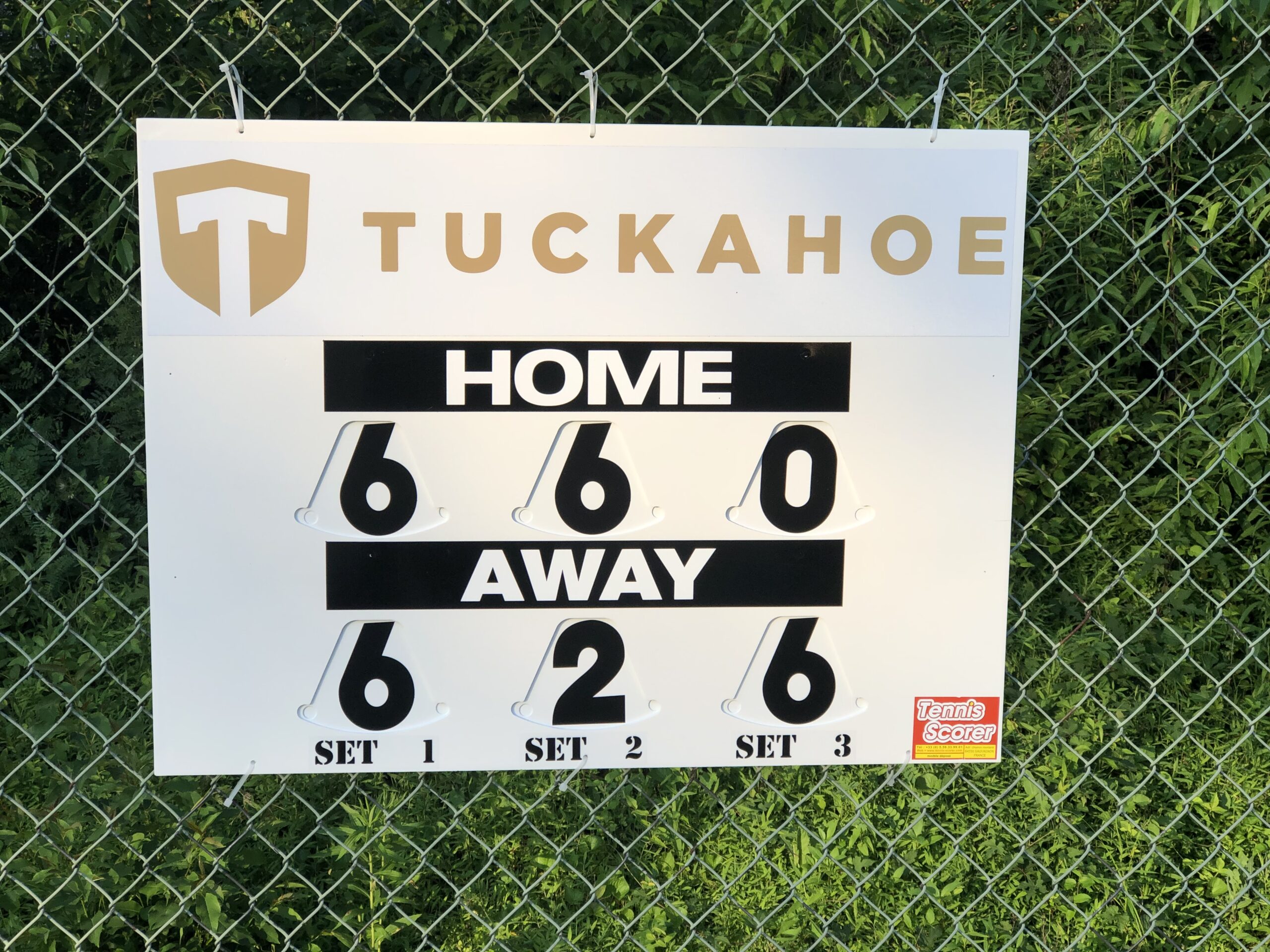
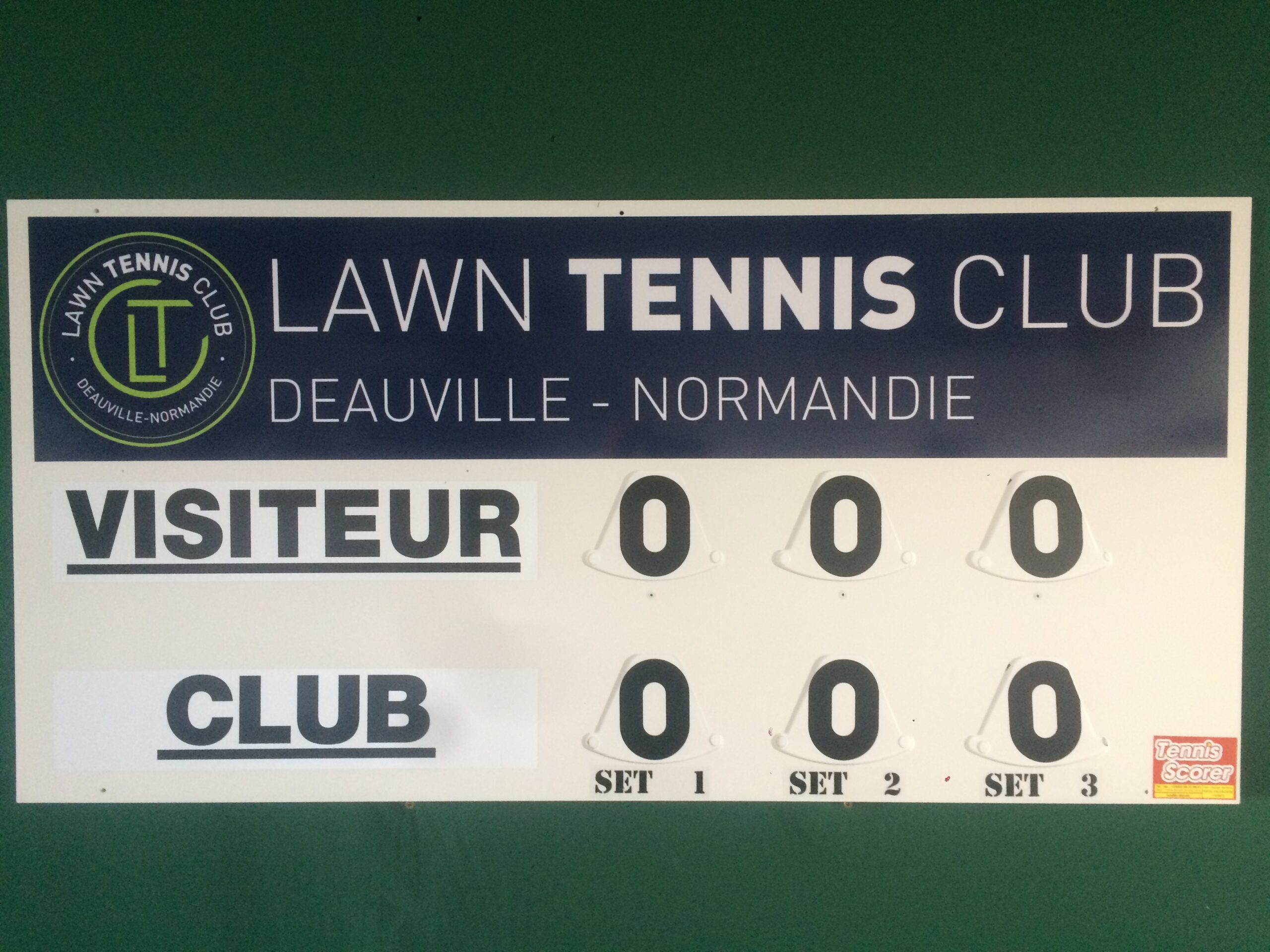
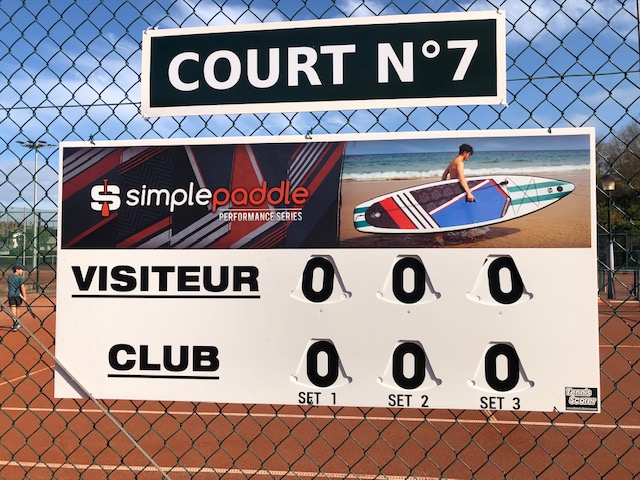
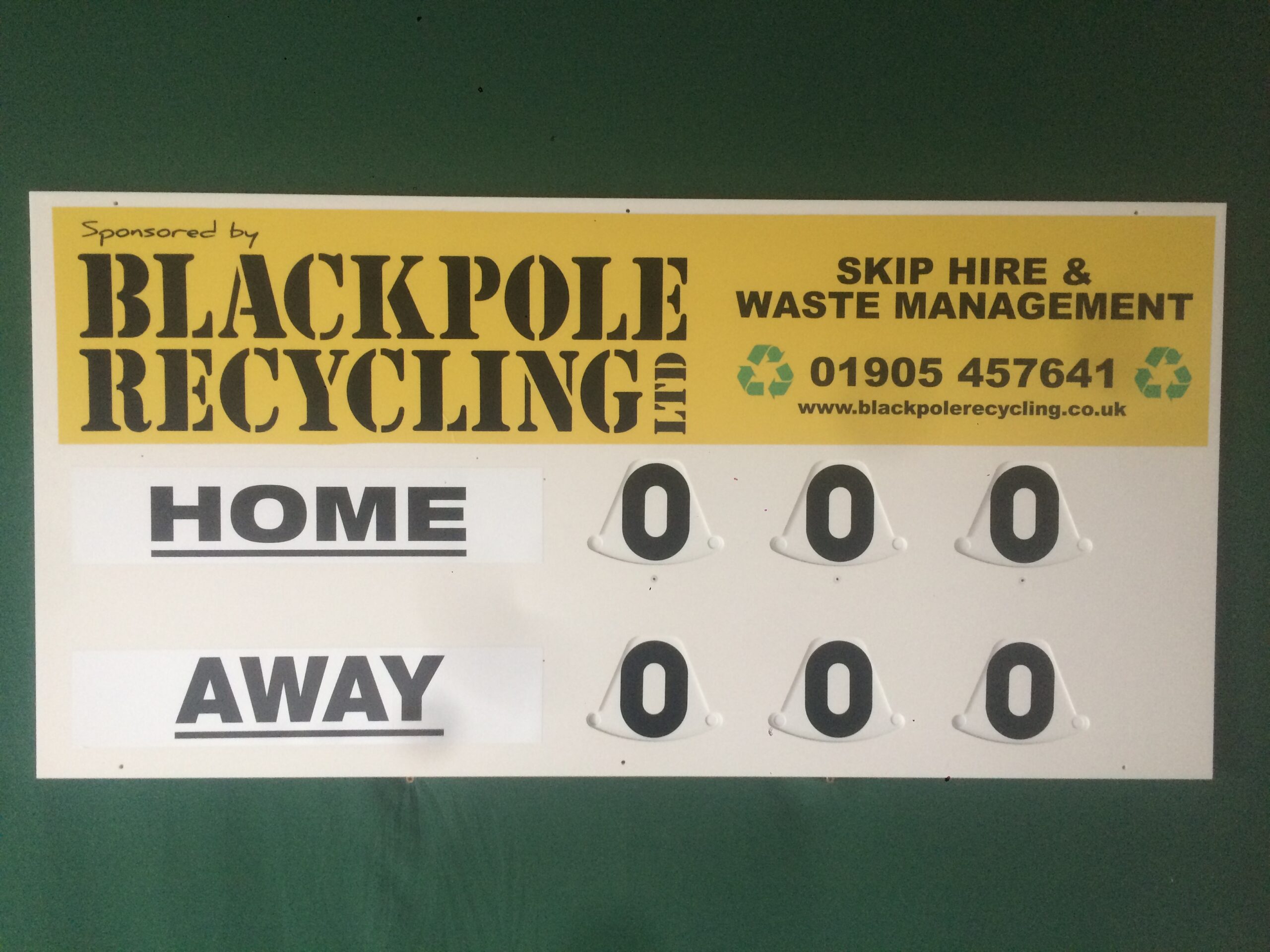
A scoreboard exists to communicate the match quickly, so club branding needs its own visually distinct space. Tennis Scorer recommends a short line so it can sit beside the club name or logo on a personalised scoreboard.
- Essential details: score, court number, player names and set information stay readable at a glance.
- Single line: a phrase on one line avoids wrapping into match information.
- Full version: logo and tagline together, for boards with a generous branding area.
- Reduced versions: a compact version or logo only, for smaller display areas.
From that point, the full line need not appear on every board: the variant follows the space available.
Check legibility from the court
Whichever variant is used, simple letterforms, clear spacing and strong contrast are practical starting points. Thin strokes, elaborate scripts and decorative outlines make small text harder to read.
For contrast, WCAG 2.2 offers a benchmark: at least 4.5:1 for ordinary text and 3:1 for large-scale text. That criterion defines large text as at least 18 point regular or 14 point bold. These web benchmarks inform scoreboard graphics without being legal or physical font-size rules for a court.
Numbers alone do not settle readability. Check a mock-up at its intended size from normal player and spectator positions, under daylight glare and artificial lighting. A board’s score-digit viewing distance does not prove that a much smaller tagline reads from the same spot.
Adapt branding to the board
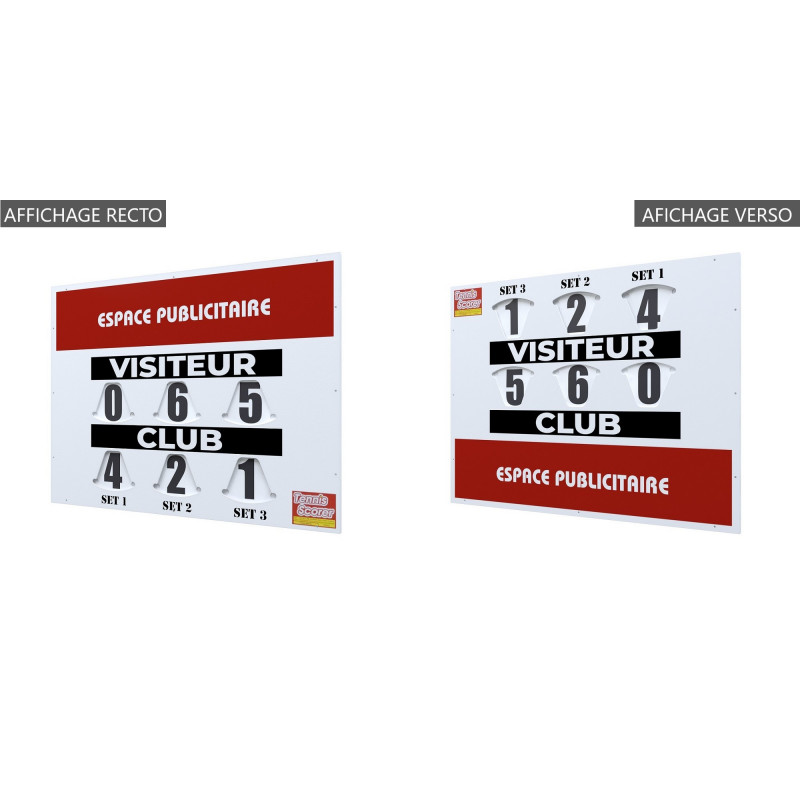
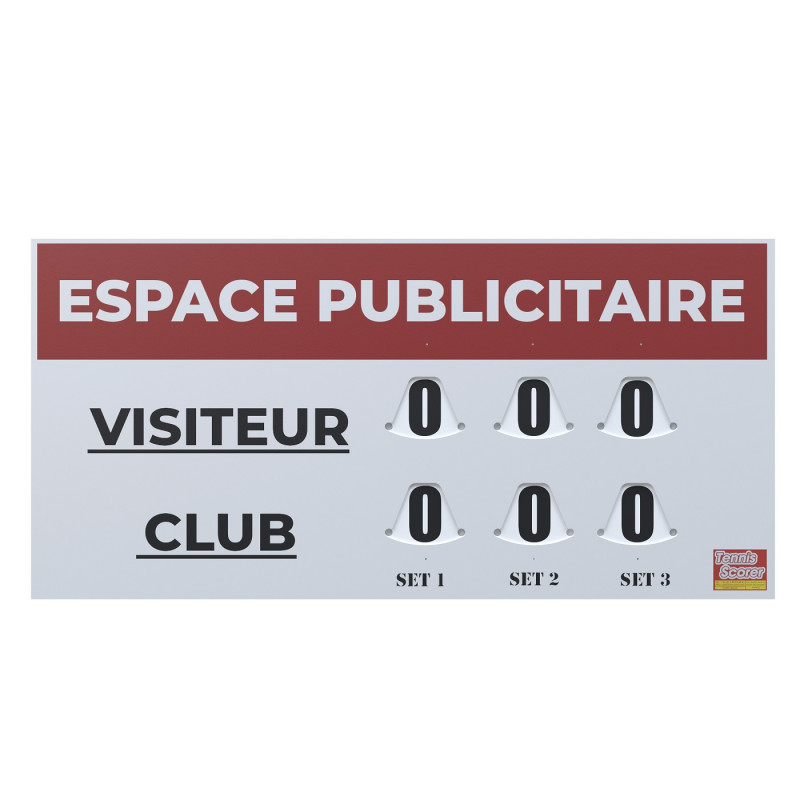
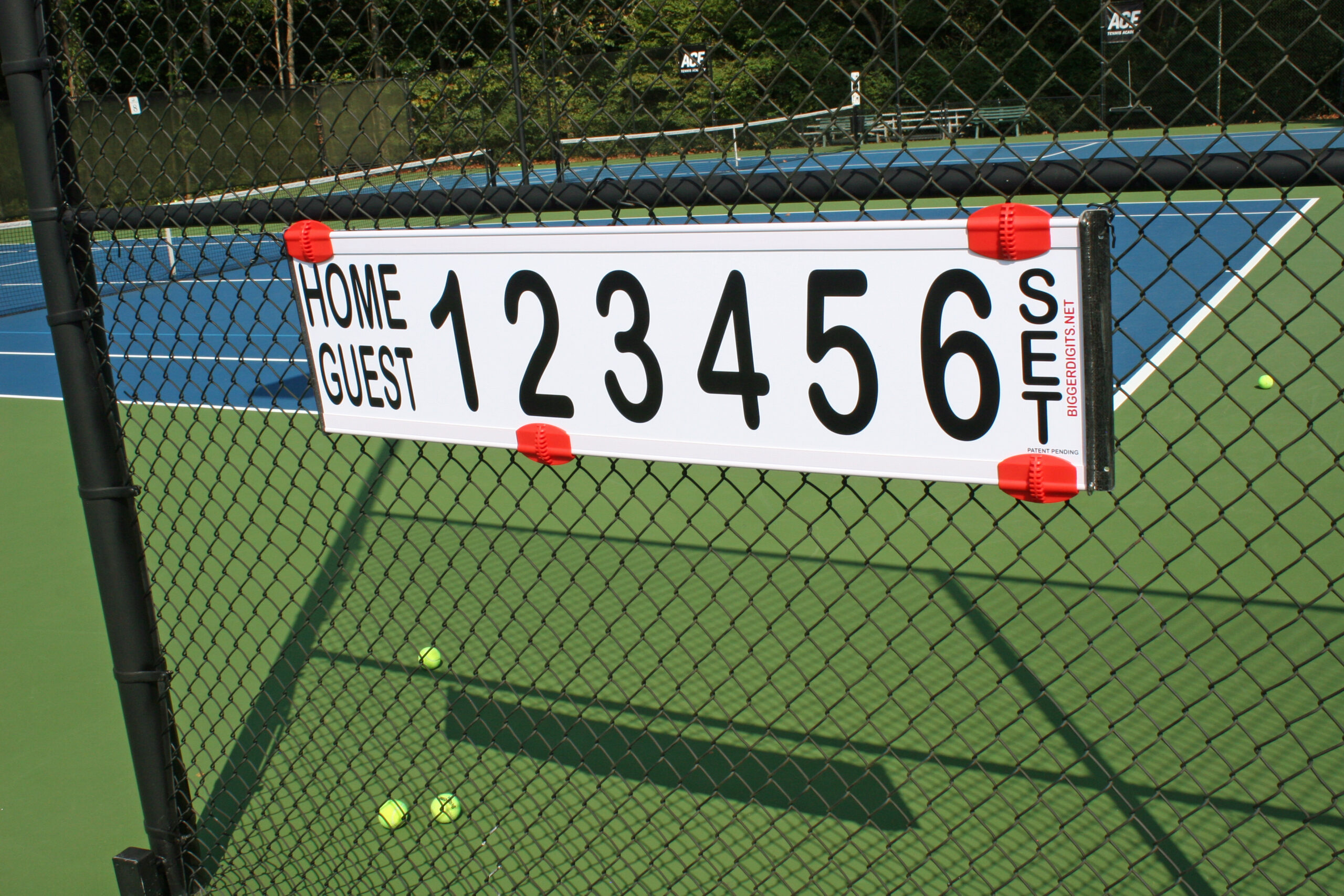
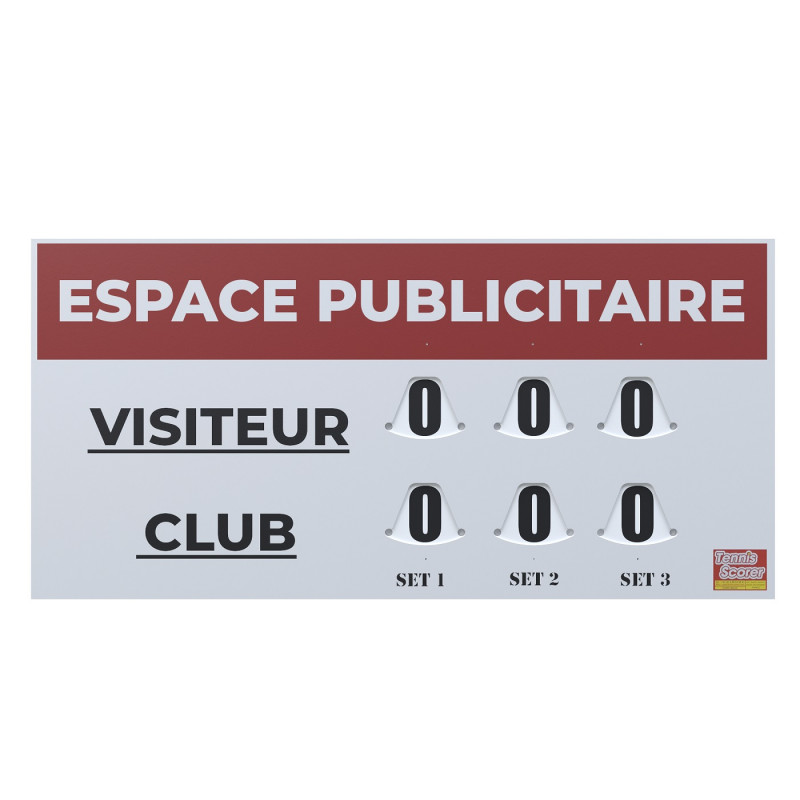
The board format then shapes the branding area. The compact outdoor tennis or padel scoreboard from Tennis Scorer uses number discs that players turn, with a personalisation sticker for a club name, logo, sponsor or court number, plus plates for player names and rankings.
On larger courts, Tennis Scorer’s large weatherproof tennis scoreboard fixes to court fencing. Its advertising sticker carries a club name, sponsor or court number, keeping the branding area distinct from the score.
Padel courts raise a different constraint, since spectators stand all around the glass. The double-sided padel scoreboard shows the score on both faces and includes name plates and advertising stickers for a club name, logo or sponsor.
Frequently Asked Questions
Does the LTA set rules on the length, size or position of a tagline on a court scoreboard?
No such rule was found: the sources reviewed establish neither an LTA rule on tagline length, font size or position nor a universal UK scoreboard size. The LTA’s promotional toolkit shows A3 posters and a 3 m × 1 m external banner, but these are toolkit examples, not mandatory scoreboard dimensions.
Should a club tagline stay the same every season or change with each campaign?
Both can coexist. An evergreen tagline works across seasons, while season-specific slogans can refer to a particular year, goal or championship campaign, and to tournaments, coaching or social leagues. A sport-neutral line stays relevant if the venue later adds facilities or activities.
Which artwork format should a club use for its logo and tagline on printed and digital displays?
The LTA’s promotional toolkit recommends high-resolution vector artwork for printed logos, and vector artwork or PNG for digital banners. The name, colours and approved logo can stay consistent across court signs, the website and booking system, with the tagline shortened or omitted where space is restricted.