
Table of Contents
Branding tennis courts comes down to choosing the right surfaces around the play, respecting the rules on advertising and briefing suppliers precisely. This guide covers where logos can go, which materials and colours work, what consent and budgets to expect in England, and how to compare contractors so each branded panel, sign or scoreboard stays consistent over time.
Where can tennis court branding go?
Branding sits around the playing area, never on it. Fencing, windbreaks, gates, signs and scoreboards all carry a club or sponsor identity, each with its own visibility and purpose.
Logos around the playing area
Brand a tennis court with a logo by working on the structures that surround it: the playing surface stays untouched. Several locations are available, each with a different role.
- Windbreaks: a continuous field for a logo or sponsor graphic, which also cuts wind disruption and gives privacy.
- Perimeter fencing and gates: graphics placed at the entrance greet players and visitors first.
- Court signs: court numbers and entrance signs help players find their destination.
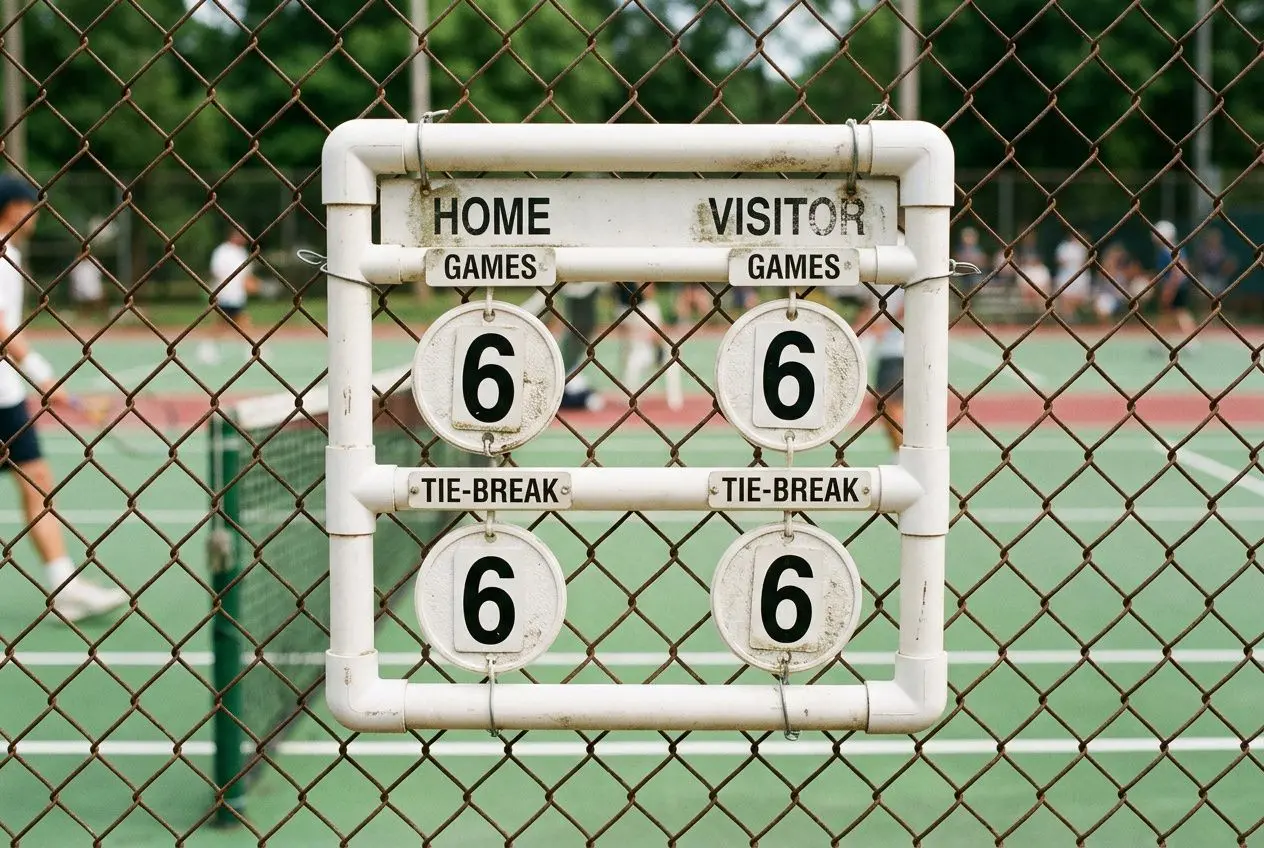
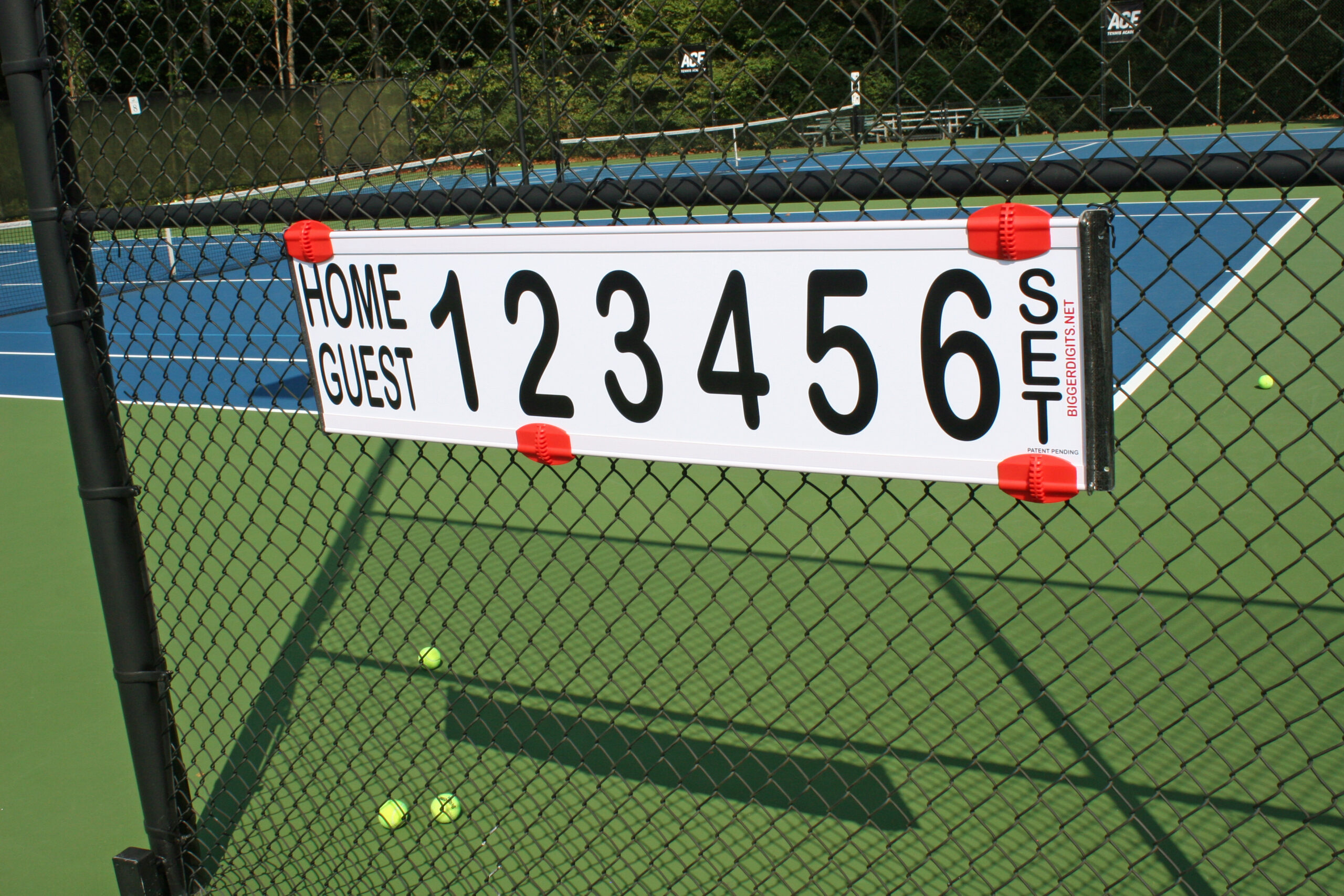
- Scoreboards: a visible place for club or sponsor identity throughout every match.
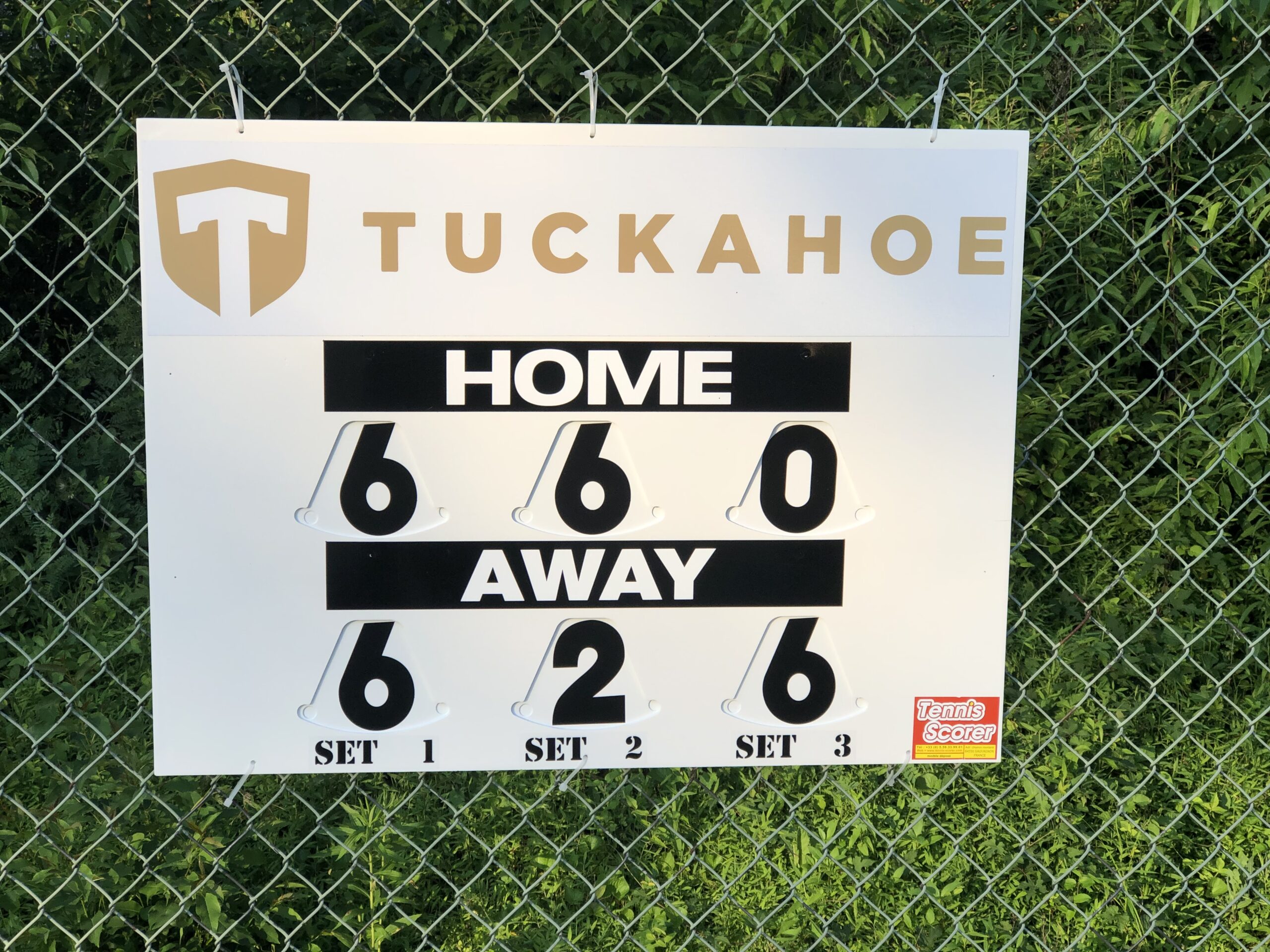
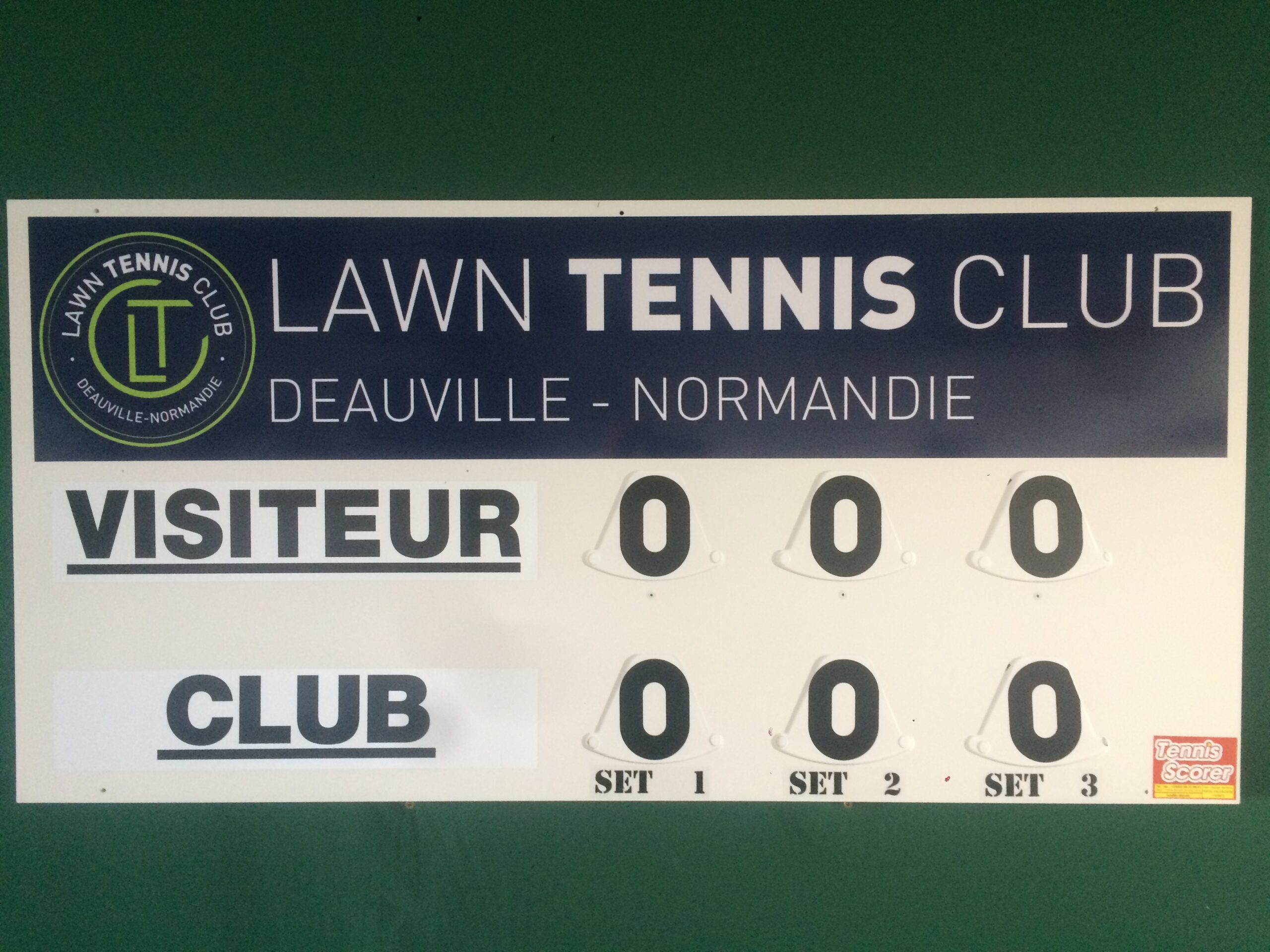
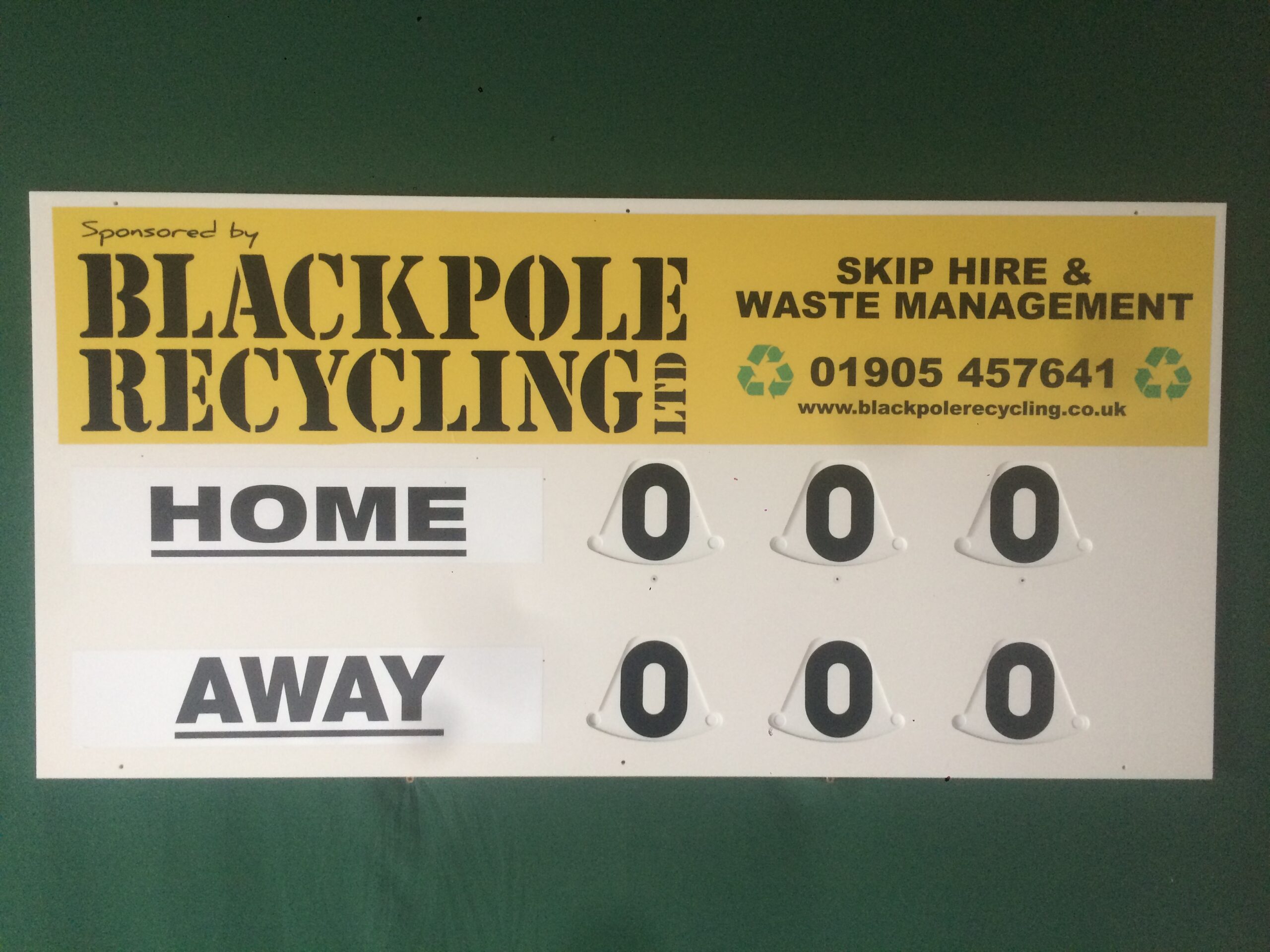
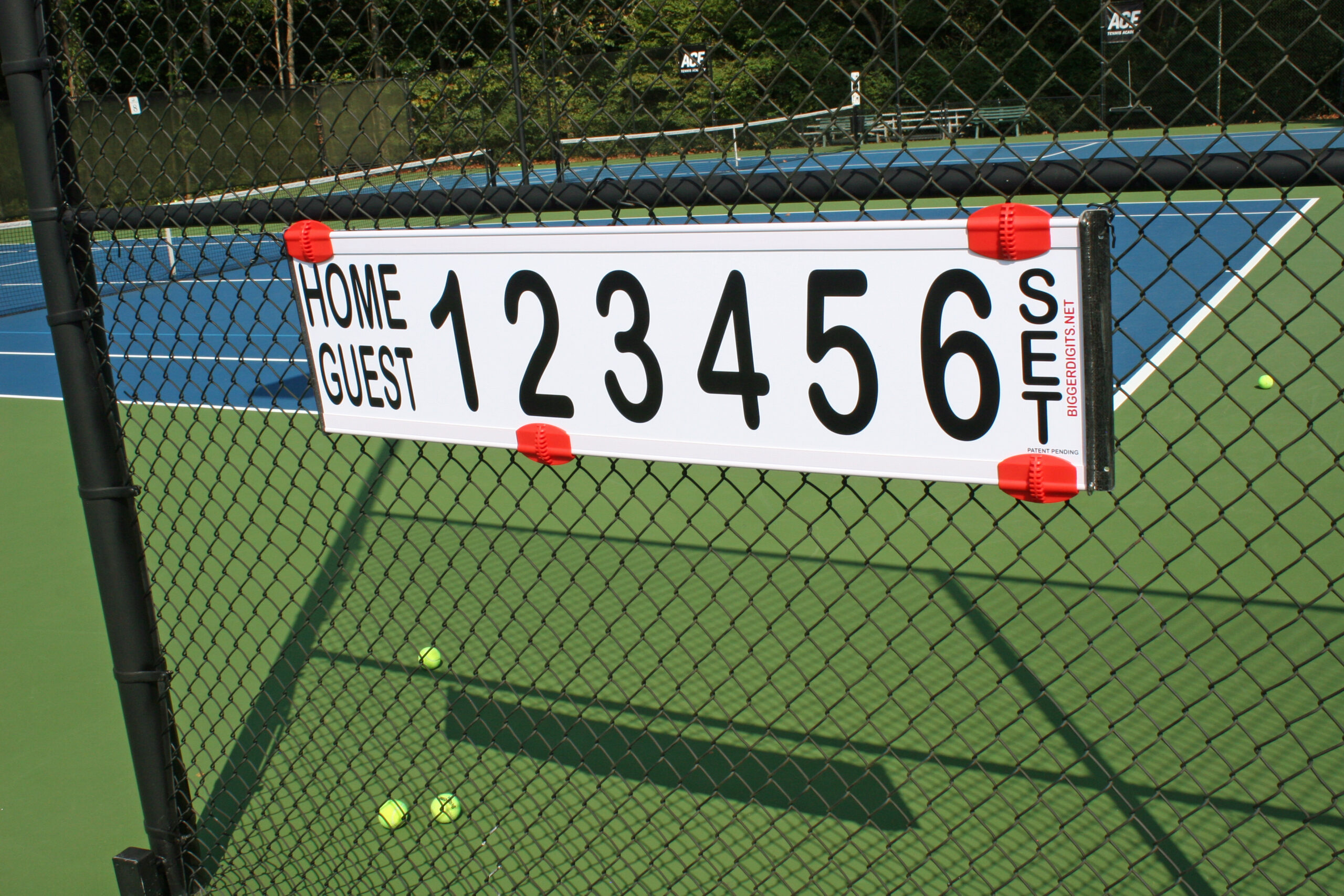
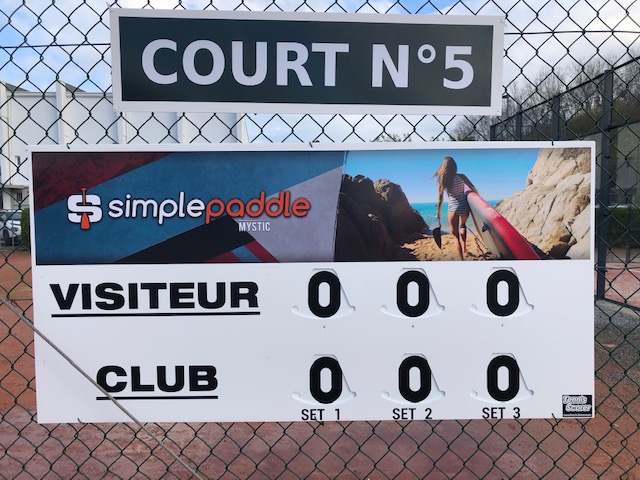
Personalised scoreboards on court fencing
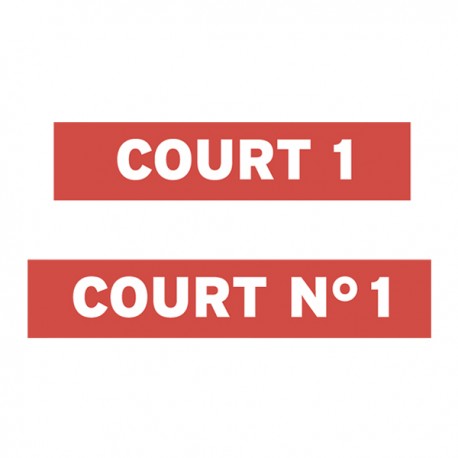
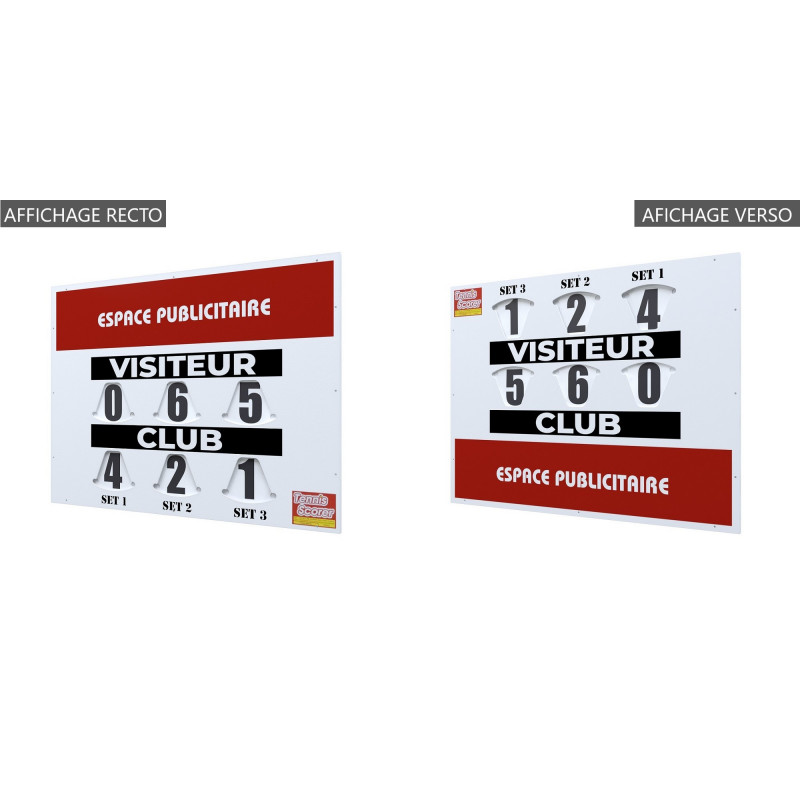
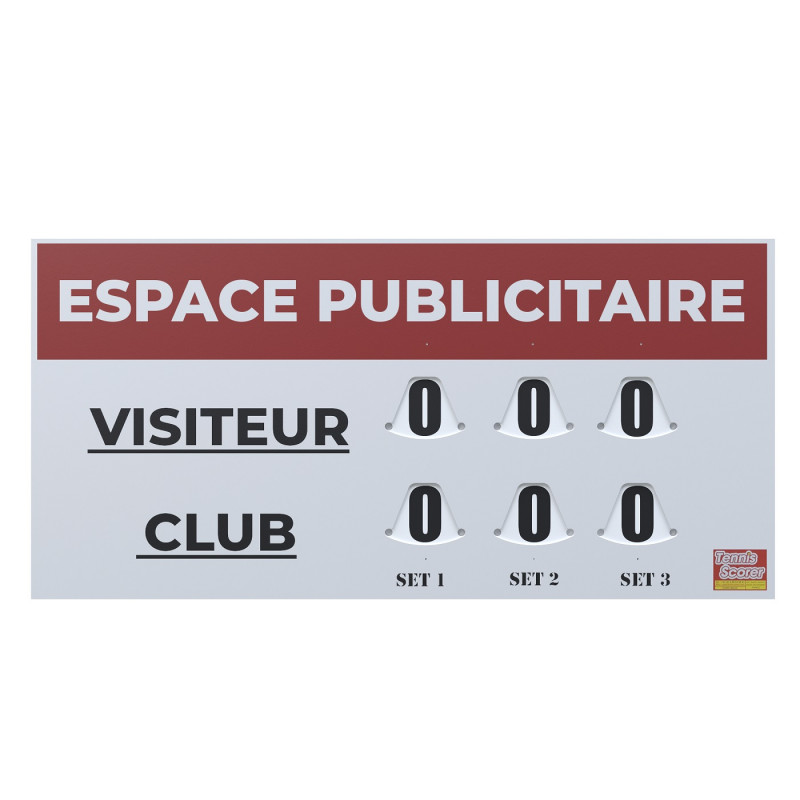
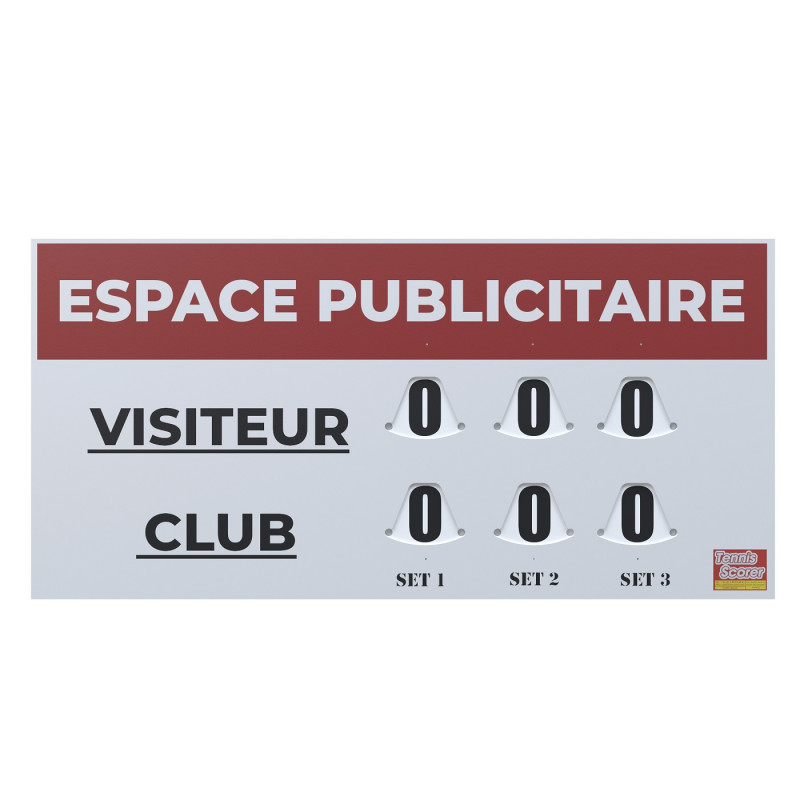
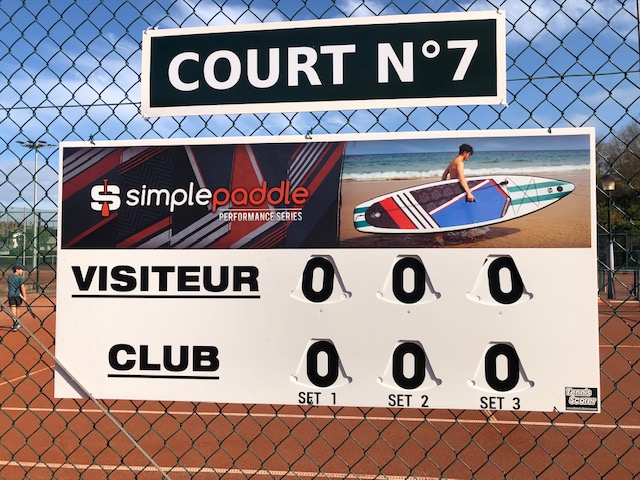
Scoreboards bring that identity to eye level. Tennis-scorer supplies the weatherproof Cliptec board, which fastens to court mesh: it measures 80 × 60 × 0.8 cm. Its free 60 × 17 cm sticker shows a club name and logo, a court number, or both.
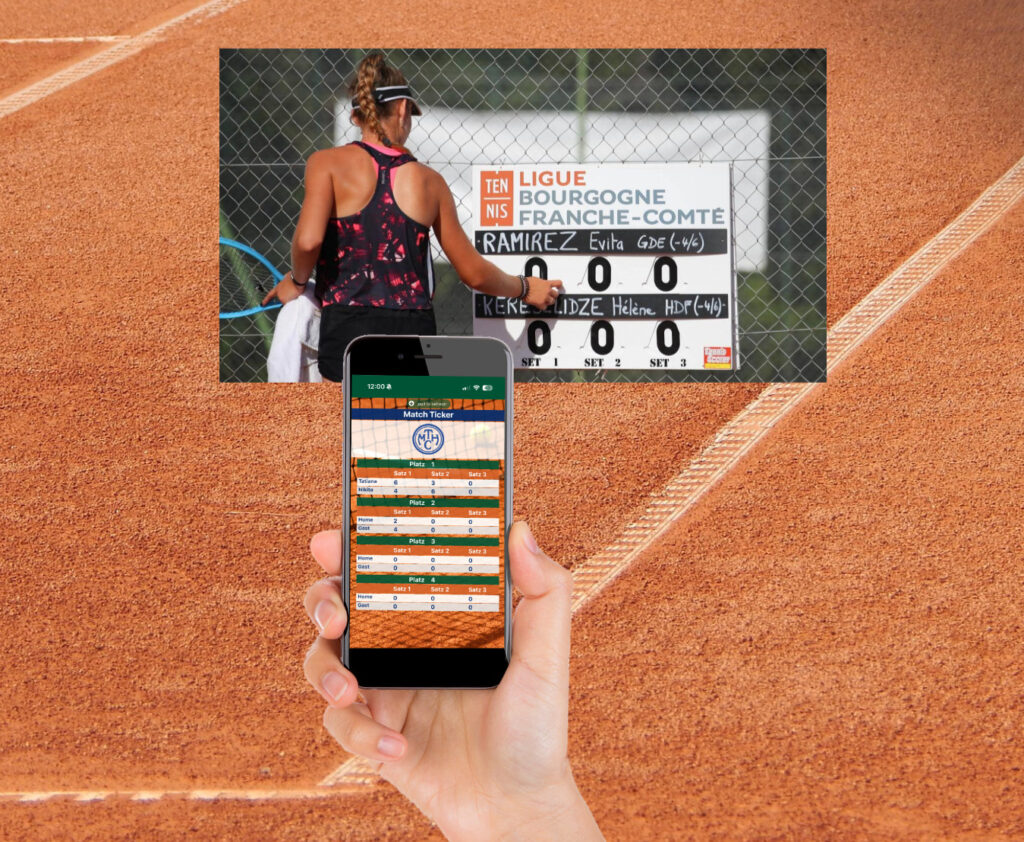
For a larger sticker, the Compact tennis and padel scoreboard measures 80 × 60 × 1 cm and carries a free 78 × 17 cm sticker for club identity, a court number or a sponsor. The Large tennis scoreboard, at 120 × 60 × 1 cm, adds a plate for displaying players’ names and rankings by hand.
Advertising limits under tennis rules
Placement is not entirely free. Under the ITF’s 2026 Rules of Tennis, no advertising or other marks may appear on the playing surface inside the court lines. Advertising is allowed at the back and sides, and outside the lines, provided it does not interfere with players’ vision or playing conditions.
The net follows the same logic: advertising is limited to within 0.914 m of the centre of the net posts. The 2026 rules also restrict white, yellow and other light-coloured material where it could affect vision. All court lines must share one colour and contrast clearly with the surface.
Which materials and colours suit court branding?
Once the locations are chosen, materials decide how the branding looks and lasts. Mesh density, fencing type and coatings each shape the final result.
Windbreak mesh and printed graphics
Mesh density sets the balance between airflow and visibility. More open mesh passes more air. Denser mesh gives greater privacy and a stronger visual field, but places more demand on an exposed supporting fence.
A material specification therefore goes beyond density: it distinguishes weight, air permeability, UV treatment, panel dimensions and edge construction. Each of these affects how a branded screen holds up outdoors.
Printing comes next. The method chosen affects the finish, and with screen printing, the number of colours in the artwork can change production cost independently of graphic size.
Fencing, fixings and signs
Screens only perform as well as the fence behind them. Tennis perimeter fencing uses chain-link, roll-weld mesh or rigid panels, and LTA guidance notes that tubular-post arrangements can accommodate windbreaks.
Height defines the available branding area. LTA guidance gives 2.75 m as an example for chain-link or roll-weld fencing, and describes typical rigid-panel fencing as 3 m high.
Condition matters as much as height: a weak or corroded fence may need repair before screens or signs go up. After installation, check for loose screen edges, failed fixings and excessive sagging.
Paint and colour on the playing surface
Colour on the surface itself carries club identity without any logo. According to LTA guidance, UK porous asphalt or macadam courts use acrylic or polyurethane-based coloured coatings containing slip-reducing agents.
Choices within those systems are wide. One UK system for macadam and concrete offers an SRV, or slip-resistance value, of 60 in wet or damp conditions, in twelve deep colours. A documented project used RAL 5015 Light Blue outside the courts and RAL 6017 Grass Green inside.
By contrast, artificial tennis surfaces call for a surface-system choice rather than a paint choice. Systems differ in yarn, infill and ITF court-pace rating.
What permissions and costs should clubs expect?
Visible branding and court changes can involve the local authority, and each element carries its own budget. Planning ahead avoids delays once suppliers are engaged.
Advertisement and court-work permissions
In England, the Town and Country Planning (Control of Advertisements) (England) Regulations 2007 have given deemed consent to some displays since 6 April 2007; others need express consent. GOV.UK states that advertisement control is separate from other planning consent and focuses on amenity and public safety.
Physical work follows a separate track. LTA guidance advises checking with the local authority before new or replacement fencing, or changes to court construction, colour or level.
Consent fees and branding budgets
Where an English advertisement-consent application attracts a statutory fee, the schedule from 1 April 2026 lists £174 for category 1 advertisements and category 2 advance signs. Category 3 advertisements cost £610, and the display determines the category.
Funding can come from outside, as Tennis-scorer suggests: a sponsoring partner could finance a scoreboard in return for branding on it.
Repainting and refurbishment costs
Colour branding is tied to the surface lifecycle. The LTA gives five years as a general repainting interval and 8–10 years for resurfacing, with actual timing set by the surface and its condition. Average refurbishment costs per court reach £17,500 for acrylic clay and £15,000 for porous asphalt.
Artificial grass averages £12,500 per court, according to the LTA. Artificial surfaces need debris removal and attention to pile, infill and drainage; for artificial clay, the LTA says infill quality affects long-term appearance, permeability and performance.
How do clubs choose and brief suppliers?
With permissions and budgets in view, supplier selection becomes a matter of method: the right specialists, a shared brief and checks before anything is made.
Shortlist the relevant specialists
SAPCA’s directory separates suppliers by trade, so clubs can shortlist according to the work required.
- Surfacing and coatings: acrylic surfacing, painting and coating contractors.
- Fencing: specialists for perimeter structures that carry windbreaks and signs.
- Construction and maintenance: court builders and upkeep contractors.
Membership is a screening check, not a substitute for a project-specific survey, written specification, installation details and maintenance instructions. For substantial tennis court work, the LTA recommends player-testing surface options, a specialist site review, a written specification and tendering to three or more SAPCA contractors.
Give each supplier a comparable brief
A shared brief makes quotes comparable: site measurements, fence-condition and wind-exposure assessments, photographs of each elevation and confirmed fixing points. For windbreaks, send everyone the same artwork and panel schedule, then ask for mesh construction, air permeability, UV treatment, printing method and fixing system. For recolouring, compare substrate preparation, coating compatibility, physical samples, reproducible colour references, performance evidence and future recoat compatibility.
Check proofs and retain specifications
Before manufacture, material samples and artwork proofs at actual panel proportions let a club verify colour and logo placement. For synthetic tennis surfaces, LTA guidance recommends an ITF court-pace certificate and evidence against relevant EN 15330 requirements.
From that point, handover records keep the branding consistent: they identify the installed windbreak material, colour, artwork version and panel position. Damaged or outdated sponsor panels can then be replaced to match.
Frequently Asked Questions
What paint is used on tennis courts?
According to LTA guidance, UK porous asphalt or macadam courts use acrylic or polyurethane-based coloured coatings with slip-reducing agents. Playing lines use paint to the same specification as the playing-area coating. Multi-layer acrylic systems come in multiple colour schemes, including custom colours.
Are personalised tennis scoreboards easy to use and maintain?
Tennis-scorer describes its scoreboards as easy to install and use, with a fastening device for mesh courts, and requiring little maintenance. Players update the score when changing ends, in about two seconds every two games. The 12 cm-high, 2.5 cm-wide figures read from at least 50 metres.