
Table of Contents
Outdoor court advertising solutions turn tennis and padel fences, scoreboards and screens into sponsor positions that players, spectators and visitors see on every visit. This guide explains which formats suit which courts, how branding fits on a scoreboard, how to price and measure a sponsorship in GBP, and which permissions and safety checks come before installation.
Outdoor advertising formats for tennis and padel courts
Courtside advertising is a venue-based form of out-of-home advertising, often shortened to OOH advertising. Its audience is specific: the players on court, spectators around them and visitors passing through. Exposure can also go beyond the venue when sponsor branding appears in match photographs or livestreams.
Fence, board and padel advertising formats
On tennis-court fences, the choice lies between separate banners and printed windbreaks. Separate sponsor banners let a club swap one advertiser without touching the rest. By contrast, a printed windbreak offers a larger continuous branding area, but it adds wind loading and needs watching for wear and fading.
Rigid boards follow a stricter rule: they go on an approved fence or a purpose-designed frame. Padel venues offer other advertising formats: approved enclosure panels, external mesh, entrance signs, court-number signs and booking screens. Court-surface graphics stand apart, since they require playing-surface compatibility and sporting approval before any paint goes down.
Locations and design for sponsor visibility
Each format then needs the right location, and that depends on the target audience. A face directed towards players, spectators or passers-by reaches different people. A large banner hidden by vegetation or facing away from spectators may offer little visibility, however generous its size.
From that point, each proposed position deserves a written record: court, display face, dimensions, viewing position and display period. Photographs taken from the baseline, the spectator area and the entrance then show whether the message reads in daylight and, where floodlights are used, after dark.
Once the position is confirmed, the design of the outdoor advertising follows simple rules: short copy, high-contrast colours, legible type and consistent graphics. A QR code meant to be seen only from across the court may be too small to provide a usable response route.
Printed signs and digital court advertising
An advertising strategy can pair fixed print, the traditional outdoor advertising format, with digital outdoor messages shown on LED displays. Fixed signs provide continuous presence. Scheduled screens, as a result, allow the creative to change during a season or a tournament.
Screens bring their own contractual detail. An LED proposal should specify slot length, appearances per match, number of matches, share of rotation and whether inventory is shared or exclusive. A screen being switched on does not, by itself, establish that spectators saw the advert.
Sponsor branding on court scoreboards
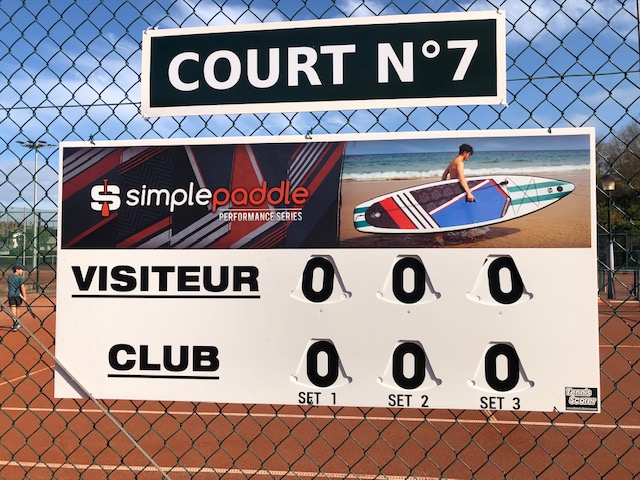
Beyond fences and screens, the scoreboard offers a compact sponsor position that every player checks throughout a match. Its limits are just as clear: a small advertising space and a scoring function that must never suffer from the branding beside it.
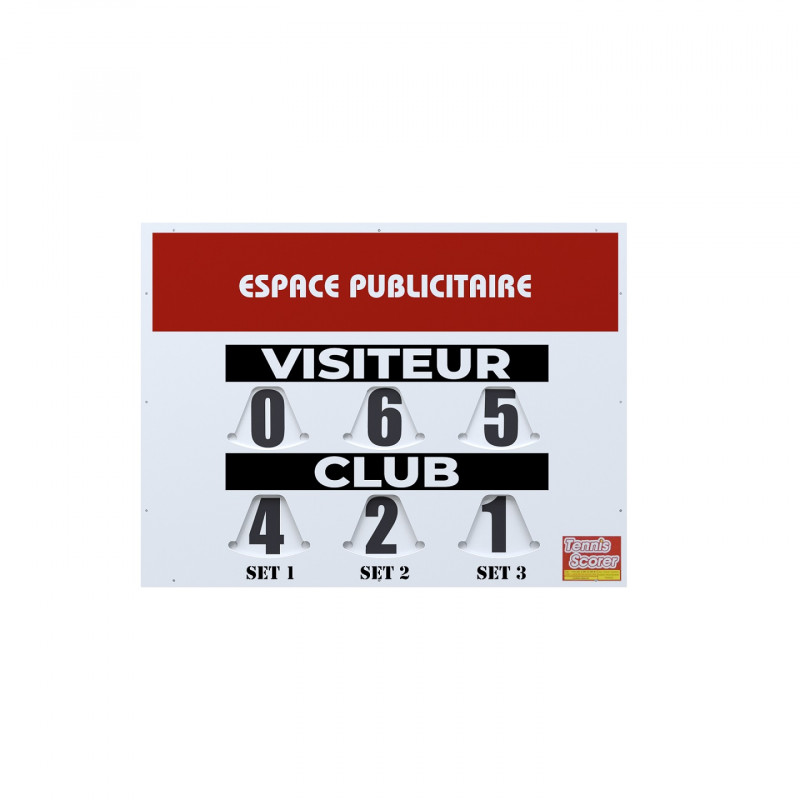
Keep scores readable beside sponsor graphics
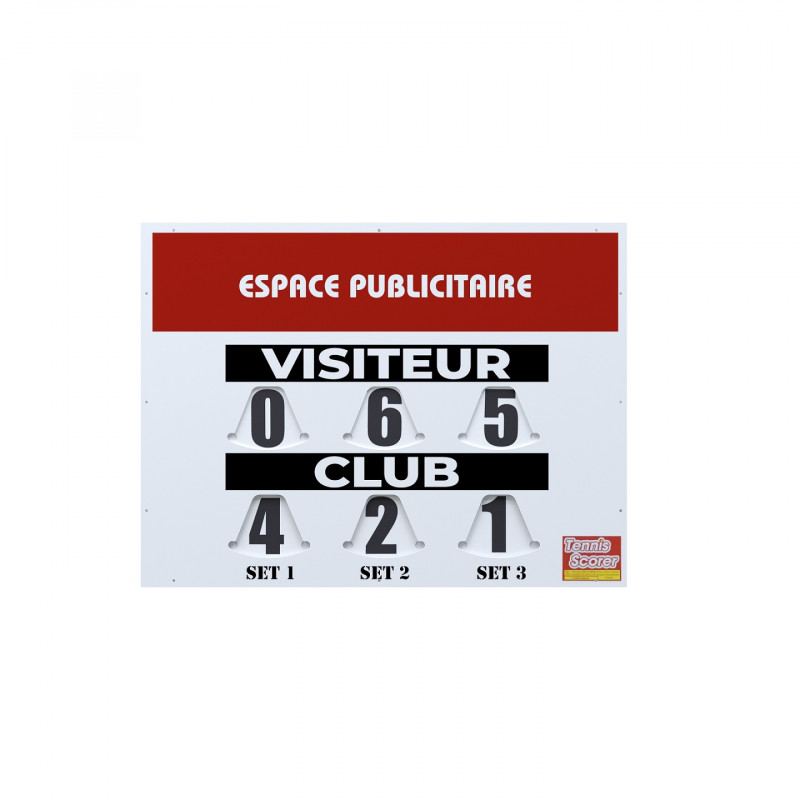
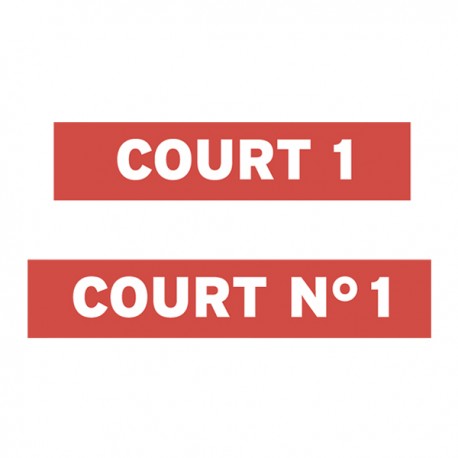
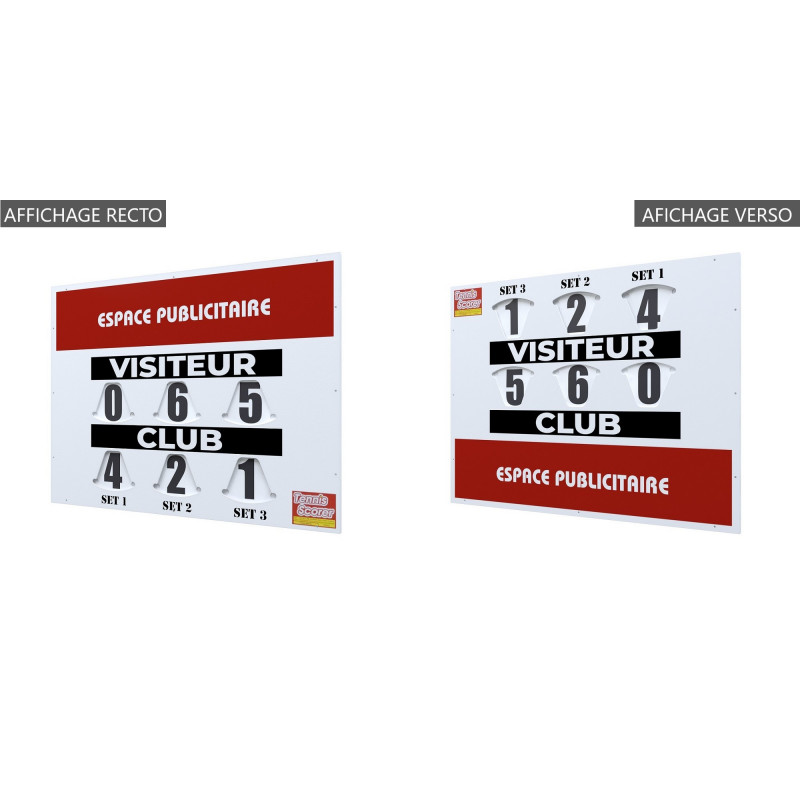
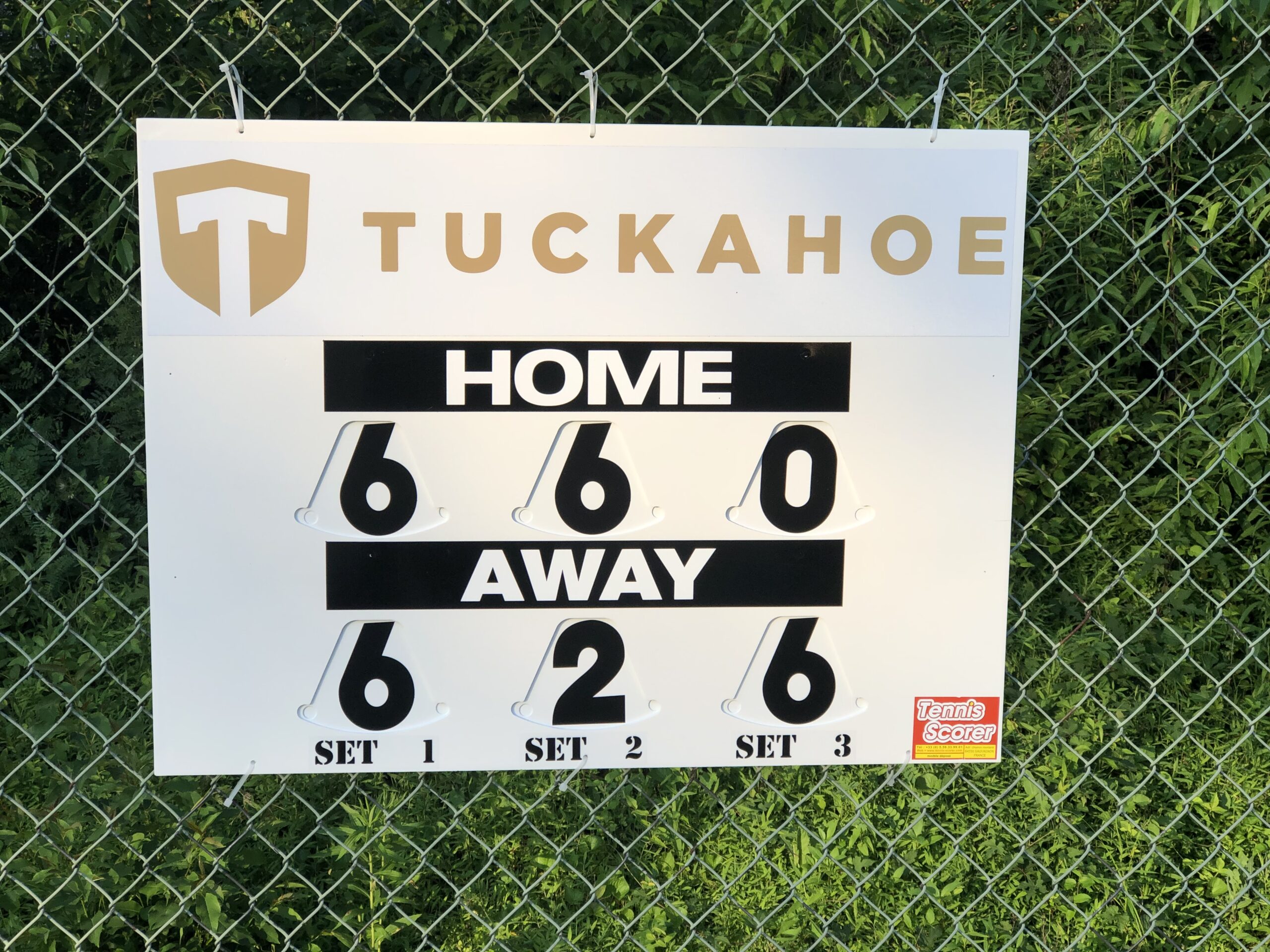
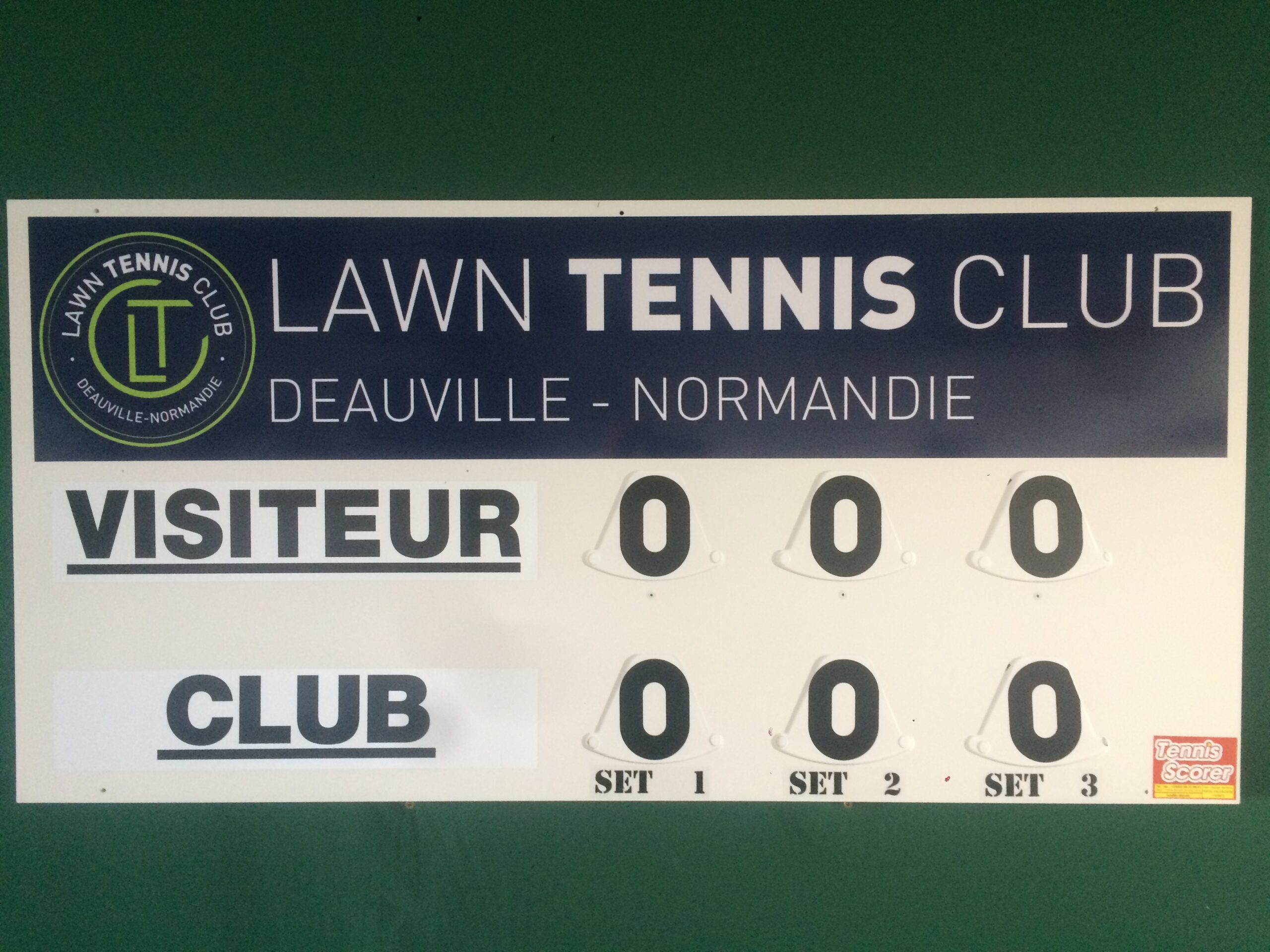
A scoreboard places branding at a functional point of reference, so the score must stay more prominent than any sponsor logo. Tennis Scorer offers custom adhesive stickers for scoreboards, fitted to the advertising area and showing a court number, club logo, sponsor logo or a combination, according to the model. Artwork preparation follows four checks:
- Scoring and sponsor areas: measure both on the chosen model, since no standard size applies across scoreboards.
- Viewing side and mounting: confirm which face spectators see and how the board attaches.
- Dimensioned proof: show the area that stays visible once any frame or fixings are in place.
- Legibility test: check the result from the intended viewing position.
Colour choices complete those checks. A sponsor palette that weakens the contrast of the figures should be adapted, since readability of the score comes first.
Compact scoreboards for tennis and padel
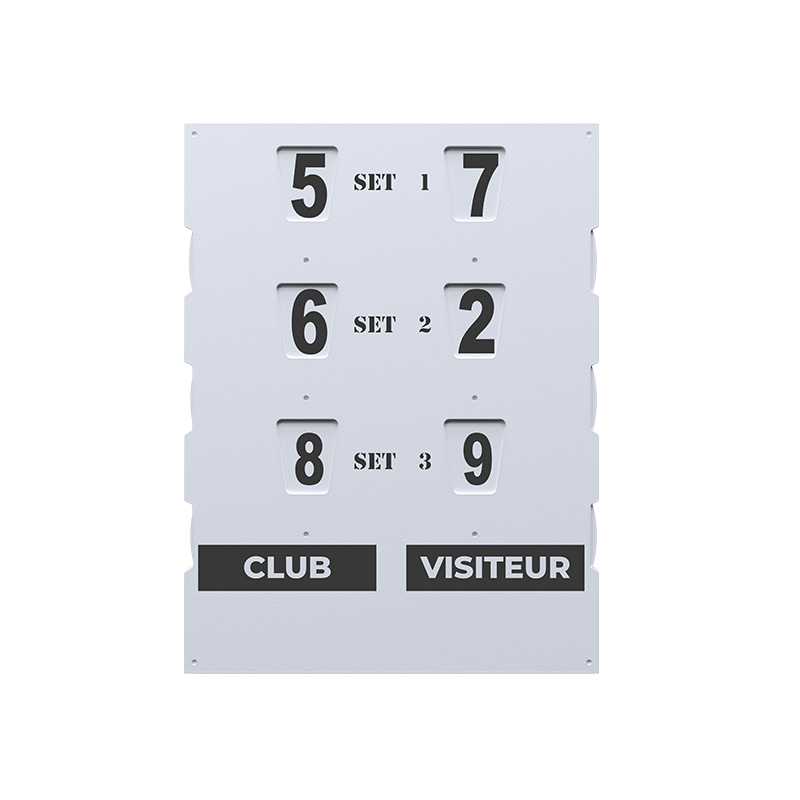
Tennis Scorer’s Compact scoreboard for tennis and padel measures 80 × 60 × 1 cm and weighs 3 kg. Made from white PVC, it stays outdoors all year and has a fastening device for mesh courts.
Its advertising sticker measures 78 × 17 cm: sponsor branding, club identity or a court number. The 12 cm-high figures are stated to be legible from more than 50 metres.
Large scoreboard branding and installation
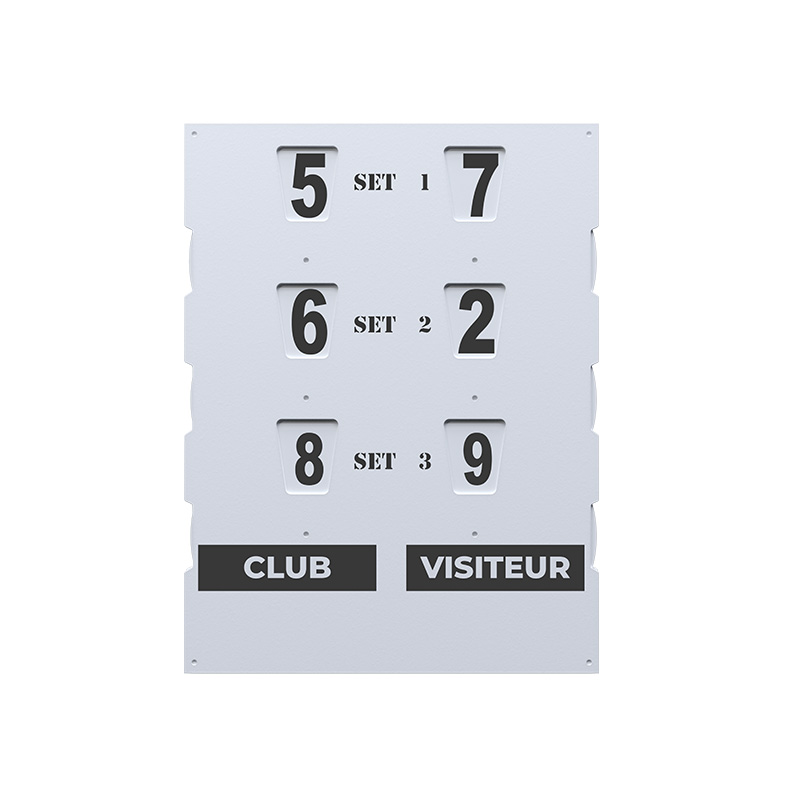
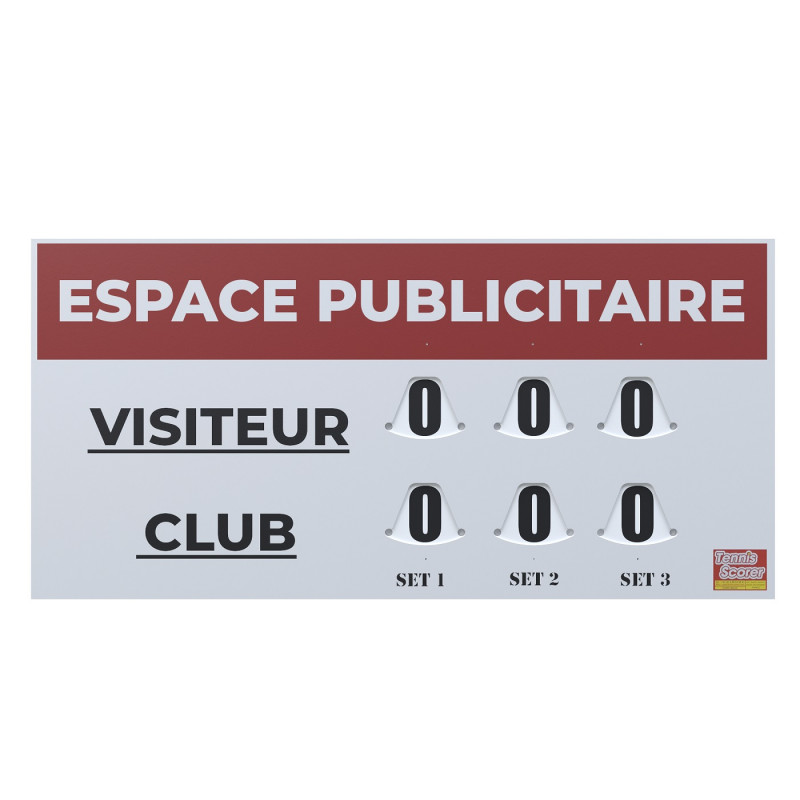
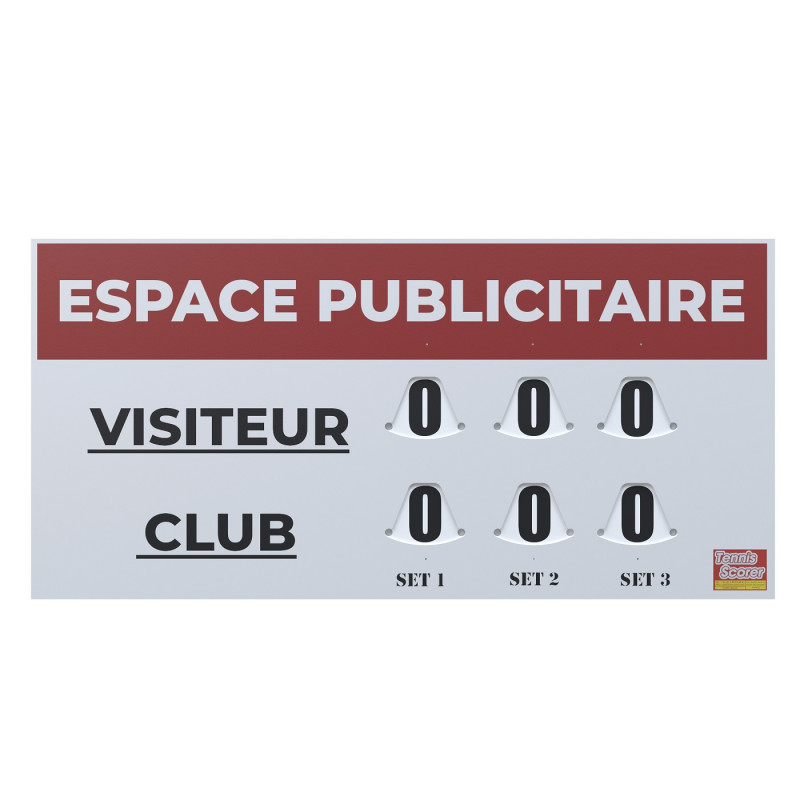
For a wider format, the large outdoor tennis scoreboard from Tennis Scorer measures 120 × 60 × 1 cm. It includes an adhesive panel for a sponsor, a club name or a court number.
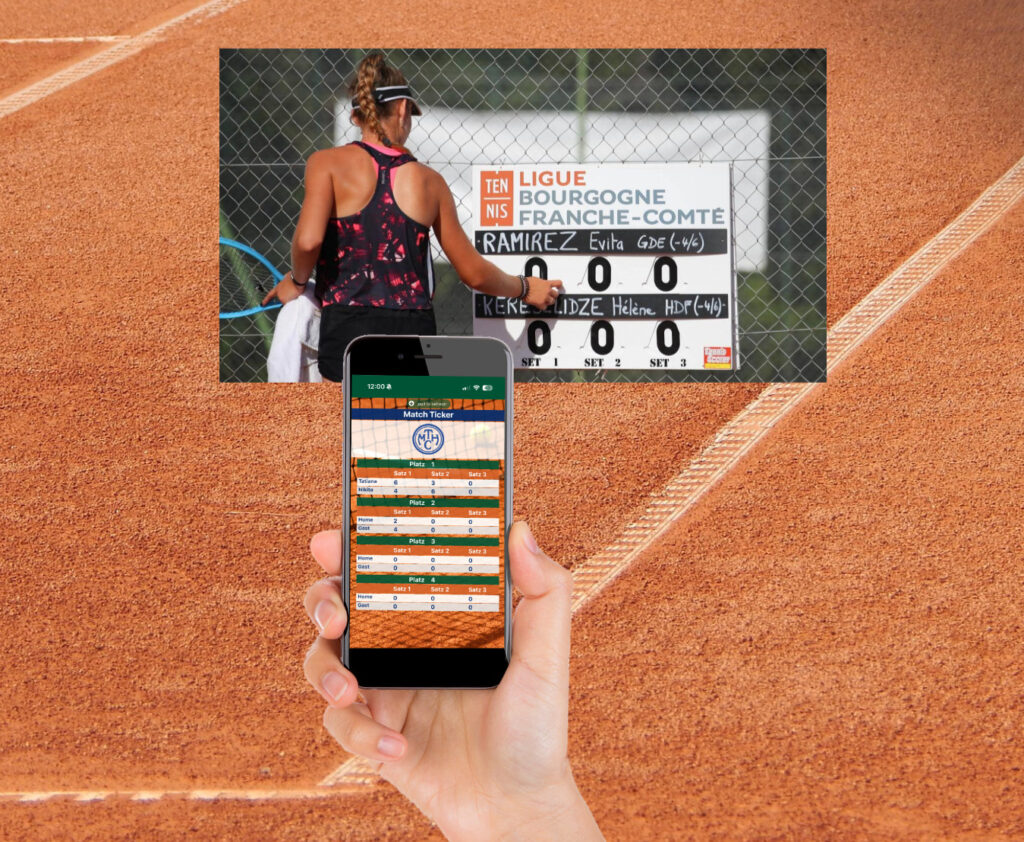
Installation is straightforward: six cable ties fix it to a mesh fence, and a plate displays players’ names and rankings manually. Tennis Scorer recommends seeking a sponsoring partner to help fund a branded scoreboard.
Court sponsorship costs, packages and results
Whatever the format, a sponsorship deal rests on three questions: what it costs, what the package includes and how the sponsor will judge the outcome. Each answer depends on the venue rather than on a national tariff.
Build a sponsorship budget in GBP
No single published UK court-sponsorship rate exists. Rates vary with venue, target audience, position, duration, exclusivity and additional rights, so a billboard advertising rate card does not work as a courtside price list. A sound budget separates the rights fee from artwork, printing, installation, maintenance, replacement, photography, measurement, agency fees and VAT where applicable.
Those service costs depend on substrate, size, finish, number of faces, artwork changes, access equipment, structural requirements, power or data, site conditions and replacement frequency. An illustrative annual calculation adds £250 for production and £100 for installation. Maintenance and administration take £50 each, and a desired contribution of £250 brings the total to £700, an illustration rather than a UK market rate.
Compare packages and advertising providers
Once costs are clear, the offer itself takes shape. A club or rights holder may sell one position, several courts, a season, an annual partnership or category exclusivity. Exclusivity can raise the rights fee, because competing businesses are shut out of that sponsor category.
Packages may also combine courtside branding with entrance signage, tournament sponsorship, club digital activity, match photography or livestream exposure. An outdoor advertising agency can compare venues, negotiate rights, produce artwork, arrange installation and evaluate an outdoor advertising campaign. The written proposal names positions, dimensions, duration, expected audience and rights, while the agreement allocates artwork approval, upkeep, damage replacement and end-of-term removal.
Measure reach, responses and ROI
Measurement starts with definitions. Physical attendance, potential audience, viewable audience, livestream viewing and social-media reach are distinct measures, and impressions mean only what their stated definition says. Route’s conventional out-of-home estimates should not be applied to a court lacking relevant measurement coverage.
For LED screens, playback records should show actual appearances, seconds per appearance, share of rotation and downtime. Agreed display dates, match counts, attendance methods, viewing positions and maintenance photographs then give those records their context.
Responses complete the picture: sponsor-specific landing pages, tracked URLs, QR codes, enquiries and customer questions indicate engagement, while pre- and post-campaign surveys test recognition and recall. Not every sale during the period is attributable. In practice, ROI equals attributable incremental profit minus campaign cost, divided by cost, multiplied by 100: an illustrative £10,000 campaign yielding £15,000 in attributable profit returns 50% ROI.
Permissions and safety before court advertising installation
Before any sponsor sign goes up, two sets of checks apply: who has the right to sell and display the advertising, and whether the court structure can carry it safely through the seasons.
Confirm rights and advertising obligations
The first step is ownership: establish who owns the land and the fence, then check the lease, management agreement and any local-authority advertising policy. A club using a public-park court may not control its advertising rights at all. Further obligations follow:
- Planning control in England: under the Town and Country Planning (Control of Advertisements) (England) Regulations 2007, as amended, an advert may fall outside control, have deemed consent or need express consent; an open park court is not automatically treated like enclosed stadium land.
- Tax and rates: HMRC treats sponsorship rights exchanged for publicity as standard-rated for VAT at 20%, and the Valuation Office Agency says a separately let advertising right may warrant its own business-rates assessment.
- Advertising codes: ASA/CAP guidance applies to gambling adverts seen by juniors and to environmental claims.
Size alone settles nothing. The Planning Portal’s 0.3 m² reference applies only in certain circumstances, so the location of the advert and its display type determine which rules apply.
Check UK advertisement-consent fees
Where express consent is needed, fees differ by nation. In England, from 1 April 2026, applications cost £174 for eligible on-premises business adverts or advance signs and £610 for others; third-party sponsor branding should not be assumed to qualify for £174. According to the Welsh Government, Welsh fees from 1 December 2025 are £248 for on-business-premises adverts and £197 for advance signs. Other Welsh adverts cost £667. In Northern Ireland, an amendment of 11 March 2025 set £231 from 1 April 2025, subject to checking the council’s current fee; displays without express consent still need landowner permission and safe maintenance.
Assess structures, installation and upkeep
Once permissions are clear, the structure comes next. A banner or windbreak adds wind loading, and LTA fencing guidance treats fence strength as a design consideration. Inspect posts, corrosion, foundations, gates and prevailing-wind exposure, then ask the original installer which loads and fixings are permitted. Competent installers work to a site-specific method controlling court access and falling objects; the HSE’s 2014 working-at-height guide calls for avoiding height where practicable and using suitable, maintained equipment otherwise.
After installation, upkeep becomes a named responsibility. Checks of tension, fixings, fraying, fading, sharp edges, scoreboard operation and storm damage are recorded, and unsafe material comes down promptly. Frequency follows site exposure, manufacturer instructions and the risk assessment, while digital signs add power, weather protection, brightness and visibility to neighbours or roads.
Frequently Asked Questions
How much does court sponsorship cost?
The price is negotiated venue by venue, and audience relevance can weigh more with a sponsor than a larger but poorly matched attendance figure. Timing also matters: concentrating the budget on the peak season, when the sponsor’s product or service is most relevant to its audience, can make the same spend work harder.
How can a sponsor measure the results of a courtside campaign?
Reach counts unique people exposed, and frequency gives their average number of exposures; impacts depend on the stated definition. As an illustration, 10,000 people reached at an average frequency of three produce 30,000 impacts, which is not a venue forecast. Pre- and post-campaign spectator surveys test recognition, awareness, recall and purchase consideration, ideally against a comparable non-attending group.
Does sponsorship income require a club to register for VAT?
Registration becomes compulsory once taxable turnover exceeds £90,000, subject to HMRC’s timing rules. The threshold applies to total taxable turnover, not to sponsorship income alone.