

Table of Contents
Selecting the right tennis scoreboard for a court or club means weighing size, visibility, materials, mounting method and long-term value. This guide covers each factor in practical detail, helping every facility choose equipment that keeps the match score clear for players and spectators.
Choose the right tennis scoreboard format
A tennis scoreboard must show four essential elements at a glance: player names, set scores, the current game score and a serving indicator.
Compare tennis board sizes
Size is the first practical decision for any club or court owner. Two main outdoor formats are available: compact rotating-disc models and full-panel PVC boards.
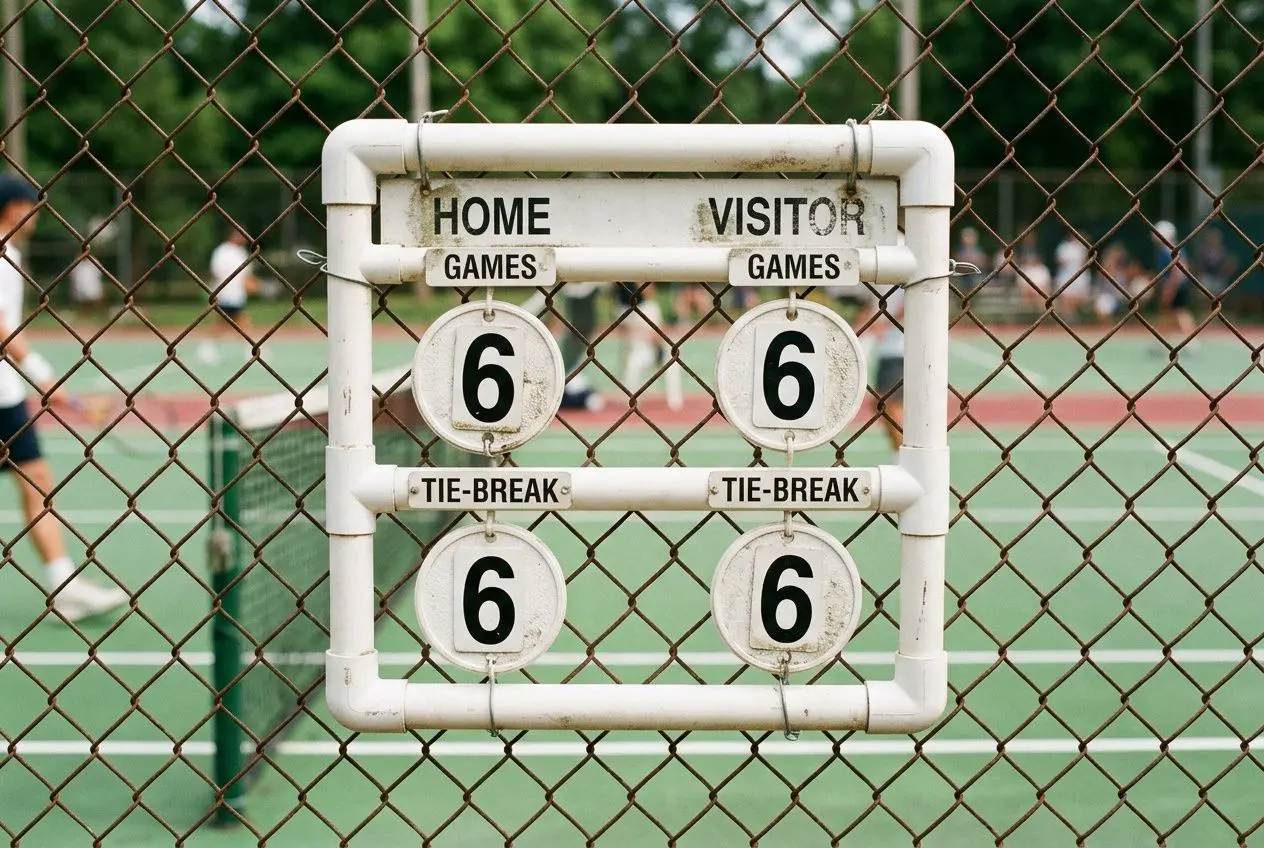
- Small rotating-disc (35 × 50 cm), suited to net-side placement on private or compact courts where viewing distances are short. The numbers remain clear for nearby players but are not intended for spectator areas.
- Medium rotating-disc (46 × 65 cm), the standard club format, readable from both baselines. It is the right choice when equipping a multi-court facility where match officials or players update the score during changeovers.
- Large rotating-disc (56 × 80 cm), built to last through tournament use in spectator areas or larger grounds where the score must remain legible from a considerable distance.
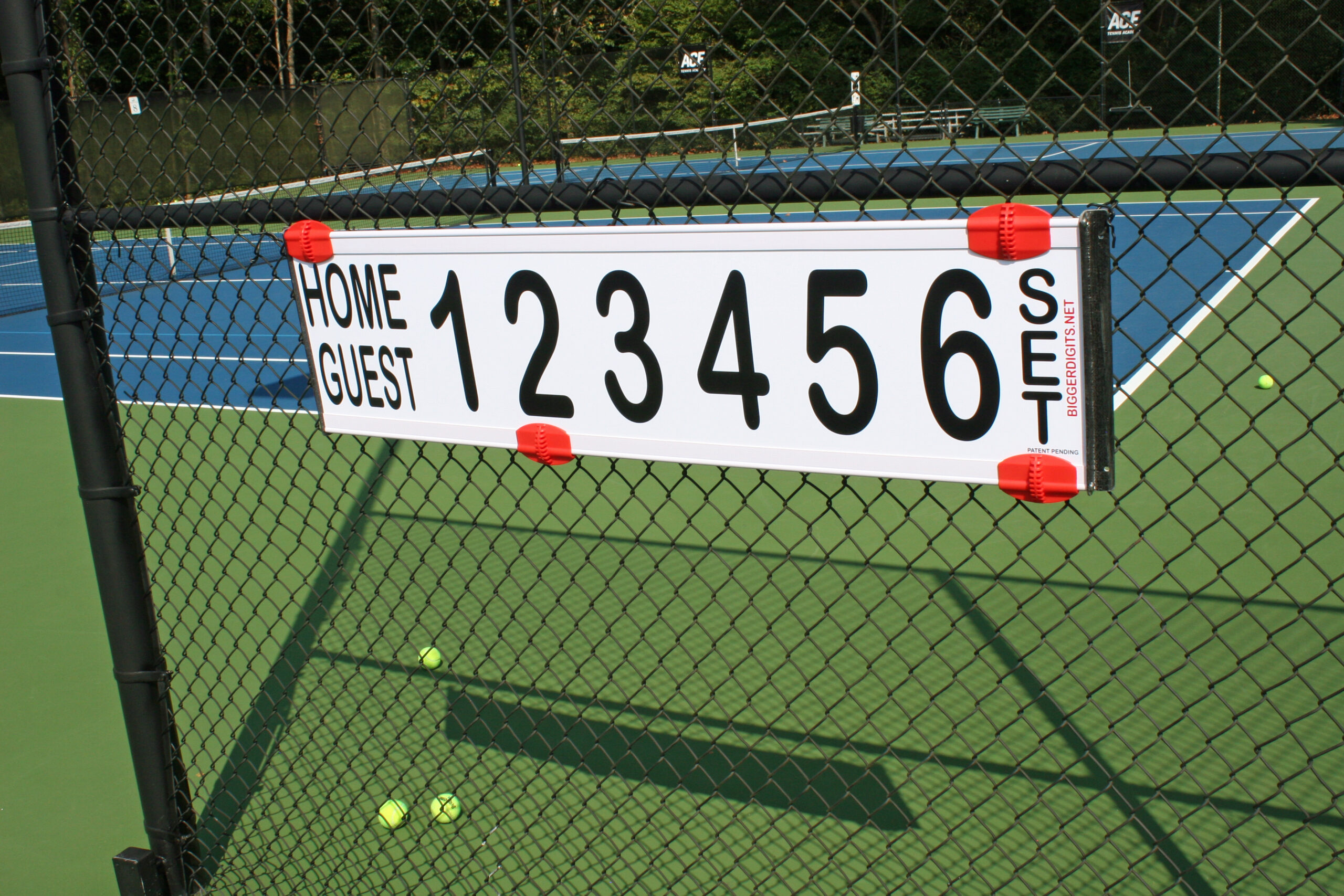
Full-panel PVC boards measure approximately 60 × 60 cm and carry 10 cm numerals on a white background. Their scale and contrast make them legible from beyond 50 metres, suiting clubs that want a non-electronic solution without installing complex equipment. Double-sided versions remain visible from both sides of the fence, which helps when spectators or club members move around the court perimeter.
| Format | Dimensions | Numeral size | Recommended use | Legibility distance |
| Small rotating-disc | 35 × 50 cm | Standard | Private/compact courts, net-side | Short range |
| Medium rotating-disc | 46 × 65 cm | Standard | Club standard, multi-court | Both baselines |
| Large rotating-disc | 56 × 80 cm | Large | Tournament, spectator areas | Extended range |
| Full-panel PVC board | ~60 × 60 cm | 10 cm | Club, non-electronic installation | 50+ metres |
Plan visibility around the court
Visibility depends on more than board size. For clear visibility, its position relative to the fence, the angle of approach and ambient light all affect how reliably players and spectators can read the score during play. Mounting the board at the correct height on the perimeter fence creates the broadest sightline from court level.
Where fence space is restricted, a post-mounted scoreboard can be more practical than a standard fence-mounted unit. The score remains visible when fence panels are occupied by windbreaks or advertising boards. Double-sided versions solve the separate problem of multiple spectator approaches, removing blind spots without requiring a second unit.
Add branding and player names
A dedicated branding zone measuring 56 × 17 cm accepts personalised adhesive stickers for a club logo, sponsor identity or court numbers. These can be replaced when sponsors change. Removable slate name plates simplify player changes between matches, while Green, Blue and Black options allow the board to match existing court equipment and club identity.
A visible tennis scoreboard helps everyone understand the score, whether they are playing, officiating or watching from the facility perimeter.
Understand tennis scoring and the score display
Once the tennis scoring system is clear—from individual points through games and sets to the end of a match—it becomes simple to update the board accurately and check the score at each changeover without delay or dispute.
Read every point and game
Tennis point values follow a sequence unlike that of most sports: love (0), 15, 30 and 40 mark successive points within a game. Anyone learning how to read a tennis score on television will see both players’ current totals displayed side by side and updated after every exchange. A player needs at least four points and a two-point advantage to win the game, so the sequence does not simply stop at 40.
Follow each set and match
Set columns on a scoreboard fill gradually because the target is six games, but a two-game margin is required before the column is complete. The target is six games, but a set continues until one side leads by two games—so set scores can climb well past six. From there, the match format shows spectators how many sets remain and whether a deciding set is approaching.
- Standard set: the first player or team to reach six games with a two-game margin wins; at 6–6, a tiebreak decides the tiebreak set, recorded as 7–6.
- Advantage set: no tiebreak is played at 6–6. Play continues until one player or team achieves the two-game margin, which can make the set considerably longer.
- Match format: most competitions use the best of three tiebreak sets. Some use the best of five, meaning the first player or team to win two or three sets respectively takes the match.
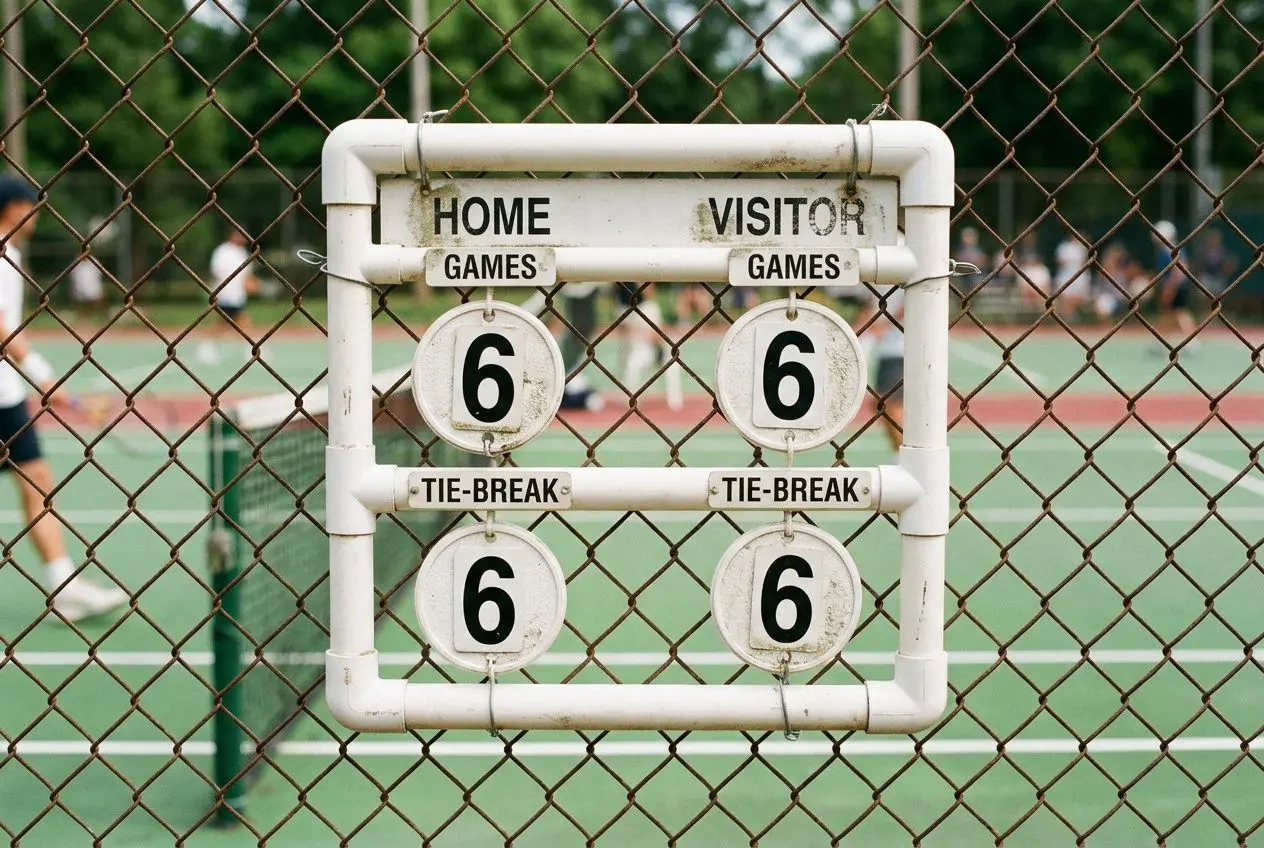
Manual scoreboard layouts support this structure directly. Separate set columns record each completed set, a current-points column tracks the game in progress, and score discs cover 0 to 7 games per set, with cumulative set totals up to 99. A dot or triangle identifies which players serve at any given moment, keeping the display clear during extended rallies and changeovers.
Recognise tiebreak notation
Tiebreak scores appear in brackets beside the set score. For example, 7–6 (7–4) records both players’ points at the end of the tiebreak. The bracketed figure shows the loser’s tally, so (5) in a score such as 7–6 (5) confirms that the tiebreak ended 7–5. Manual boards support this notation directly, showing tiebreak scores at 7 and 10 points separately from ordinary game-scoring columns.
A complete match scoreline such as 6–4, 4–6, 7–6 (5) shows three sets, with the deciding set resolved by a tiebreak. At Grand Slam level since 2022, a 10-point tiebreak replaces a deciding set when the match reaches one set apiece in the final set; the first player to reach 10 points with a two-point lead wins. Manual boards accommodate this format through the same bracketed notation, without additional components beyond the standard column layout. The tennis scoreboard buyer’s guide covers display features and formats in greater detail.
Compare durability, fitting and long-term value
A scoreboard bought for a British club must survive wind-driven rain, frost, and years of handling by players. The key decisions are the scoring system, the weatherproofing, and the way the board is fixed to the fence. Getting all three right means the board keeps working through wet autumns and hard winters without extra spending.
Manual or digital scoring systems
Anyone trying to understand how to choose a tennis scoreboard for beginners or a club with limited technical infrastructure will find that manual rotating-disc boards offer a simple, immediately operational solution: no power supply, software or maintenance contract. That means zero running costs and reliable operation during power cuts, a practical advantage for outdoor facilities without guaranteed mains access.
- Manual rotating-disc: no electricity is required. Players serve as their own scorekeepers by rotating the discs during changeovers, and no electronic servicing is needed throughout the board’s service life.
- Digital scoreboard: scores can be updated conveniently with a wireless remote control from up to 125 metres. This reduces recording errors during fast-paced play, but requires a 12 V DC power source or an alternative battery pack.
- Portable electronic systems: these can be transported, dismantled and stored between events. They suit tournament organisers who move between venues rather than clubs with permanent court installations.
A digital system needs a power solution and periodic servicing, whereas a manual board needs neither. Tennis Scorer has supplied manual scoreboards continuously since 1994; nearly 3,000 clubs and 16,000 courts across Europe and the USA still rely on them. That documented record demonstrates practical dependability beyond the convenience of a single digital season.
Protect the board from weather
Understanding how many sets a tennis match can require—potentially five in some competitions—shows why a reliable, all-weather display matters. A board that fades or warps mid-tournament creates immediate operational problems. Full-panel PVC boards from Tennis Scorer use UV-stabilised, rot-proof plastic throughout, resisting colour fade and repeated freeze-thaw cycles without seasonal removal. Counter-glued watertight edges reduce moisture ingress, delamination and frost damage, keeping the board serviceable on a perimeter fence through winter.
Compact rotating-disc models use sealed-disc engineering that sheds water cleanly, maintaining a clear score display in heavy British rain. Both formats have a documented service life of 20 to 30 years when properly installed. Consult the outdoor tennis scoreboard durability guide for a detailed comparison of weatherproofing methods and long-term performance. Replacement digits are available separately, so a worn numeral does not require a complete replacement.
Fit a fence-mounted scoreboard securely
Full-panel PVC boards use a no-drill cable-tie system: four heavy-duty serflex ties supplied with every unit secure the board to standard mesh or wire fencing without specialist tools. Compact rotating-disc models attach with brass eyelets and an anti-rust metal hook, making them compatible with the wire, netting and mesh structures found at public playing facilities. All mounting hardware is included, so installation is straightforward when the board arrives on court.
Once installed, corrosion-resistant fixing points, brass eyelets and anti-rust hooks keep the mounting secure through years of outdoor exposure without replacement hardware. Clubs comparing formats, materials and fixing options can use the fence mounted tennis scoreboard buying guide. It covers the main features, including scoreboard sizes and materials, as well as the daily-use differences that determine which scoring system suits a particular court.
Frequently asked questions
How does a manual tennis scoreboard display deuce and advantage?
At 40–40, a tennis game reaches deuce. If the server wins the next point, the score becomes “Ad-In”, giving the server advantage; if the receiver wins it, the result is “Ad-Out”, giving the receiver advantage. On a manual scoreboard, the current-points disc rotates to the relevant advantage marker. The player must win the following point to take the game. Losing that point returns the score to deuce, and the disc resets. A dot or triangle marks the server, keeping the display clear throughout the game.
What scoring features should a club scoreboard include?
A club scoreboard should display player names, individual point scores—love, 15, 30 and 40—game totals for each set, and a serving indicator showing which players serve. Tiebreak scores in brackets and separate columns for every set are also important features, particularly for multi-set match formats. Manual boards covering 0 to 7 games per set, with cumulative set totals up to 99, support standard three-set and five-set formats without modification. Removable slate name plates make player changes simpler between matches on busy club days.
Is understanding tennis scoring necessary before buying a scoreboard?
Understanding tennis scoring—points, games, sets and tiebreaks—helps when assessing which board layout and column format suit the matches being played. A single set column may suit casual play, whereas a club running competitions needs separate columns for each set, a dedicated points column and support for tiebreak scores. That understanding also makes the choice clearer: a suitable board should display every detail a match generates, avoiding confusion on court and protecting the value of the investment.