
Table of Contents
Sports facility branding gives a tennis or padel venue an identity players recognise, from the logo on the gate to the booking page and the score on court. This guide covers how to define that identity and plan the marketing around it. It then follows the brand onto courts and grounds through signage, branded scoreboards and a measured rollout.
Define your sports facility branding
A sports facility brand rests on three decisions: what the venue should be known for, whom it serves, and which experience it can deliver every week. Visual choices come afterwards. Once those answers are settled, the logo, colours and messages have something real to express.
Choose the experience your club can deliver
Those three decisions should come from evidence. An audience audit shows who actually uses the courts, rather than assuming every player wants the same offer. Four records are a good place to start:
- Membership enquiries: who asks about joining, and what they ask first.
- Court use: which courts and time slots fill up, and which stay empty.
- Repeat bookings: which players come back, and how often.
- Coaching attendance: which age groups and levels sign up for lessons.
From that data, the target audience becomes clear, and so does the message. A community-focused tennis club can put beginner sessions and family activities first. By contrast, a competitive club puts leagues, coaching and club teams at the centre of its communication.
Design a logo that works at every size
A brand identity brings together a logo, colours, typography, messaging and tone of voice. The logo alone does not define the club. In practice, a club can use two versions of it: a primary logo for entrance signs and the website, and a simplified one that stays legible on small scoreboard panels, clothing and profile images. Test both at small sizes, and on light, dark, photographic and mesh backgrounds, before anything goes into production.
Create rules for consistent use
Once the logo versions are approved, a brand guide records how to use them. It sets out colour values, typefaces, clear space, photography style and how the club and sponsor marks appear together. The designer’s handover should then include editable vector artwork, suitable PNG files, single-colour versions, CMYK colours for print and RGB or HEX colours for screens.
The same guide can cover related brands. A junior sports academy or a league can have its own name and graphic treatment while keeping the club’s parent identity. Before any signs are commissioned, check every proposed name and logo for trade-mark conflicts. Agree in writing who owns the artwork.
Build a player-focused marketing plan
With the identity defined, marketing puts it in front of the right players. A useful plan names who it is for, what resources it has and one measurable objective for each method. That way, every channel has a job that can be checked.
Match channels to player groups
Each player group is reached through different channels. A club can find potential customers through online marketing, social media, referrals and printed material targeted at the local area. Three other routes deserve their own place in the plan:
- School partnerships: bring juniors and their parents to introductory sessions.
- Community partnerships: link the club with local groups and residents.
- Events: give first-time visitors an easy reason to come to the venue.
Tournaments and leagues go a step further. They bring local athletes, spectators and fans onto the site, many of whom have never seen the courts before.
As a result, hosting an event is a test of the brand in person. The facility and the staff need to be ready to receive those visitors.
Connect discovery to the next booking
The visitor journey follows a clear order: discovering the club, understanding the offer, booking online, arriving at the correct court and finding reasons to return. The website carries the first three steps. It should show real photographs, explain the facilities and coaching, work well on mobile phones and offer a clear route to booking.
From that point, social media keeps players coming back. Service updates, coaching clips, event announcements and booking links can all use repeatable visual templates, so each post is recognisably the club’s without being designed from scratch.
Measure retention as well as reach
Reach shows who has heard of the club. Loyalty shows who stays. Enquiries, first bookings, conversions from introductory sessions, repeat bookings, coaching enrolment and membership renewals each capture a different stage of that journey. Tracking all of them shows where players drop away.
Those figures show what players do, but not why. Surveys, focus groups and social-media polls reveal whether the club’s message matches the experience players actually get on court.
Brand courts and grounds with clear signage
Signage is where the brand becomes physical. At a sports facility, the same identity used online has to guide people from the car park to the right court, without getting in the way of safety information or play.
Make arrival and wayfinding coherent
The club’s visual identity can run through the entrance, reception, court gates, court-number signs, scoreboards and booking page. Entrance and directional signs then point visitors to the main places, where applicable:
- Arrival points: reception and the courts.
- Facilities: toilets and changing rooms.
- Safe routes: accessible routes and emergency exits.
Court signs need one more check: their numbers should match the booking system and site maps, so that a player who booked Court 4 finds Court 4.
Size matters as much as content: the text has to suit the distance it will be read from. Each small panel should also have one main purpose, rather than mixing directions, rules and several sponsor messages.
Check permissions and accessibility
Before any external sign is ordered, consent comes into play. In England, outdoor advertisement control separates signs with deemed consent from those that need express consent. The site owner’s permission and approval to attach the sign to a structure are separate checks. From 1 April 2026, the advertisement-consent fee is £174 for qualifying category 1 or 2 applications. Category 3 applications cost £610, and neither fee applies to every sign.
Accessibility is a separate check. Sport England’s Accessible and inclusive sports facilities guidance, released in August 2024, covers wayfinding. Clear directions and unobstructed routes matter more than an accessibility symbol on its own.
Protect play and keep information current
Once permitted, each sign needs a safe position: readable sightlines and enough clearance from play, gates and access routes. Fence-mounted panels also need a support that can take their weight and the wind. On padel courts, graphics must be checked against the actual enclosure, glass, mesh and rebound surfaces. They cannot be treated as ordinary fence signs.
According to the Health and Safety Executive, safety signs add to other risk controls; they do not replace them. Replace faded or out-of-date directions promptly. Clubs hosting LTA-sanctioned events should also check the advertising restrictions in the LTA Competition Regulations, which took effect on 1 January 2026.
Choose scoreboards that carry the club identity
Every match brings players’ eyes back to the scoreboard. That makes it a natural place for the club mark on court, provided the score always stays easy to read.
Select a board for each court
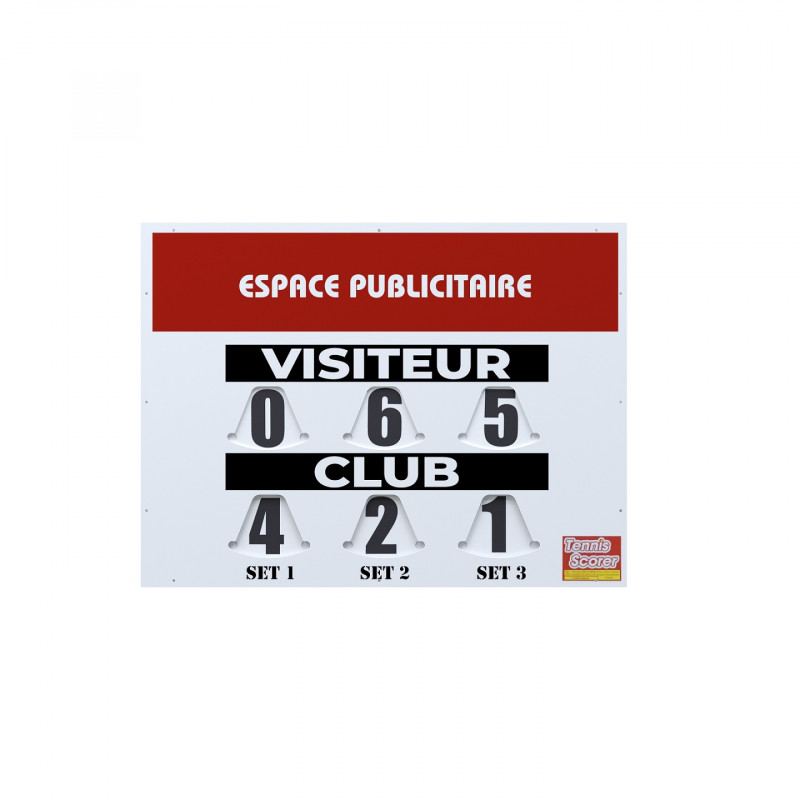
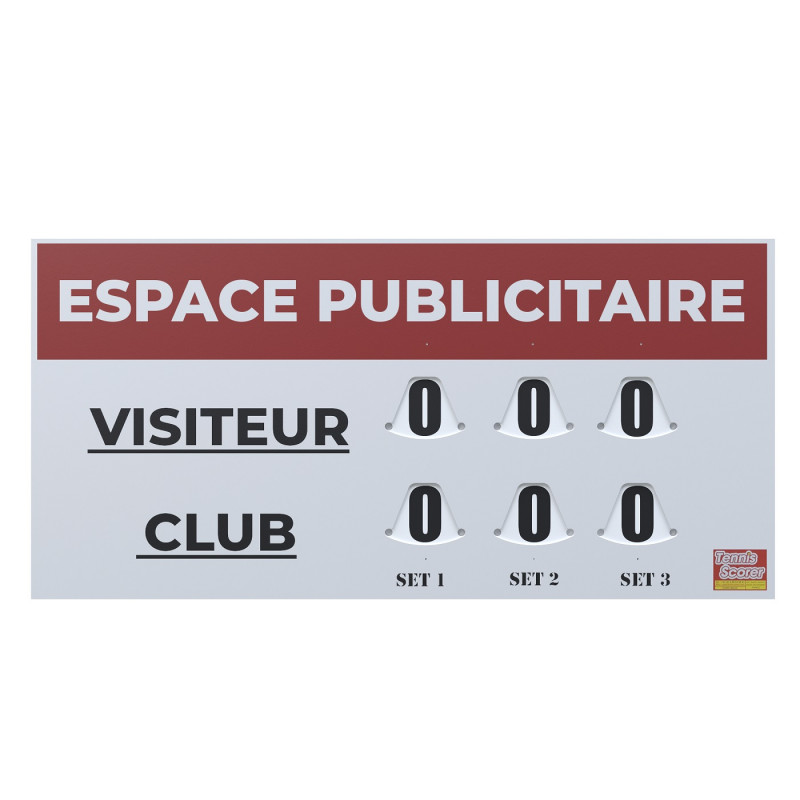
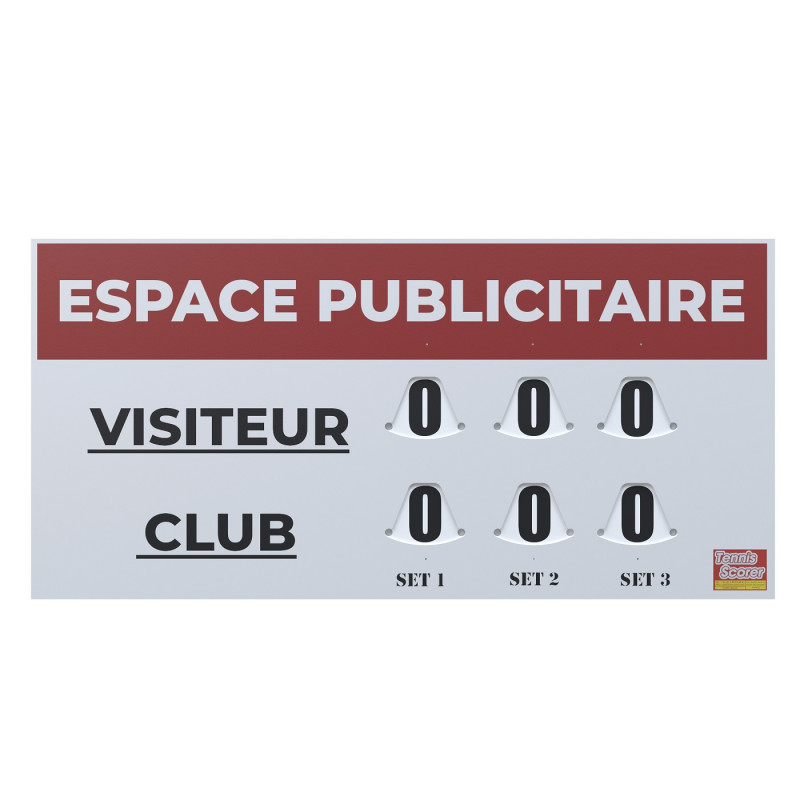
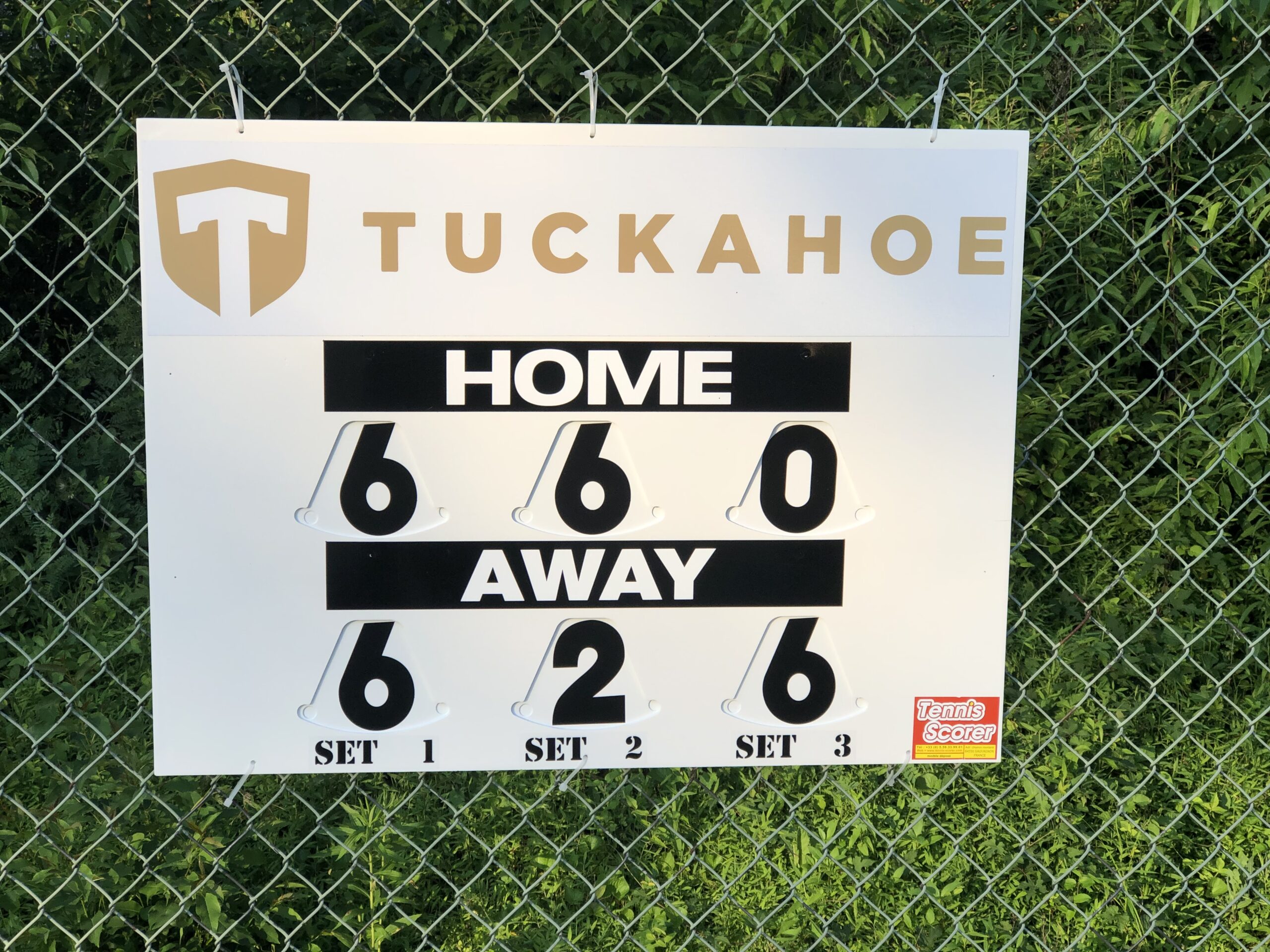
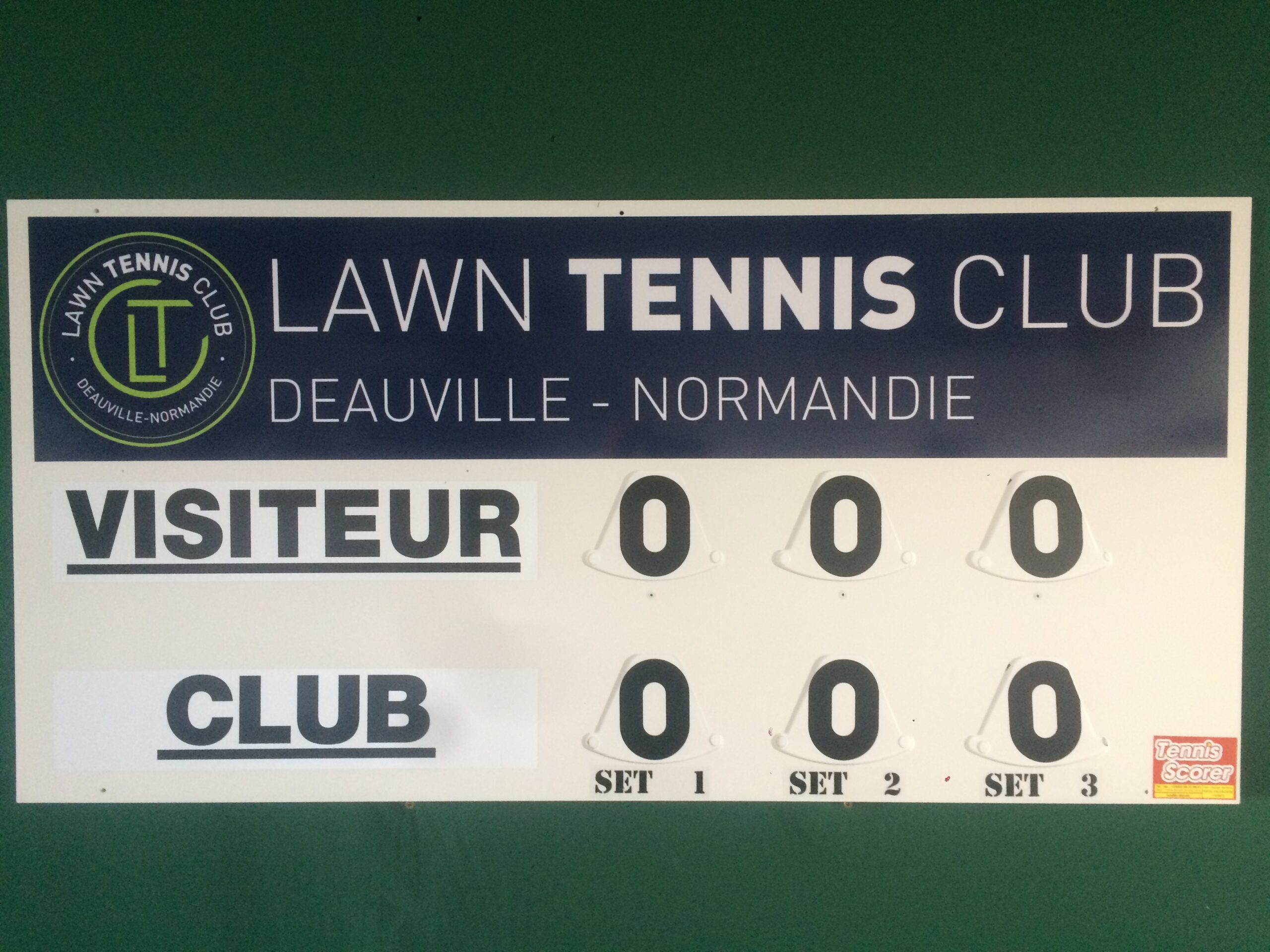
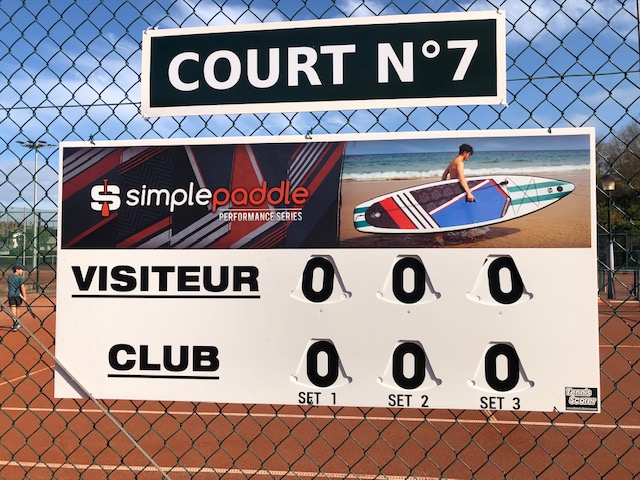
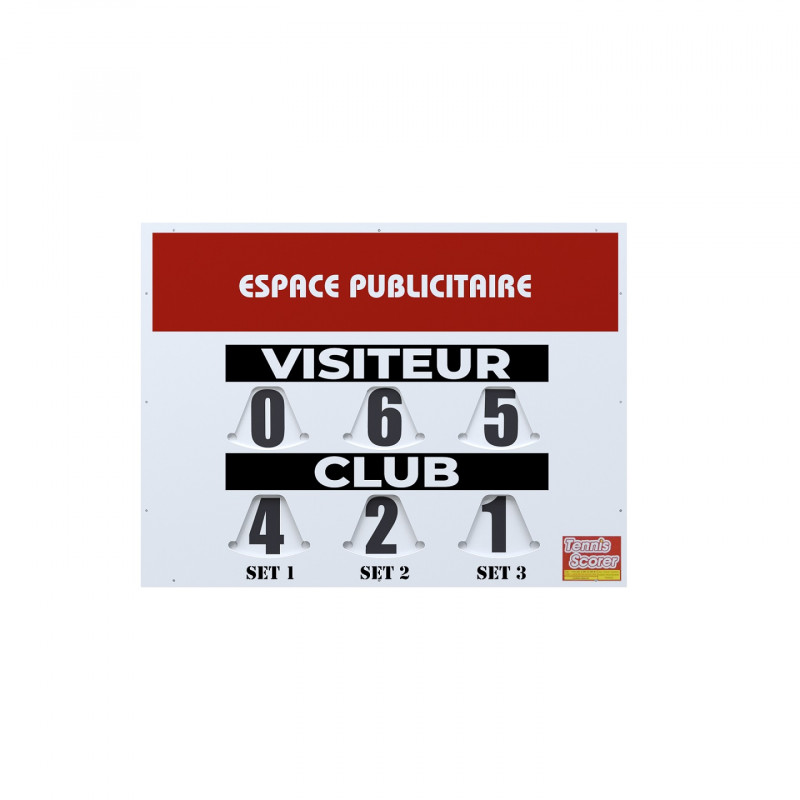
The first choice is manual or electronic. A manual scoreboard needs no power, and players update the score themselves at each change of ends. An electronic board adds checks on installation, controls and software support. Tennis Scorer’s Compact tennis and padel scoreboard measures 80 × 60 × 1 cm. It is made of white PVC designed to stay outdoors all year and comes with a customisable advertising sticker.
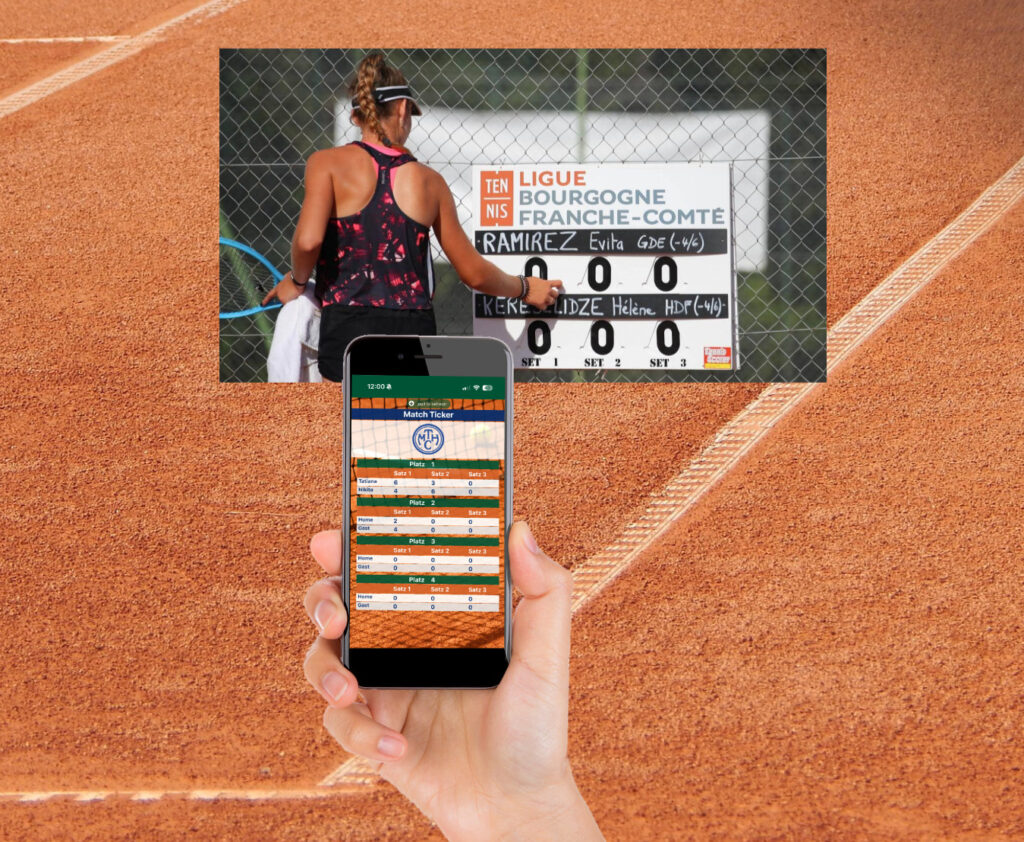
The Compact displays three sets, each numbered, with digits from 0 to 7 for tennis or 0 to 9 for padel. Plates are supplied so that player names and rankings can be written by hand.
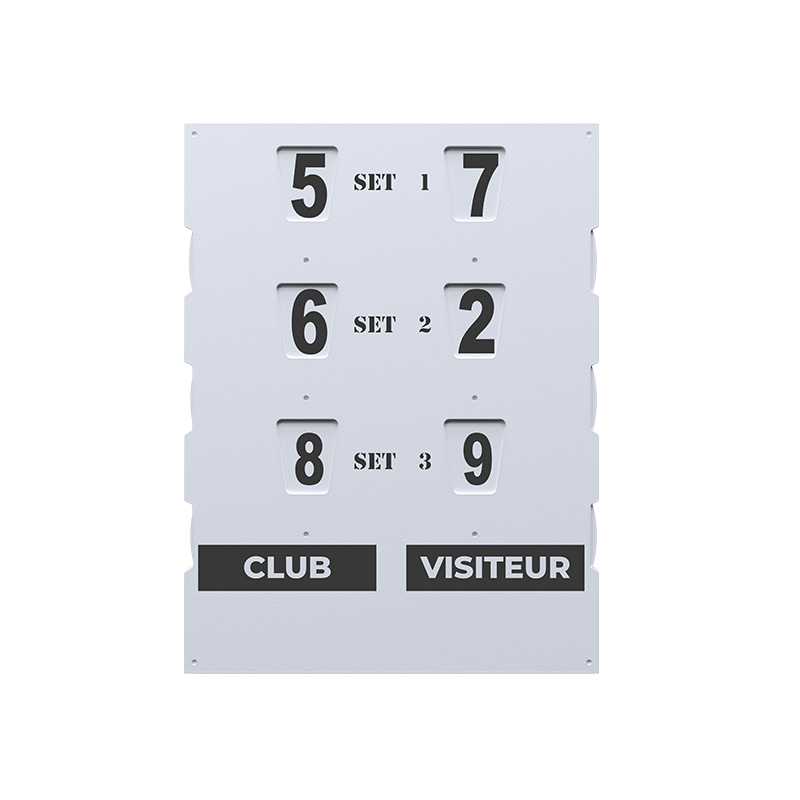
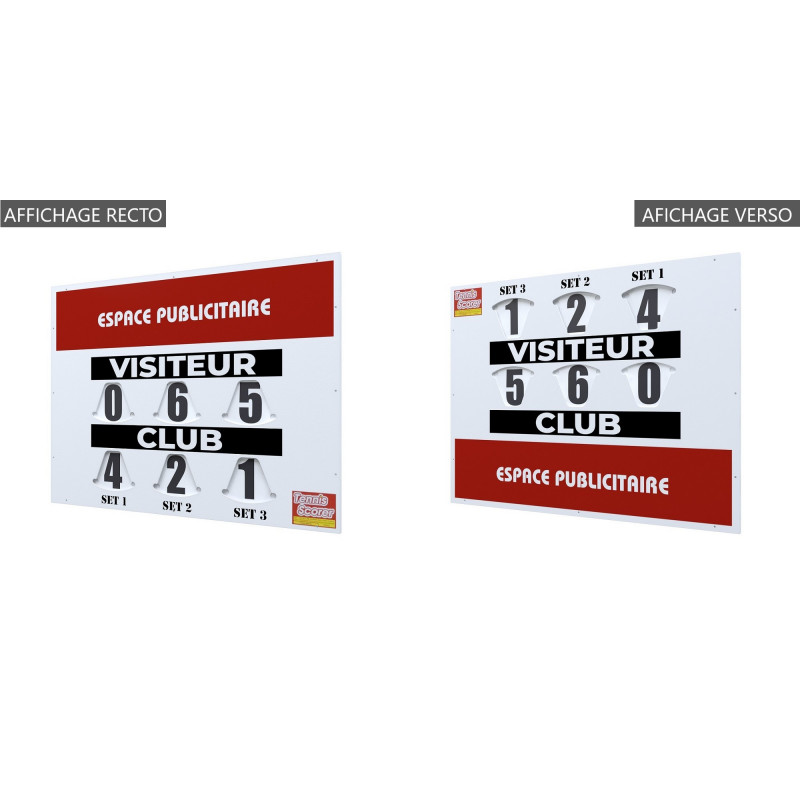
For padel courts specifically, the double-sided padel scoreboard measures 60 × 80 × 1 cm and shows the score on both faces. Digits run from 0 to 7 for the first two sets and from 0 to 9 for the third.
Keep scores clearer than logos
On either board, the layout should give the club logo a fixed place and the sponsor a separate area, while player names and scores remain the most prominent. Before approving the artwork, ask for a dimensioned drawing showing the overall size, depth, visible scoring area and logo spaces. Then approve a scaled proof made with the final logo files.
Both Tennis Scorer boards use numerals 12 cm high and 2.5 cm wide, which the company says can be read from more than 50 m. Legibility should still be checked on the actual court, in its real light conditions. The Compact’s advertising sticker measures 78 × 17 cm, and the padel double-sided board has a 59 × 11 cm area with two stickers included.
Manage sponsor space over time
That advertising area also has commercial value. LTA club sponsorship guidance lists venue branding alongside digital advertising, events, team branding and coaching programmes as possible sponsor assets. Tennis Scorer presents scoreboard sponsor space as a way for a partner to fund the club’s equipment.
Any such deal is best put in writing. The agreement can set approved logo versions, exact placements, dates, exclusivity, maintenance and removal. Check existing agreements before promising an area to a new sponsor.
Sponsors change; the club mark stays. A replaceable panel lets the sponsor identity change without replacing the whole board, as long as it attaches and comes off easily. Additional adhesive panels for scoreboards come in 60 × 17 cm for Cliptec, 78 × 17 cm for Compact and 118 × 24 cm for the Grand Modèle. Installation photographs and a renewal review record whether the sponsor got what was agreed.
Roll out and evaluate the brand project
A practical rollout follows this sequence: audience and brand decisions, a site audit, permissions, specifications, artwork approval, installation and inspection.
Audit assets before approving production
The site audit lists every sign and scoreboard on site. For each item, record:
- Location and dimensions: where it is and its measured size.
- Condition: whether it is sound, faded or damaged.
- Owner and sponsor: who it belongs to and whose logo it carries.
- Fixing and replacement need: how it is attached and whether it needs replacing.
From that inventory, a sign schedule gives each asset a defined purpose and a replacement plan, so production follows a single approved list.
Compare equivalent quotes and inspect delivery
Quotations can only be compared when they are based on the same specification. Ask each supplier to price these lines separately:
- Artwork and manufacture: design work kept apart from production.
- Fixings and installation: hardware and fitting on site.
- Electrical work: only where relevant, such as illuminated signs.
- Maintenance and future replacement: the cost of keeping each asset in service.
After installation, check that fixings are secure, that there are no sharp edges, that gates still clear and that the signs are legible. Then confirm the work matches the approved artwork.
Track results and maintain the assets
Sports facility management records keep the brand in working order. They track who owns each asset, its condition, inspection dates, sponsor expiry dates and the triggers for replacement. Record a baseline before the change: enquiries, booking conversion, repeat use, wayfinding questions and sponsor delivery.
That baseline only shows what changed, not why. A rise in bookings after a rebrand can also come from weather, seasonality, pricing, new courts, local events or coaching availability.
Frequently Asked Questions
How much does it cost to register a club name or logo as a trade mark in the UK?
Registration is optional. The UK Intellectual Property Office charges £205 for an online application in one class and £60 for each additional class. A paper application in one class costs £250. Registration lasts 10 years, after which it must be renewed.
What are the most common mistakes when ordering a branded scoreboard?
The usual errors are approving artwork before the dimensions are confirmed, using low-resolution logos, choosing sponsor colours that reduce score contrast and picking fixings that do not suit the board’s material. Permanent sponsor graphics also need a plan for when the sponsor agreement ends.
Which consumer rules apply to a club’s marketing claims and offers?
The UK’s unfair-commercial-practices rules, in force since 6 April 2025, ban misleading commercial claims. Factual claims about a product or service must be backed by evidence. Consumer reviews must be genuine, and prices and offers must not mislead consumers.