
Table of Contents
This buyer guide covers every key decision involved in choosing a weatherproof scoreboard for tennis courts: materials, sizing, mounting, scoring features and long-term value. From compact rotating-disc models to full-panel fence-mounted options, it explains what separates a board that lasts one season from one built for three decades.
Choosing a weatherproof tennis scoreboard
Selecting the right scoreboard starts with understanding how outdoor exposure affects materials and hardware. A model that looks suitable in a showroom can fail within two winters if it is not designed for frost, UV degradation and persistent moisture—conditions that any UK court will face. The weatherproof tennis court scoreboard guide from Tennis Scorer covers these conditions for clubs considering a fence-mounted scoreboard.
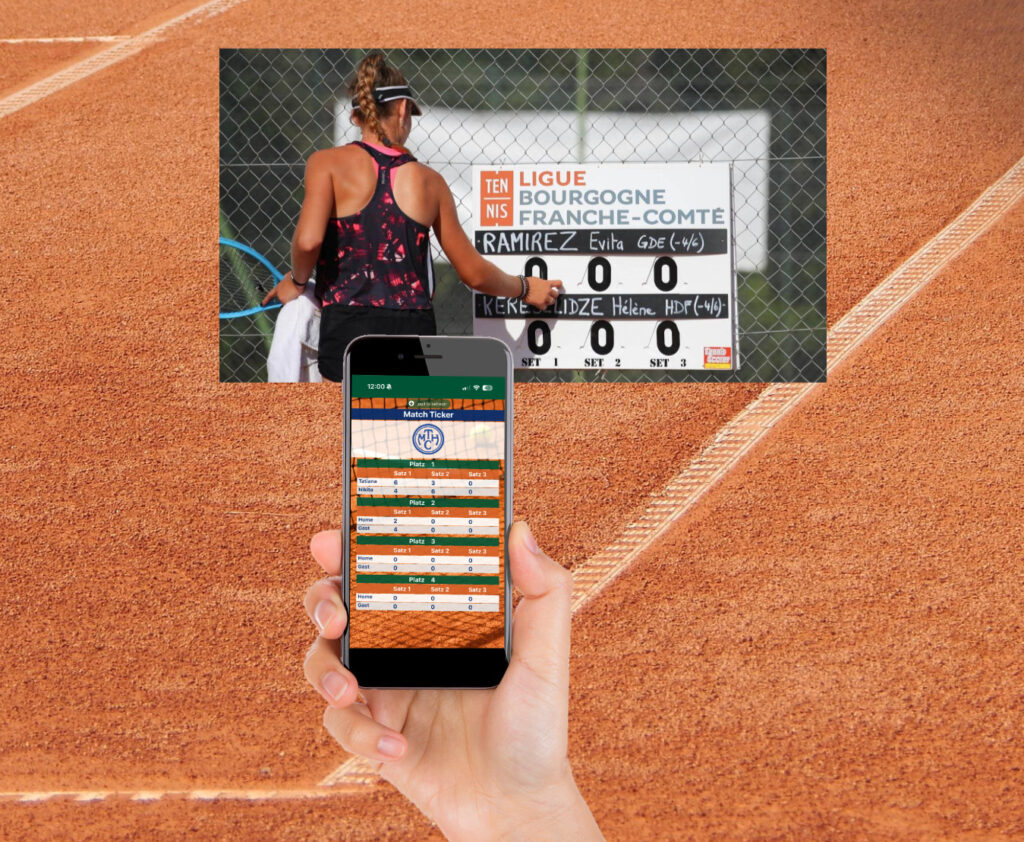
The choice between manual and electronic formats also affects costs well beyond the purchase price. Manual tennis scoreboards need no power supply, electronics servicing or maintenance contract. For a broader comparison, the weatherproof tennis court scoreboards resource covers sizing, durability and mounting across the range.
Outdoor materials for year-round use
The performance gap between a weatherproof scoreboard made for tennis courts and a standard painted board becomes clear after the first hard winter. UV-stabilised, rot-proof PVC resists blistering, cracking and fading throughout its depth rather than relying on a surface coating.
- Counter-glued watertight edges Full-panel PVC boards with sealed, counter-glued edges form a weatherproof barrier against moisture ingress, delamination and frost damage during repeated freeze-thaw cycles.
- Corrosion-resistant fixings Brass eyelets and anti-rust metal hooks protect the attachment hardware during prolonged outdoor use. These corrosion-resistant components help prevent the mounting system from failing before the board.
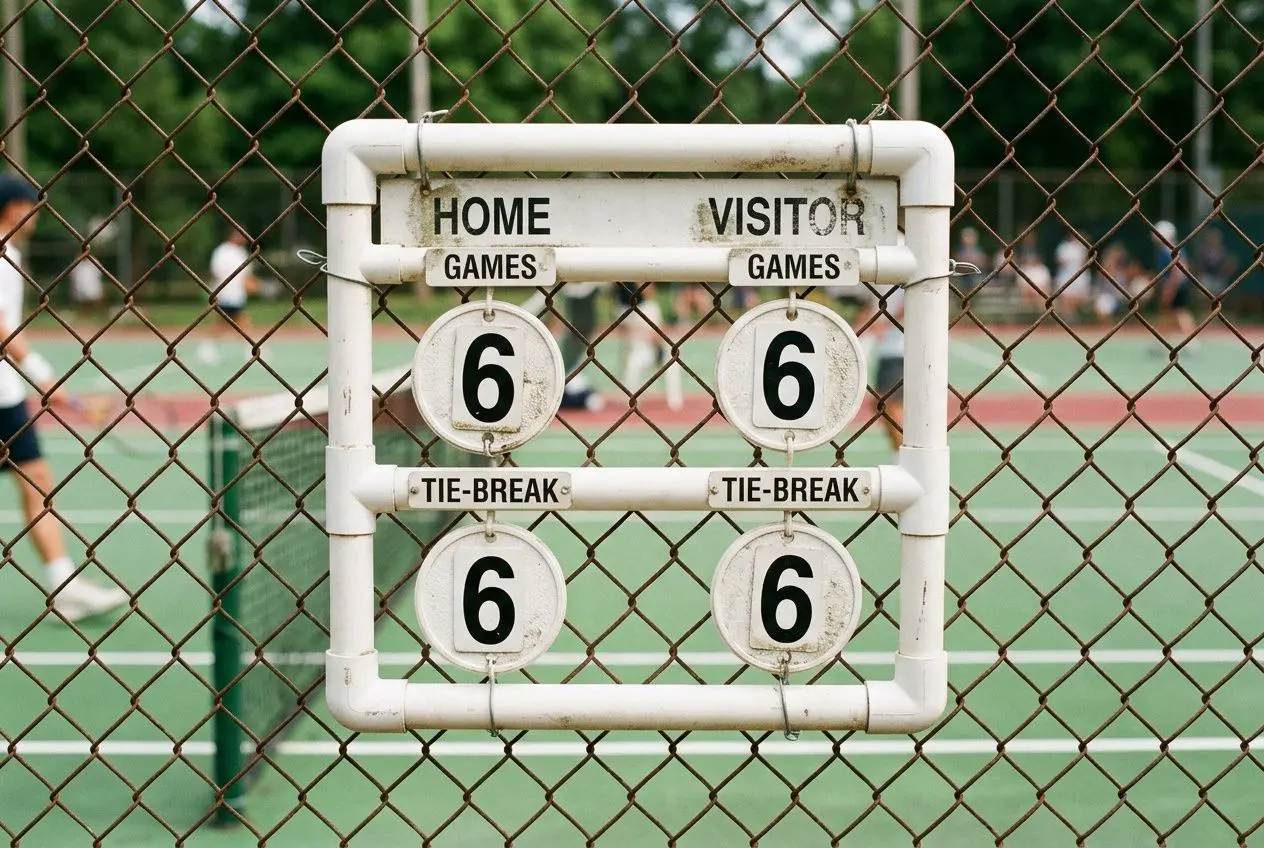
- Engineered rotating discs Compact disc models are designed to shed water cleanly, keeping the score display readable in heavy rain without removal after play.
Untreated boards, or models without sealed edges, often need to be removed and stored for winter. A properly made, ultra-durable PVC board with watertight edges can remain mounted throughout the year.
Tennis scoreboard sizes and visibility
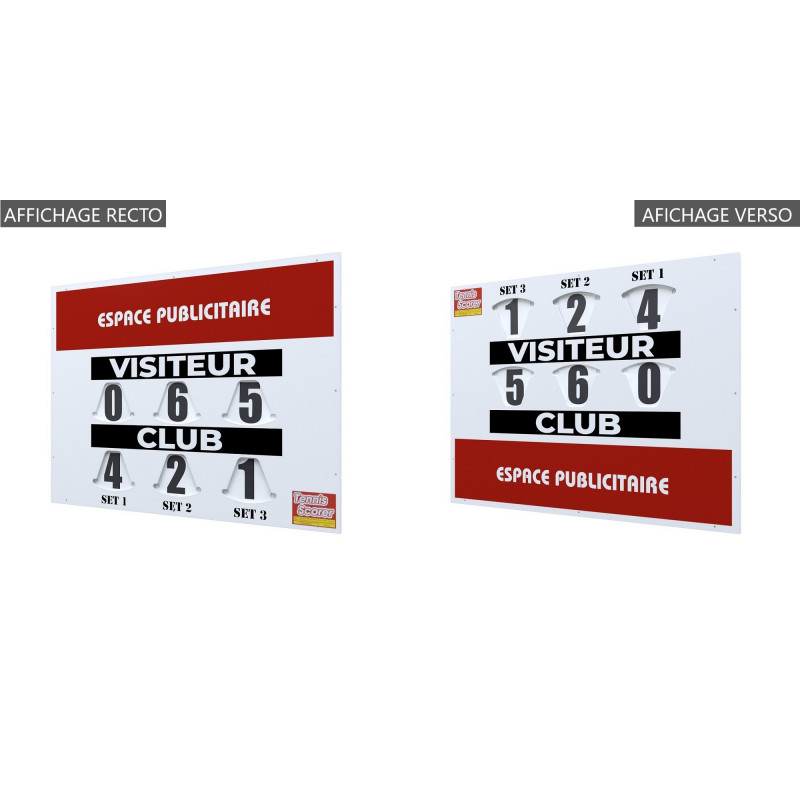
Two principal manual formats suit different court layouts. Compact rotating-disc models are available in Small (35 × 50 cm), Medium (46 × 65 cm) and Large (56 × 80 cm). The full-panel PVC board measures approximately 60 × 60 cm and weighs around 2 kg. On a tarmac tennis court, fence height and available panel space may determine the practical format before visibility is assessed.
A white PVC background with 10 cm numerals remains readable from more than 50 metres, covering both baselines and courtside spectators. Durable signage for outdoor courts at this distance means players at the far baseline can check the score without walking to the net. Double-sided full-panel boards also suit courts approached from several directions.
| Format | Dimensions | Recommended position | Readability |
| Small rotating-disc | 35 × 50 cm | Net-side | Up to 50 m |
| Medium rotating-disc | 46 × 65 cm | Fence-mounted | Up to 50 m |
| Large rotating-disc | 56 × 80 cm | Fence-mounted | Up to 50 m |
| Full-panel PVC board | ~60 × 60 cm, ~2 kg | Fence-mounted | Up to 50 m |
Match pointer and manual scoring
The rotating-disc system displays game scores from 0 to 7 per set and cumulative set totals up to 99. A serving indicator, known as the match pointer, identifies the current server for players, officials and spectators. Tie-break scoring appears in brackets: 7–6 (7–4).
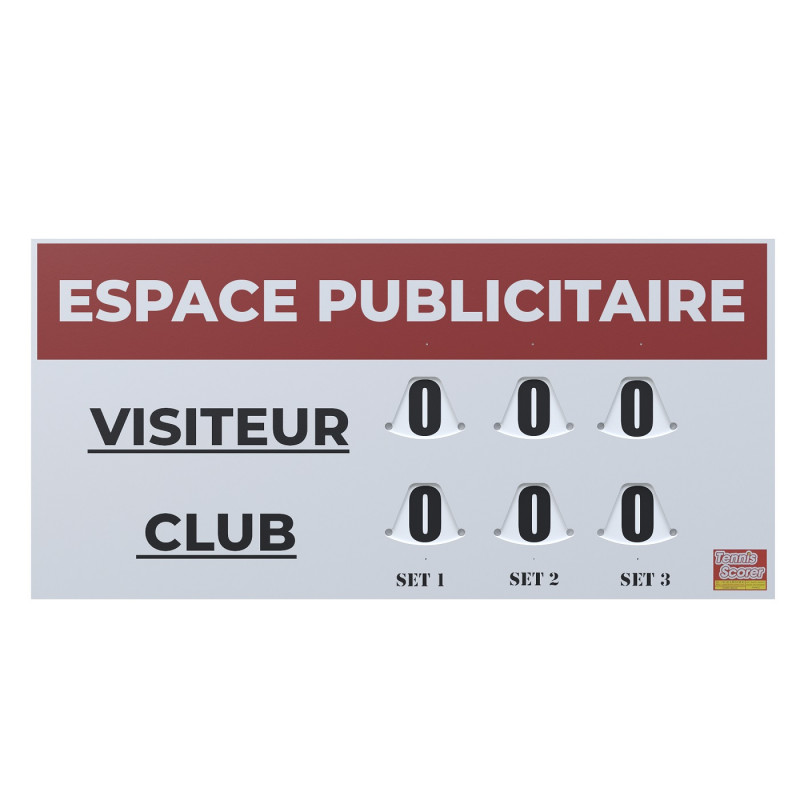
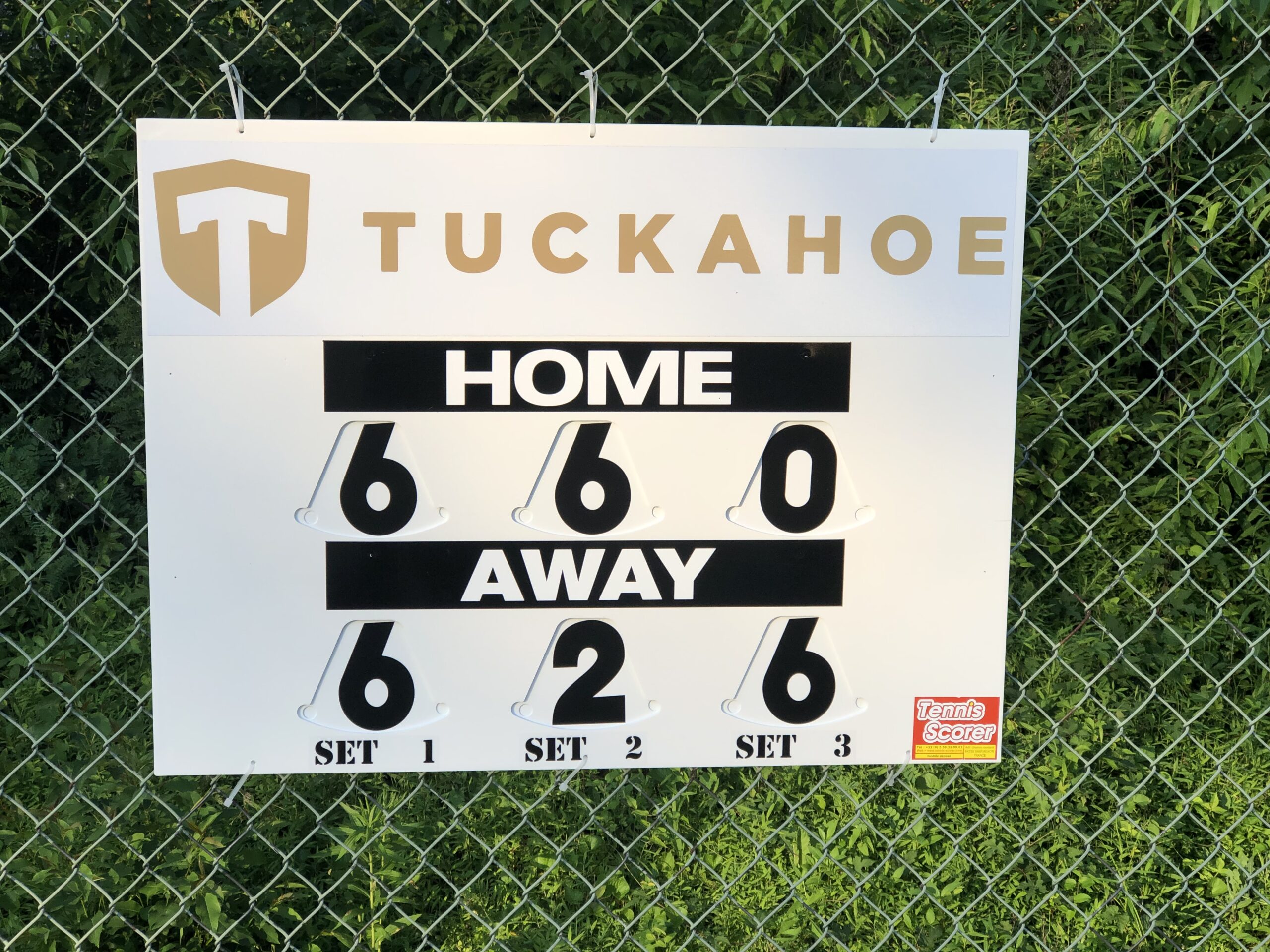
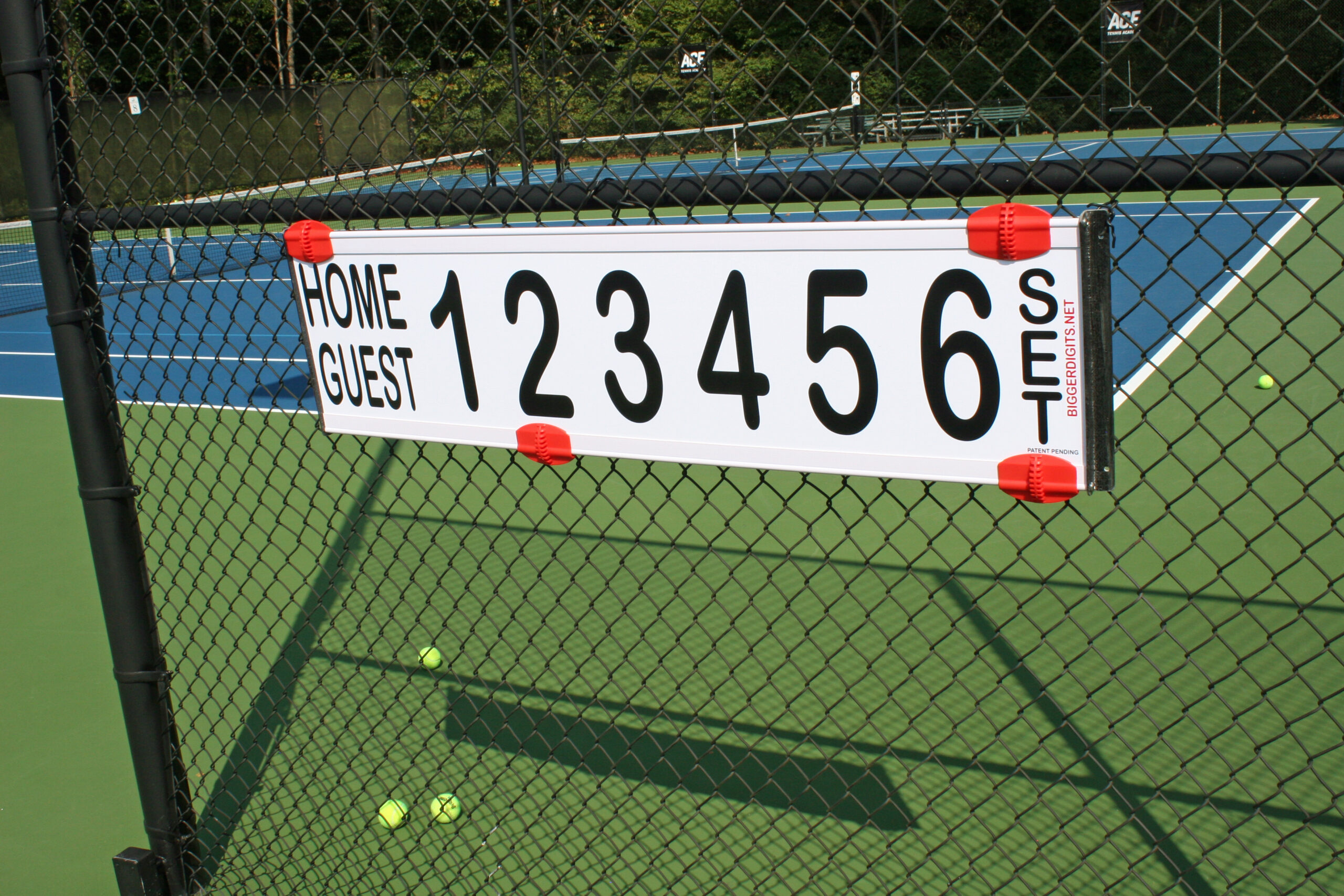
Full-panel boards use removable slate plates for player names, a current-points column and a separate column for each set. Players or officials update the scorer manually during changeovers. No software, power or specialist intervention is required.
Complete court mounting and long-term value
A fence-mounted scoreboard can be installed without drilling. Full-panel PVC boards use four heavy-duty serflex cable ties supplied with the unit, while compact disc models attach through brass eyelets and an anti-rust hook compatible with wire, netting and mesh structures found at public facilities.
Once installed, the hardware needs no annual sealing, replacement coating or electronic inspection. The mounting system is built to last through the board’s documented service life of 20 to 30 years when correctly installed.
Frequently asked questions
What is the tennis scoreboard maintenance cost over its lifetime?
For a properly constructed manual model, tennis court scoreboard maintenance costs are close to zero in practice. UV-stabilised, rot-proof PVC needs no recoating, seasonal removal or servicing contract. The only foreseeable expense is replacing individual digits on a full-panel board or discs on a compact model; both are available as low-cost spare parts. Field evidence from nearly 3,000 clubs across Europe and the USA includes models that have remained in continuous use since 1994. That durability shows how robust construction can remove ongoing expenditure. By contrast, an outdoor electronic scoreboard needs a mains power supply, electronics servicing and potentially a maintenance contract, producing a significantly different lifetime cost.
Is a portable tennis scoreboard suitable for outdoor use on a permanent court?
A portable tennis scoreboard is waterproof and fade-resistant, so it can be used outdoors in fair conditions. It is designed for mobility rather than permanent installation: a typical unit weighs around 3 kg and uses a fold-out design that assembles in seconds. That suits venues sharing courts between tennis, badminton and volleyball. For a dedicated outdoor court, particularly a tarmac tennis or hard-court facility used throughout the year, a fence-mounted scoreboard made from UV-stabilised PVC provides a sealed, UV-resistant and long-lasting solution. It needs no handling between sessions or winter storage, making it the right choice when permanent installation and weather exposure are the main concerns.
What scoring features should a full tennis scoreboard display for a club match?
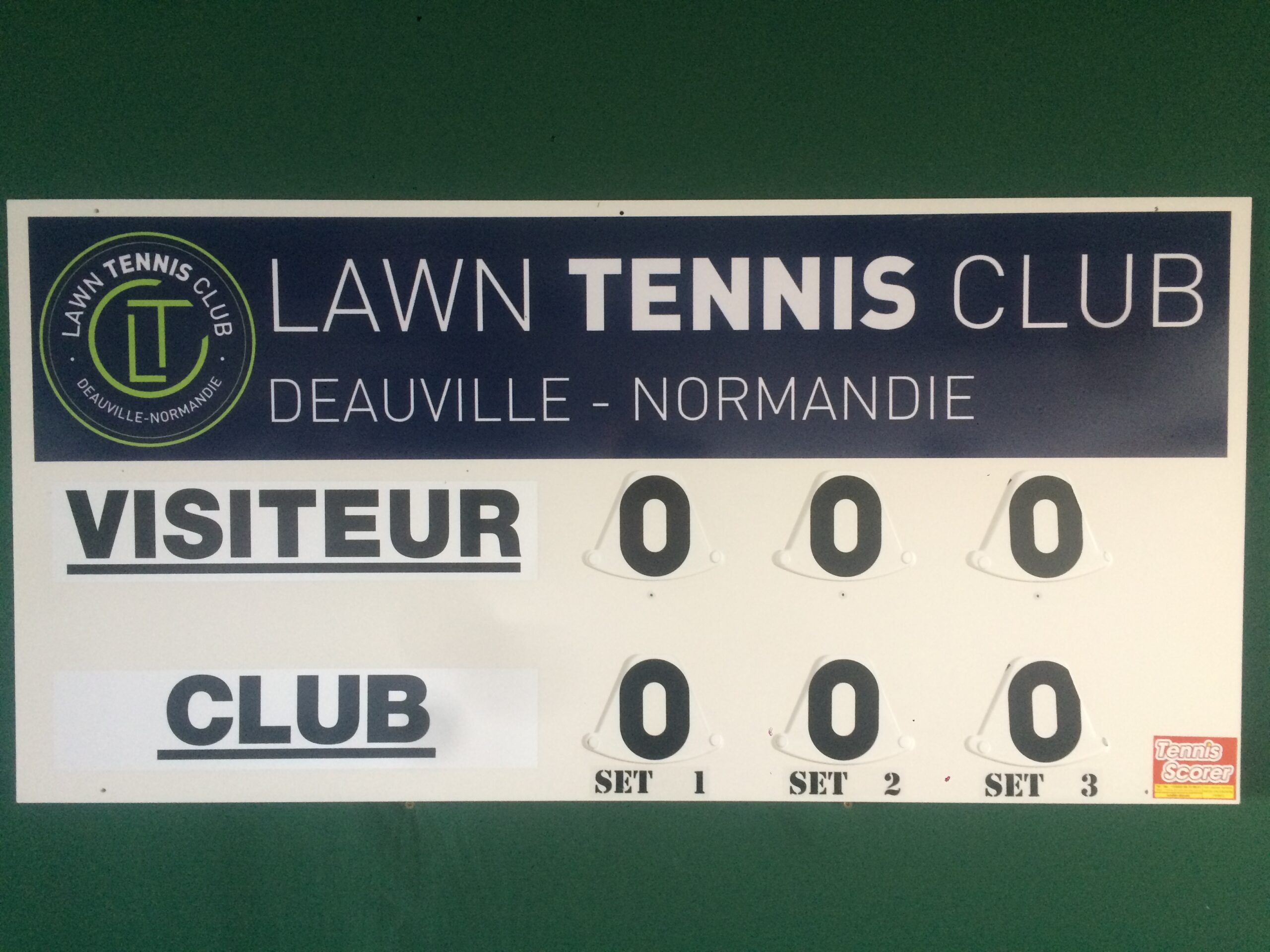
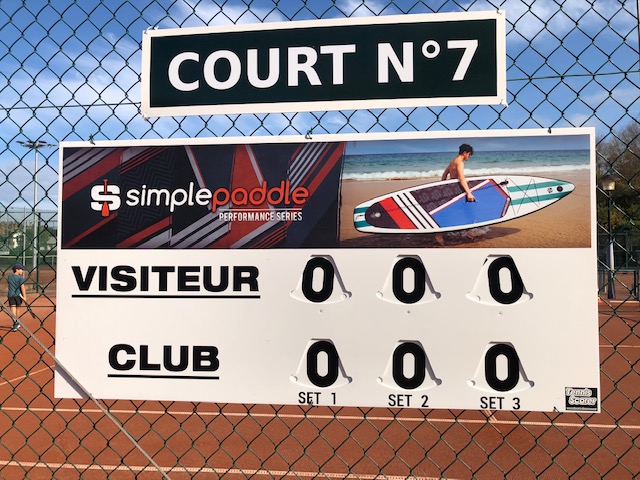
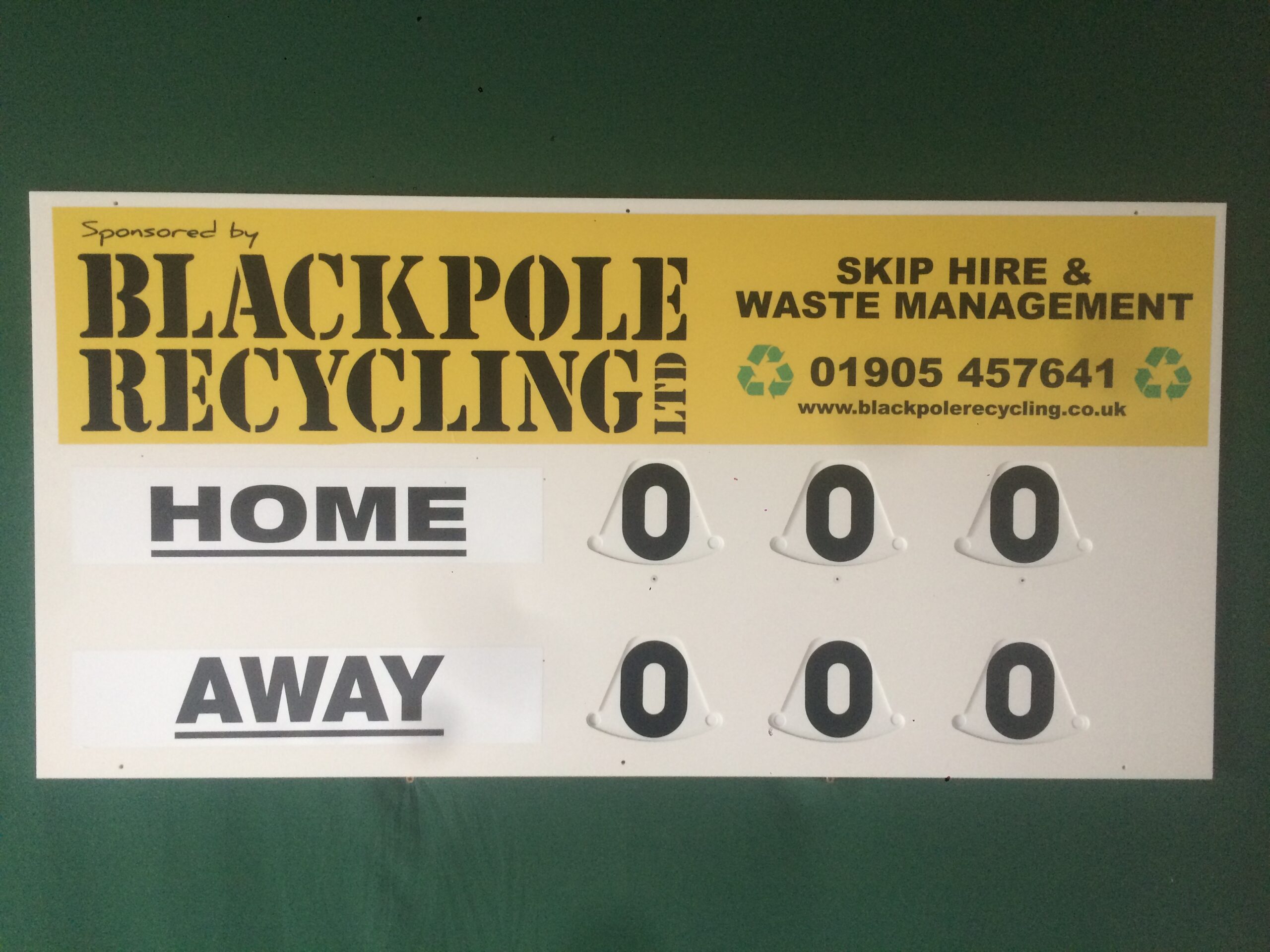
A full tennis scoreboard for club-level use should show each player’s current points, the score for every game in each set and the cumulative set totals. A match pointer or serving indicator also matters: it identifies the server at a glance and helps prevent disputes during long rallies. Tie-break results should appear in brackets beside the set score, such as 7–6 (7–4), so the scoreboard guide remains clear for spectators who missed the tie-break. Tennis Scorer’s full-panel models include a branding zone measuring 56 × 17 cm, allowing a tennis club to display sponsor logos or court numbers without reducing display space. Green, Blue and Black colour options allow the board to complement existing court equipment.